
A Tampa Bay technician's field guide to heat, humidity, power, salt air, well water — and the failures that end fridges early.
Got a fridge acting up while you read this? Call (813) 522-0014. Same-day in most Tampa Bay areas. $69 diagnostic, 100% applied to your repair if you approve the work. If we can't fix it, you don't pay.
The short version (read this in 60 seconds)
If you only have a minute, here is the whole guide in plain terms.
A refrigerator in Tampa Bay almost never dies of old age. It gets pushed to an early grave by five things it couldn't do: shed heat, hold a seal, trust the power from the wall, survive what our air and water do to its metal, and get a small problem fixed before it cascaded. Everything below is downstream of those five.
The three highest-payoff actions, in order:
- Clean the condenser coils every six months (every four with pets or near construction). This single habit prevents more compressor failures than anything else I see in the field.
- Put a quality surge protector on the fridge. West-central Florida gets more than 80 days with thunder and lightning in a typical year. A surge protector guards a $300–$1,200 control board for a fraction of the replacement cost.
- Keep door gaskets clean and lubricated. Florida humidity hardens rubber fast, and a leaky seal makes the compressor run nonstop.
And if your home is near the bay or runs on well water, add a fourth: read the salt-and-water section. That is the factor almost nobody warns you about, and it is the one I watch destroy sealed systems in 5–7 years.
Respond to early warning signs the same week. In this climate a small issue becomes an expensive one in days, not months. A $150 repair that waits becomes a $700 one.
How long should a refrigerator last? The real numbers
Ask how long refrigerators last and most industry estimates range from 10 to 15 years; the United States Department of Energy puts the average refrigerator lifespan — the life expectancy of the appliance — at about 12 years. Real-world repair data and warranty patterns show a more useful picture by style — and my own repair log shows how Tampa Bay compresses every one of those ranges. The chart below puts the two side by side.
Those blue ranges assume average conditions. In Tampa Bay, average conditions don't exist. The heat, the humidity, the electrical stress, and — near the coast and on well water — the corrosion — all of it normal here — compress every one of those timelines, unless you actively work against them.
The honest bottom line: a well-maintained refrigerator in Tampa Bay can reach the top of its range. A neglected one hits the bottom, and often not even that.
What Tampa Bay throws at your refrigerator
Four numbers explain most of what this guide covers. None of them appear in any owner's manual, because manuals are written for a national average that does not live here.
Now let's walk through the factors one by one — what each does, what it costs you, and what actually works against it.
Factor 1: Heat — the compressor's permanent enemy
Every refrigerator is a heat-moving machine. The compressor, condenser coils, and fans pull warmth out of the food compartment and dump it into your kitchen. In Tampa Bay, where kitchens run 80–90°F from March through October, that machine is fighting much harder than in any moderate climate.
The mechanical consequence is direct. Every extra degree of ambient temperature the compressor works against adds thermal stress. Thermal stress accumulates. Accumulated thermal stress shortens motor life.
Where heat becomes a problem in Tampa Bay kitchens:
- Tight cabinet installations. Counter-depth and built-in refrigerators that fit perfectly into an alcove often have almost no room for heat to escape. A "perfect fit" is frequently a performance liability in disguise.
- Proximity to heat sources. Refrigerators next to ovens, ranges, or dishwashers — common in older Tampa and South Tampa layouts — absorb radiated heat constantly. South-facing kitchens make it worse.
- Garage refrigerators. A second fridge in a Florida garage can hit 95–105°F in July and August. A unit designed for 70°F ambient operation running in 100°F heat isn't running efficiently. It's running damaged, slowly.
What you can do: confirm at least 1 inch of clearance on all sides and 2 inches at the rear, keep the toe-kick ventilation panel clear, and take everything off the top of the fridge — stored items trap the heat the unit is trying to release.
Factor 2: Dirty condenser coils — the highest-payoff maintenance action available
If you do one thing differently after reading this guide, make it this: clean your condenser coils every six months.
The condenser coil is where the refrigerator releases the heat it pulled from your food. When that surface is coated with dust, pet hair, and kitchen grease — as it will be in virtually every Tampa Bay home within six months — heat transfer drops. The refrigerant can't release heat as fast as the system needs.
What follows is a chain reaction. The refrigerant leaves the condenser hotter than intended. It enters the compressor at higher pressure. The compressor works harder to compress it, generates more heat, draws more current, runs longer cycles, and wears out faster than its design life assumed.
The measured picture: refrigerators with significantly dirty coils consistently show 10–25% higher energy consumption, along with higher current draw and longer run cycles — both direct predictors of shortened compressor life.
Tampa Bay reality: in Wesley Chapel, Riverview, and Zephyrhills, where construction is essentially permanent, airborne dust is far higher than in established neighborhoods. In South Tampa kitchens with open layouts and range cooking, grease circulates continuously. In Dade City and rural Pasco homes with pets, coils load up faster still. The manufacturer's "annually in normal conditions" was written for normal conditions. Tampa Bay is not normal conditions.
Expert opinion — Anatoli Didenco After 20+ years of hands-on work across Hillsborough, Pinellas, and Pasco Counties, I'm confident in this: more of the compressor replacements I've performed — across every brand, every style, every price point — trace back to dirty condenser coils than to any other single preventable cause.
The compressor is the most expensive single part in a refrigerator. The tool that prevents its failure most reliably is a $12 coil brush used for 20 minutes, twice a year. Clean coils also cut electricity use measurably — and in Florida, where a fridge accounts for 10–15% of home electricity use, that shows up on the bill.
My recommendation for Tampa Bay: every 6 months for all households, every 4 months with pets or near active construction.

Factor 3: Door gaskets — seal integrity is a compressor lifespan issue
A door gasket that doesn't seal fully is adding to the compressor's workload every hour the fridge runs. Warm, humid Tampa air leaks in; the compressor runs to compensate for the heat and moisture.
The standard check is the dollar bill test: close a bill in the door at several points around the perimeter. If it slides out without resistance, you have a seal failure at that spot.
In Florida, gaskets degrade faster than in dry climates for a specific reason. The rubber absorbs and releases moisture continuously in humid air. That cycling makes it lose flexibility. A stiff gasket can't conform fully to the door frame, and a gasket that can't conform can't seal.
What the data shows: a well-maintained gasket can last the life of the appliance, 15 years or more. A neglected one in a humid Florida kitchen may need replacing in 5–7 years. The difference is mostly maintenance.
Expert opinion — Anatoli Didenco Cleaning: wipe the gasket folds with a damp cloth and mild soap every 2–4 weeks. Florida humidity turns dirty gasket folds into mold habitat within days, and a dirty gasket physically can't make full contact with the door frame.
Lubrication: apply a thin layer of food-grade silicone grease or mineral oil to the gasket surface 2–3 times a year. Gasket rubber dries and hardens with age; lubrication counteracts the drying and extends its life. Some manufacturers advise against petroleum-based products on certain gasket materials, so food-grade silicone is the safest universal choice.
The outcome is a seal that holds longer, a compressor that works less across the whole lifecycle, and a gasket replacement pushed years down the road.
Factor 4: Lightning and power surges
This factor matters most to Tampa Bay homeowners specifically, because our electrical environment is more aggressive than almost any other US market.
Modern refrigerators are electronics-heavy. Your Samsung or LG runs an inverter board, a control module, and multiple sensor arrays. Even standard French-door models from Whirlpool and GE have control boards governing defrost, compressor timing, and ice maker logic. None of that was in refrigerators fifteen years ago, and all of it is sensitive to voltage anomalies.
Florida is the lightning capital of the country, and west-central Florida — our side of the state — gets more than 80 days with thunder and lightning in a typical year, a summer storm frequency the Florida Climate Center compares to the most thunderstorm-prone regions on Earth. A direct strike to a nearby line can destroy a control board instantly. The more common and more insidious failure is partial damage from smaller surges: the board keeps working but with degraded tolerance. A board that should last 12 years now lasts 6, and the failure shows up months later with no obvious connection to the original event.
Expert opinion — Anatoli Didenco In Tampa Bay, a quality surge protector on your refrigerator is not optional equipment. It's basic asset protection.
The math: an appliance-rated surge protector with a joule rating above 1,000 and a clamping voltage below 400V costs a fraction of what it protects. The control board it guards runs several hundred dollars to replace on a standard fridge, and $700–$1,200 on a Sub-Zero or other premium built-in.
One more layer: stable voltage matters as much as surge protection. A fridge sharing a circuit with a window AC unit or space heater sees voltage sags every time those cycle on, and repeated sags stress inverter electronics in ways that accumulate. A dedicated 15A circuit is ideal. If that's not possible, don't run other major appliances on the same circuit at the same time.
Factor 5: Inverter compressors and messy power — the new failure pattern
This factor didn't exist in any meaningful way ten years ago, and it's the one I now watch most closely on newer refrigerators in Tampa Bay. The industry's maintenance advice hasn't caught up to it.
Here's the shift. For decades, a refrigerator compressor was a single-speed motor: it switched fully on, ran at one speed, then switched fully off. It was electrically simple and surprisingly tough. Most refrigerators sold today — across Samsung, LG, Whirlpool, GE, Bosch, and the premium built-ins — use a variable-speed inverter compressor instead. An inverter board converts incoming AC power into a controlled, variable signal that lets the compressor run slower and quieter most of the time and ramp up only when needed. It's genuinely more energy-efficient. It's also far more sensitive to the quality of the power feeding it.
That sensitivity is where Tampa Bay homeowners get hurt. An old single-speed compressor either got hit by a surge or it didn't. An inverter board lives on a spectrum. It is exposed not just to lightning-scale surges but to the small, constant electrical noise on a residential circuit: brief voltage sags when the AC compressor kicks on, micro-interruptions during summer storms, the rapid reclosing events utilities use to clear faults on the line. None of these trips a breaker. None of them announces itself. Each one is a small electrical stress event the inverter board absorbs.
The pattern I see in the field is consistent. An inverter board rarely dies from one dramatic event. It dies from accumulated micro-stress — months of small sags and noise that slowly degrade its tolerance — and then a single ordinary summer storm finishes a board that a year earlier would have shrugged the same storm off. The homeowner blames the storm. The storm was just the last straw on a board that had been quietly aging faster than its design assumed, in an electrical environment Tampa Bay makes uniquely hostile.
Expert opinion — Anatoli Didenco The newest, most efficient refrigerators are, paradoxically, the most vulnerable ones in this market, and almost nobody is telling homeowners that. Three things protect an inverter fridge, and they stack: surge protection plus a voltage-protection device that disconnects the fridge during prolonged over- or under-voltage; a dedicated circuit, which matters more for an inverter fridge than it ever did for an old single-speed unit; and — the diagnostic point most technicians miss — when a newer fridge fails after a storm, the right question isn't "did lightning hit it." It's "how much accumulated electrical stress had this board already taken." That's why a proper Tampa Bay diagnostic includes outlet voltage-quality readings and a board inspection for the carbon scoring and early arcing that reveal a board that's been degrading for months.
If you've bought a refrigerator in the last five years, assume it has an inverter compressor, and treat clean, stable power as a maintenance item, not a one-time install decision.
Factor 6: Salt air and well water — how Florida eats the metal inside your fridge
This is the section I most wish every Tampa Bay homeowner would read, because it explains the failures that surprise people the most — and it is almost completely absent from national maintenance guides.
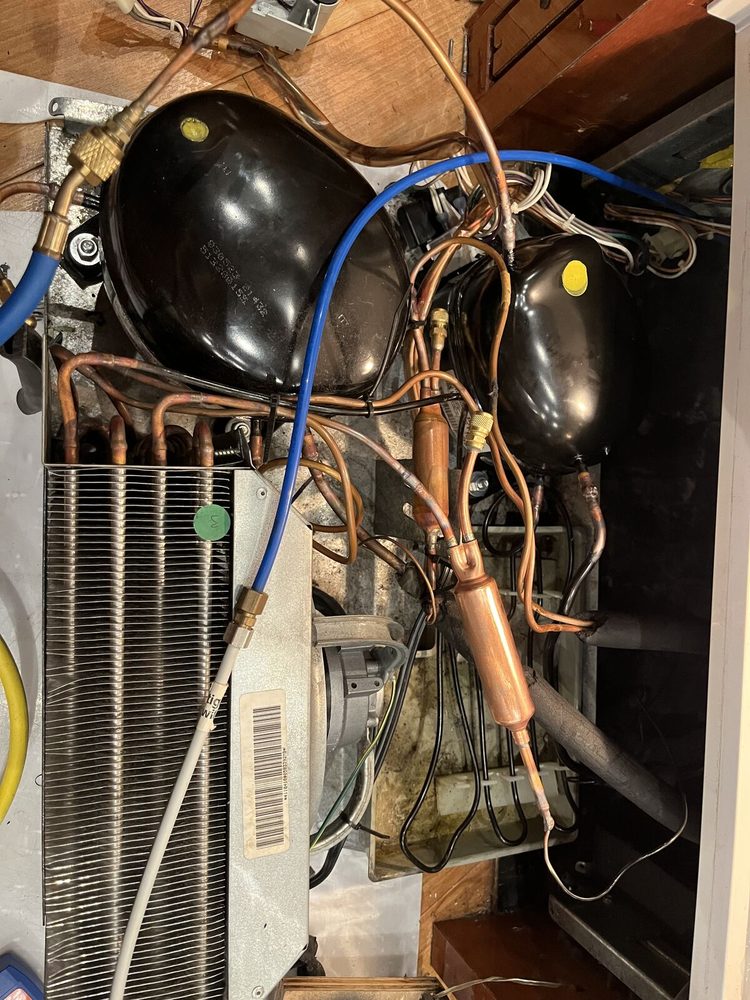
Inside every refrigerator is a sealed loop of copper and aluminum tubing carrying refrigerant. That loop is engineered to outlive the appliance. The metal is supposed to be the part you never think about. In a large share of the homes I service, it is the part that fails first.
What I find in the field. In homes close to the bay — South Tampa, Apollo Beach, Ruskin, the waterfront streets of St. Petersburg — and in well-water homes around Zephyrhills, Dade City, and rural Pasco, I open fridges whose copper lines are covered in green-blue powder at 5–7 years old. The tubing that should still be bright metal is dull, pitted, and thin. On the worst jobs the line doesn't bend — it crumbles between your fingers like a dry branch, and the refrigerant has been quietly escaping through pinholes for months. The homeowner never saw anything. The fridge just "stopped being cold."
That is not bad luck, and it is not a bad brand. It is chemistry, and it comes at the metal from three directions at once here:
Salt air: corrosion that starts miles from the beach
Salt-laden air carries chloride, and chloride is copper and aluminum's worst enemy. It penetrates the thin protective oxide film metals build and starts pitting — corrosion concentrated into tiny points that drill down instead of spreading out. Coastal HVAC studies put chloride-driven corrosion at 4 to 8 times the inland rate, with visible fin and coil degradation in as little as 3–5 years near tidal water. And Florida is the worst-case state: because of our wind patterns, measurable salt influence reaches much farther inland here than almost anywhere else in the country — this is not just a Bayshore Boulevard problem. If your evening breeze smells like the bay, your kitchen is in the zone.
Ant-nest corrosion: the pinhole maker
There is a second, sneakier attack the industry calls formicary corrosion — "ant-nest" corrosion, named for what it looks like under a microscope: networks of microscopic tunnels eating through the tube wall from the outside in. It needs three things at once: oxygen, moisture, and traces of organic acids — which come from everyday sources like cleaning products, cooking vapors, and off-gassing from building materials. Tampa's 88% morning humidity supplies the moisture year-round. Corrosion researchers note that once the conditions line up, perforation can happen in weeks or months, not years. The result is a pinhole you cannot see, in a tube you cannot inspect without opening the machine, leaking refrigerant you cannot smell.
Well water: sulfur and iron on the inside of the line
About 2.5 million Floridians get their water from private wells, and a big share of my Pasco County customers are among them. Florida well water commonly carries two things that attack a refrigerator from the inside: hydrogen sulfide — the rotten-egg smell — which reacts with copper and brass, blackening and weakening the water line, the inlet valve, and ice maker components; and iron, which builds deposits inside the narrow water line, clogs the inlet valve screen and the filter, feeds rust stains and bacterial slime, and forces every water-side component to work against a slowly closing pipe. On the outside, chloride and humidity attack the sealed system; on the inside, sulfur and iron attack the water system. A well-water fridge near the coast gets both at once.
What that does to a copper line, year by year
The chart below is how I explain it at kitchen tables. It compares what happens to the refrigerant tubing in two identical fridges — one in an inland home on treated city water, one in a coastal or untreated-well-water home. Drag the slider to any year and read what I typically find at that age. This curve is an estimate from my own repair log across 20+ years in Tampa Bay — not a laboratory study — and individual homes vary widely.
Years 6–7 in a coastal or well-water home: first pinholes. This is the 5–7 year window from my repair log — oil traces at the evaporator, a slow refrigerant loss nobody notices until the fridge runs warm. An identical fridge inland on city water at the same age: tubing still near full thickness.
Expert opinion — Anatoli Didenco What actually helps, in order of impact. First: if you're on a well and the water smells of sulfur or stains fixtures orange, treat the water before it reaches the fridge — a whole-house sulfur-and-iron system if possible, and at minimum change the fridge's filter every 4–6 months instead of 12 and have the inlet valve and line checked yearly. Second: near the water, ask for a corrosion inspection once a year — ten minutes with the panels off catches the green crust and oil traces while the fix is still small. Third: keep the kitchen ventilated and don't store open chlorine cleaners, solvents, or pool chemicals near the fridge — their vapors are exactly the acid source ant-nest corrosion feeds on. And at the first sign of weak cooling, stop guessing: a sealed system that has been running low on refrigerant for months cooks its own compressor, and that turns a small leak repair into the biggest bill in appliance repair.
Factor 7: The ice maker and the water feeding it
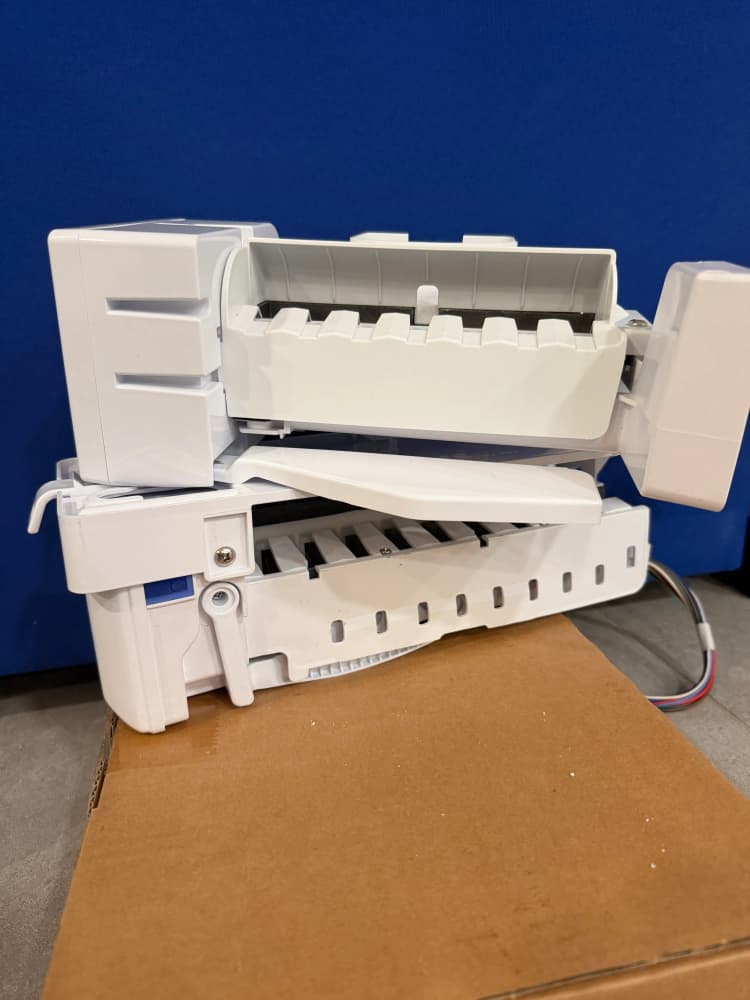
Ice makers are the most failure-prone system in any modern refrigerator. They operate in a tight, cold, humid space with multiple moving parts, an electronic controller, a water valve, and a fill tube, all exposed to the thermal cycling of the freezer.
In Florida humidity, ice makers fail more often than in dry climates. Excess moisture causes ice bridging — fused clumps that jam the harvesting paddle. Fill tubes freeze over. Frost builds up around the housing. Each of these stresses the defrost system and cuts freezer airflow.
And everything from the well-water section lands here first: sulfur attacks the valve and the aluminum ice mold, iron narrows the fill tube and plugs the filter. When a Zephyrhills or Dade City customer tells me the ice tastes off, the cubes are shrinking, or the maker has simply stopped, the water is my first suspect — before any electronic part. The same goes for a water dispenser that slows to a dribble: that's the line and the filter, not the dispenser itself.
Expert opinion — Anatoli Didenco Periodic rest: when you don't need ice — typically November through February in Tampa Bay, or during extended travel — turn the ice maker off. The mechanism gets a break that reduces accumulated wear. It's one of the simplest lifespan steps available, and almost nobody does it.
Filter discipline: on well water, replace filters every 4–6 months, not the standard 12. A clogged filter makes the inlet valve work harder on every fill.
Early symptom response: small cubes, hollow cubes, slow production, or intermittent operation are early signals. At that stage the fix is typically a minor repair. Wait until it freezes over completely and the repair often triples, with secondary defrost complications.
Factor 8: Temperature settings and loading habits
Two factors entirely within your control, both directly affecting compressor run time and lifespan.
Temperature: the practical target is 37°F. The FDA recommends keeping the fresh food compartment at or below 40°F; 37°F is cold enough for safety without excessive run time. Don't trust the display panel — most fridges put their sensor near the top, in the coldest zone, and middle-shelf temperatures can run 3–5°F warmer than the readout. Use a separate $8–$12 thermometer in the middle of the cabinet. Turning the dial colder when things feel slightly warm is one of the most common mistakes I see — it burns extra electricity while the real problem, dirty coils or a bad gasket, keeps progressing.
Loading: airflow inside matters as much as airflow outside. Modern refrigerators cool by circulating air along a specific path between compartments. Items packed against the back panel block that air circulation and force longer run times. Items against internal vents starve whole sections of airflow. Leave 1–2 inches of clearance from the rear panel, keep internal vents clear, spread large warm grocery loads in gradually rather than all at once, and cut unnecessary door openings — every opening lets in warm humid air the compressor has to remove.
Factor 9: Leveling and mechanical stability
A refrigerator tilted even slightly toward the front lets the door rest a fraction open under gravity. Most homeowners never notice the gap, but the result is continuous cold-air loss and continuous compressor compensation. The correct orientation for most fridges is very slightly higher at the front than the rear, so the door swings closed and seals on its own. Adjust the front leveling feet to get there.
Vibration is the second effect. An unlevel fridge on tile or hardwood — common across Tampa Bay homes — sends vibration through the floor. Over years that can loosen compressor mounting hardware and accelerate fan-bearing wear, parts that don't announce their failure until they're already badly degraded.
Factor 10: How fast you respond to small problems
How fast you respond to early warning signs decides whether a $150 repair stays $150 or becomes $700.
In Tampa Bay's climate, problems progress faster than in moderate climates. A small door-seal leak in a humid kitchen introduces more moisture per hour than the same leak in Phoenix. A partially blocked defrost drain accumulates debris faster. A compressor running slightly hot in July's heat accumulates thermal wear faster than the same compressor in October. And a pinhole refrigerant leak near the coast only ever grows.
Symptoms that deserve same-week attention:
- Clicking every few minutes — the compressor trying and failing to start. Usually a start relay. Cheap to fix early, expensive once the compressor overheats.
- Frost buildup in the freezer, starting on the back panel — defrost system failure, manageable at this stage.
- Water under the crisper drawers — blocked defrost drain, simple to clear early.
- Compressor running without cycling off — dirty coils, seal failure, airflow restriction, or a slow refrigerant leak. All addressable early.
- New sounds that weren't there before — fan-bearing wear. Inexpensive to replace, expensive when the fan seizes.
The principle: in this climate, "minor" issues accelerate. A small airflow problem becomes a defrost problem. A defrost problem becomes ice buildup. Ice buildup becomes an evaporator fan failure. By the time the fridge stops cooling, three components have been damaged by what started as an $80 drain-line clog.
Question about a symptom you're seeing right now? You don't have to guess. Call (813) 522-0014 and describe it. Real humans answer, Monday through Saturday. If we come out, the $69 diagnostic is 100% applied to your repair when you approve the work, and if we can't fix it, you don't pay.
Check your own kitchen: the 60-second risk check
Answer three questions and get the maintenance rhythm that matches your actual home — not the national average. (The full logic is spelled out in the sections above; this just puts your answers together.)
- Clean the condenser coils every 6 months.
- Wipe gasket folds monthly; dollar-bill test twice a year.
- Appliance-rated surge protector on the fridge outlet.
The 7-Point Florida Perfect Fridge Inspection
This is the diagnostic framework I apply to every refrigerator I service in Hillsborough, Pinellas, and Pasco Counties. It's built for Florida conditions — the failure modes our climate creates and a standard diagnostic often misses. When a technician arrives at your home in Tampa, Wesley Chapel, or Zephyrhills, this is what a thorough Florida-aware diagnostic looks like. If what you get is "I looked around and it seems like the compressor" with no instruments used, that isn't a diagnostic. That's a guess formatted as a conclusion.
- Humidity Impact Assessment — every door gasket checked for softening, warping, and mold in the folds, pulled open and inspected, not eyeballed from a distance. A gasket that passed in January can fail by August.
- Corrosion Inspection — salt air doesn't stop at the Bayshore. Homes in South Tampa, Westshore, Harbour Island, Apollo Beach, and coastal Pinellas see accelerated corrosion on evaporator fins, condenser brackets, and copper lines, reducing efficiency with no visible symptom. I check for the green crust, the black sulfide film, and the oil traces that mark an early leak.
- Sealed System Diagnostics — compressor function, condenser heat dissipation, evaporator temperature profile, refrigerant charge. This requires gauges, temperature probes, and amperage readings. A sealed-system check without instruments is speculation.
- Electrical Stress Test — outlet voltage quality, control board inspection for burn marks and carbon scoring, wiring harness check for heat damage. Post-storm electrical checks are essential here; a lightning-induced surge can partially damage a board without obvious failure.
- Control Board Inspection — checking for swollen capacitors, corroded contacts, and arcing evidence, catching it before a board fails completely and a full fridge stops working with no warning.
- Performance Verification — actual temperature readings in both compartments under real load, cycling-time measurement, fan airflow confirmation. The only objective proof a fridge is working is what the instruments show.
- Florida Longevity Plan — a maintenance schedule specific to your model, kitchen environment, water source, and local climate zone. A Sub-Zero in South Tampa near the water has a different profile than the same unit inland in Wesley Chapel.
Lifespan factors by refrigerator style — what I see in Tampa Bay kitchens
French-door models (LG, Samsung, Whirlpool, GE) — Wesley Chapel, New Tampa, Wiregrass. The ice maker is the most failure-prone system, and Florida humidity makes it worse. The mullion heater between the two fresh-food doors, which prevents condensation, fails more often in our humidity than the design assumed. Priority: ice maker maintenance, gasket cleaning every 2–4 weeks, surge protection.
Side-by-side models (Whirlpool, Kenmore, GE) — Zephyrhills, Dade City, Land O' Lakes. The narrow freezer creates airflow challenges. Uneven freezer temperatures — ice cream solid at the bottom, items softening near the top — are almost always a defrost or airflow issue, not a sealed-system problem, and they get misdiagnosed and overcharged constantly across this market. Many of these homes are on well water, so the filter-and-valve discipline from the water section applies double. Priority: defrost system monitoring, condenser cleaning, door-seal maintenance.
Counter-depth models (Samsung, KitchenAid, Bosch, Miele) — South Tampa, Hyde Park, Palma Ceia. Less clearance behind the unit makes condenser maintenance more critical here than anywhere else. A dirty condenser on a counter-depth fridge in an 82°F South Tampa kitchen is a compressor-failure timeline, not a deal-with-it-later situation. These are also the neighborhoods where salt air does its quiet work. Priority: condenser cleaning every 4–5 months, minimum rear-clearance confirmation, yearly corrosion look.
Premium built-ins (Sub-Zero, Monogram, Thermador) — Davis Islands, Harbour Island, South Tampa waterfront. These need Florida-specific maintenance most national chains aren't equipped to provide. Sub-Zero condensers in Tampa Bay need cleaning every 4–6 months, not the 12-month manufacturer recommendation. Salt-air corrosion inspection is especially important for waterfront installations. OEM parts only for sealed-system work — aftermarket components on these units are a false economy that leads to repeat failures. Priority: condenser cleaning every 4–5 months, annual corrosion inspection, OEM parts.
A realistic Tampa Bay maintenance rhythm
Every 4–6 weeks: wipe gasket folds with a damp cloth to prevent mold and keep the seal clean; do a quick visual check for water, frost patterns, or temperature anomalies; replace the water filter if due (every 4–6 months on well water or Florida hard water, not 12).
Every 4–6 months: clean the condenser coils (6 months minimum, 4 with pets or in dusty areas); run the dollar-bill gasket test around the full perimeter including corners; apply food-grade silicone grease or mineral oil to the gasket; confirm the fridge is level and adjust feet if needed; check the surge protector's status indicator and replace it if it has taken a major hit.
Annually: a full 7-Point Florida inspection if the fridge is 8+ years old or after a significant storm season; a corrosion inspection for South Tampa, Harbour Island, Apollo Beach, and any home within a few miles of salt water; an inlet-valve and water-line check on well water; an ice maker rest period (November–February for low winter ice demand); professional condenser service for Sub-Zero and premium built-ins.
Questions Tampa Bay homeowners ask about refrigerator lifespan
My fridge is 10 years old. Repair or replace? Age alone doesn't answer it. What matters is what specifically is wrong. A 10-year-old fridge with a failed defrost sensor is an easy repair — an easy yes. The same fridge with a failing compressor and a discontinued control board is a different conversation. Get the specific diagnosis first, then decide with actual numbers — that's how you tell a worthwhile repair from a unit where it's time to replace. There's a full breakdown in Is it worth repairing a refrigerator?
Why do refrigerators fail faster near the coast? Chloride from salt air penetrates the protective oxide layer on copper and aluminum and concentrates corrosion into pits that drill through the tube wall. Coastal studies measure corrosion running 4–8 times faster than inland. In my repair log, unprotected sealed systems in homes near the bay show first refrigerant pinholes at 5–7 years — the same components inland routinely pass 12 years.
Does well water really damage a refrigerator? Yes, in two specific ways. Hydrogen sulfide — the rotten-egg smell — reacts with the copper and brass in the water line, inlet valve, and ice maker; iron builds deposits that clog the line, the valve screen, and the filter. The fix is treating the water before it reaches the fridge and changing the filter every 4–6 months instead of 12.
How do I know if my condenser coils need cleaning? The simplest field check: if the area behind or below the fridge feels noticeably hot, or the compressor rarely cycles off, the coils are likely clogged. The definitive check is pulling the unit out and looking. If the coils are coated with gray-brown debris, clean them now.
My refrigerator is in the garage. What's different? Florida garages hit 95–105°F in July and August. A fridge designed for 70°F ambient running in 100°F heat uses much more electricity and wears its compressor faster. If you genuinely need a garage fridge, buy one specifically rated for garage environments, with a high ambient operating temperature spec — it will outlast a standard residential model in that setting.
Is it worth putting a surge protector on an older refrigerator? Yes, as long as you plan to keep it at least another year or two. Any fridge from the early 2010s onward has a surge-vulnerable control board. A surge protector is a small upfront cost compared to a board replacement. In Tampa Bay, the math is clear.
How does humidity specifically shorten a refrigerator's life? Three mechanisms: it accelerates gasket degradation; it increases the moisture load the defrost system manages, adding hours to the defrost heater and thermostat; and it supplies the moisture that both mold in drain lines and ant-nest corrosion on copper tubing need to get started.
Do newer refrigerators really not last as long as the old ones? There's truth in it. Many refrigerators sold in the 1990s were built to last two decades on a simple mechanical design. A new refrigerator today is quieter and more energy-efficient, but it carries far more electronics, and its job hasn't changed — keep your food fresh and your perishable groceries safe. That's why maintenance now matters more than it did a generation ago: the machine protecting your food is also the one absorbing Tampa's heat, storms, and water chemistry every day of its life.
What's the best refrigerator style for longevity in Florida? The data points to top-freezer designs: 15–20 year average lifespan, fewer electronics, simpler defrost, no ice maker complexity. If you need French-door or side-by-side capacity, consistent maintenance — especially condenser cleaning and gasket care — closes most of the longevity gap.
The bottom line for Tampa Bay homeowners
A refrigerator that lives a long life in Tampa Bay has four things going for it: it can shed heat efficiently (clean coils, adequate clearance, no heat sources nearby), it can seal reliably (clean and lubricated gaskets, regular testing), it can trust the power coming out of the wall (surge protection, stable voltage, a dedicated circuit where possible), and its metal is protected from what our air and water want to do to it (treated water, corrosion checks, early leak response). Everything else is downstream of those four.
The 7-Point Florida inspection exists to verify them periodically, catch early signs of failure before they cascade into expensive compressor or electronics problems, and build a maintenance schedule for the actual conditions a Tampa Bay refrigerator faces, not the national averages manufacturer documentation assumes.
The most eco-friendly appliance is the one you don't have to replace early. In Tampa Bay, keeping a refrigerator at its full potential lifespan saves more — in money, resources, and hassle — than almost any other home maintenance action available. The tools are simple and inexpensive. The knowledge is what most homeowners have been missing.
Ready for a Florida-aware diagnosis? Call (813) 522-0014 or book online. Same-day in most Tampa Bay areas. $69 diagnostic, 100% applied to your repair if you approve the work. If we can't fix it, you don't pay — no labor, no parts, no charge.
Where these numbers come from
Climate figures: Florida Climate Center (FSU) — thunderstorm frequency and NOAA climate normals for Tampa via CurrentResults. Corrosion mechanisms: ACHR News on formicary corrosion and pinhole leaks, the Copper Development Association's paper on HVACR coil corrosion, and Florida HVAC Authority on coastal salt-air corrosion rates. Salt-air inland reach: Poma Metals' review of salt-deposition studies. Well-water usage: UF/IFAS, citing the Florida Department of Health. Lifespan ranges by style: U.S. DOE averages and industry warranty data, adjusted with my own Tampa Bay repair log — the local adjustments are field experience, clearly marked as such.
Related services
Book same-day service or read more about the exact repair:
- Refrigerator repair
- Refrigerator light not working? Bulb, switch, or LED board
- Refrigerator repair cost in Tampa: real price ranges
- Is it worth repairing a refrigerator?
- What to check before hiring an appliance repair service
Call or text (813) 522-0014 or book online — Perfect Appliance Repair Tampa covers Tampa, South Tampa, Wesley Chapel, Zephyrhills, Dade City, and surrounding Tampa Bay.
Anatoli Didenco is the owner-technician of Perfect Appliance Repair Tampa, with 20+ years of hands-on technical experience in refrigeration and appliance repair across Hillsborough, Pinellas, and Pasco Counties. He specializes in refrigerators — particularly Sub-Zero, Wolf, and premium built-in systems — and sealed-system and compressor work. He personally answers the phone and shows up at the door. Read more on the About page.
Perfect Appliance Repair Tampa serves Tampa, South Tampa, Wesley Chapel, Zephyrhills, Dade City, and the surrounding Tampa Bay area. Reviews are available on the company’s Google Business Profile and BBB listing.
We Stand Behind Our Work.