Most "dead" freezers are not dead. A wall of ice on the back panel, a freezer that clicks but will not start, frost creeping over the food — each of these usually traces to one modest, testable part: a defrost heater, a start relay, a gasket, a fan. The pages below are the tools we use to think about your freezer before we ever open a panel: find your freezer type, match your symptom, read the frost pattern, and see whether repair or replacement wins. And if a storm took the power out, the outage tool answers the question every Tampa Bay household asks in June: how long is the food safe?
Pick your freezer — each type fails its own way
An upright with a broken defrost heater, a chest freezer with a tired start relay, a French-door whose freezer section frosted over, a garage freezer fighting August — these are different jobs with different fixes. Pick yours and read what we actually find on Tampa Bay service calls.
Where we see it: Frigidaire, GE, Whirlpool and Kenmore uprights in kitchens, garages and Florida rooms
Frost-free uprights: the defrost system is the usual suspect
Most modern uprights are frost-free: several times a day a heater melts the frost off the hidden cooling coil. When that defrost system fails — the heater, its thermostat, or the control that schedules it — frost swallows the coil, airflow dies, and the freezer slowly warms even though the compressor never stops. The telltale is a freezer that got worse over days, not minutes.
Manual-defrost uprights: simpler, tougher, still mortal
The old-school uprights with wire shelves that double as coils have less to break — no fan, no heater, no timer. When one fails it is usually the thermostat, the start relay on the compressor, or the door seal. These are some of the most repairable appliances ever made, and we say so instead of talking you into a new one.
Unplugging it for a day to melt the frost. It works — and if the defrost system is broken, the frost is back in two or three weeks, with the grocery bill that goes with it.
We open the back panel, read the frost pattern on the coil, test the heater and defrost thermostat with a meter, and fix the part that actually failed — then verify the freezer pulls down to 0°F before we leave.
Where we see it: Garage and lanai chest freezers across Tampa Bay — hurricane stock, bulk meat, fish from the boat
Warm chest freezer with a silent compressor
A chest freezer that stopped cold usually comes down to the start components on the compressor — a small relay and capacitor that take the brunt of Florida power flickers — or the compressor itself. The relay is a quick, inexpensive repair; the compressor is a real decision. Testing tells them apart in minutes, and guessing wrong on this one is how a repairable freezer ends up at the curb.
Runs forever, food is soft at the top
Cold air sinks, so a struggling chest freezer fails from the top down. A worn lid gasket, a torn hinge seal, or a refrigerant issue thins the cold at the top first — soft ice cream and pliable vegetables up top while the bottom stays rock hard. In a hot garage that top layer is the first thing hurricane-season stock loses.
Piling more food in to "help it hold cold." Thermal mass helps in an outage, but it cannot fix weak cooling, and it hides the symptom until the middle of the load thaws.
We test the start relay and capacitor first — the cheap fix — before anyone says the word compressor, check the lid seal the way it actually seals under weight, and measure real cabinet temperature at top and bottom, not just at the thermostat.
Where we see it: The freezer section of French-door, side-by-side and top-freezer refrigerators — LG, Samsung, Whirlpool, GE, Frigidaire
Freezer warm, refrigerator fine — or the other way around
One compressor cools both sections, so when only one side misbehaves the compressor is rarely the culprit. The usual causes are a frosted-over evaporator from a failed defrost cycle, a dead evaporator fan that no longer moves cold air, or a stuck damper that splits the air wrong between the two sections. Each has its own fingerprint, and each costs far less than the sealed-system repair people fear.
LG and Samsung: the compartment tells on the electronics
On LG and Samsung combos the freezer section is often the first place a failing control board or sensor shows itself — erratic temperatures, a fan that stops after a defrost, ice where ice should not be. Florida storm season feeds these boards more voltage spikes than they were designed to shrug off, which is why we check power-side damage before condemning anything.
Setting the dial colder. If the airflow or defrost system is the problem, a colder setpoint just makes the compressor run longer on its way to the same warm freezer.
We pull the freezer back panel, read the evaporator frost pattern, test the fan, damper, defrost circuit and sensors, and fix the section that failed — the whole appliance comes back with it. If your LG is also clicking or running warm, see our LG compressor page.
Where we see it: Sub-Zero, Thermador, Monogram and Liebherr freezer columns and built-in freezer drawers
A premium column deserves a diagnosis, not a guess
Built-in freezer columns are integrated into cabinetry and into a refrigeration design that expects OEM parts and careful hands. The classic calls are a vacuum-condenser overdue for cleaning (these want it every six months in Florida), ice maker faults inside the column, and door alignment after years of use. On appliances at this level a misdiagnosis costs more than the repair.
Freezer drawers under the counter
Drawer units live low, where kitchen dust and pet hair choke the condenser fastest, and their slide seals wear in ways a swing door never does. Both are routine fixes — if someone actually looks.
Calling the manufacturer network and waiting weeks for an appointment while the column sits warm.
Independent specialists with 12-month parts and labor warranty on premium-brand work. We service Sub-Zero and its peers; we are not the manufacturer, and we say so plainly. Condenser cleaning is part of every visit on these.
Where we see it: Any freezer living in a Tampa Bay garage — which is a harder job than the same freezer indoors
A Florida garage is the toughest room a freezer can live in
A freezer rated for a 110°F ambient is working at the edge of its design for months at a time out there. The condenser sheds heat into air that is already hot, the compressor runs longer and hotter, and dust plus humidity coat the coil exactly when it needs to breathe most. Garage freezers in this climate age roughly twice as fast as their indoor twins — and they fail in August, when the load is highest and the food in them matters most.
The freezer is fine in winter and fails every summer
That seasonal pattern is the garage talking, not coincidence. Marginal start components, a dusty condenser, or a tired door seal all cross the failure line when ambient heat removes the slack. The fix is part repair, part survival kit: clean the condenser, replace the weak link, and give the machine room and shade to breathe.
Waiting for winter, when it "fixes itself." It did not fix itself — it got a five-month reprieve.
We service the freezer where it lives: condenser cleaning against garage dust, start components tested at real ambient temperatures, clearance and airflow advice, and a surge protector on the quote — Florida storms take out more freezer electronics than age does.
Where we see it: True, Turbo Air, SABA and similar reach-ins in restaurants, bars and c-stores
Downtime is inventory
A commercial reach-in freezer that drifts warm is not an inconvenience, it is product loss and a health-inspection problem on a timer. These units share physics with residential freezers but run harder, defrost more often, and live in hot kitchens — so gaskets, evaporator fans and defrost systems earn their keep and wear accordingly.
Running it colder and propping fans at it during service. That buys hours, not weeks.
Commercial refrigeration is its own service line here — reach-ins, prep tables and walk-ins, with EPA-certified sealed-system work. Full details on the commercial refrigeration page.
You call, the technician answers. Same person at your door.
Perfect Appliance Repair Tampa is owner-operated: the person reading your freezer's frost pattern has two decades of refrigeration work behind him and no script in front of him. You get a straight diagnosis in plain language, a written estimate before any work starts, and a 90-day labor warranty on every repair. If we can't fix it, you don't pay — no labor, no parts, no charge.
Same-day service in most Tampa Bay areas when you call before 2 PM, seven days a week.

The most common freezer problems — and what each one usually means
The eight most common freezer problems, the likely causes in the order we actually find them on Tampa Bay calls, one safe check you can do yourself, and what we do about it on the visit.
Not freezing at all
The compartment is at refrigerator temperature or warmer. Everything is thawing.
In the order we actually find them: a frosted-over evaporator from a failed defrost system; a dead evaporator fan; failed start components on the compressor; a control or thermostat fault; and only then the compressor or sealed system itself. Most "dead freezers" are one modest part, not a funeral.
Listen at the back: is the compressor humming, clicking, or silent. Note whether the inside light works — that separates power problems from cooling problems in one glance.
We test the chain in order — power, controls, fan, defrost, compressor — and show you the failed link before replacing anything.
Running, but food is soft
Ice cream like soup, bags that bend, ice cubes that sweat. It works, just not enough.
Partial cooling loss: a coil half-blocked by frost, a fan slowing down, a door gasket leaking warm humid air, a condenser choked with dust, or low refrigerant from a slow leak. Soft ice cream is the earliest warning the system gives — it means the freezer is above about 10°F and losing ground.
Put a separate thermometer inside overnight; the display lies more often than you would think. Check the gasket with the dollar-bill test around the full door.
We measure true temperature, inspect the coil frost pattern, and find where the cold is leaking out or failing to arrive.
Sheet of ice on the back wall
A smooth plate of ice behind the panels or across the back wall, coming back after every defrost.
The defrost system has stopped doing its job — heater, defrost thermostat, or the control that schedules the cycle. The compressor is usually fine; it is buried alive under its own frost. This is one of the most common and most repairable freezer failures there is.
Nothing to check safely — but note how fast it returns after a manual thaw. Two weeks means the defrost circuit, not your door habits.
We test the heater and defrost thermostat with a meter, replace the failed part, clear the drain so meltwater leaves, and verify a full defrost cycle runs.
Fluffy frost everywhere
Snow-like frost on food, walls and shelves — not a smooth ice sheet, a furry coat.
Humid Tampa air is getting in: a worn or warped door gasket, a door that does not quite close against a crowded shelf, a chest lid that lost its spring, or door hinges out of alignment. The freezer is fine; the seal is not. Every cubic foot of humid air that sneaks in leaves its moisture behind as frost.
The dollar-bill test around the entire seal, corners included. Look for a shelf, bag or ice-cube tray propping the door open a few millimeters.
We replace or reseat the gasket, align the door or lid, and check the vent that equalizes pressure — a freezer that is hard to reopen after closing has its own story to tell.
Runs constantly, never cycles off
The hum never stops, the sides are hot, the electric bill noticed before you did.
The freezer is losing the race: a dusty condenser that cannot shed heat (the number-one cause in Florida garages), a failing gasket pulling in warm air, low refrigerant, or a sensor reading wrong and never letting the compressor rest.
Feel the airflow at the condenser area — weak, hot, dusty airflow is the tell. If you can see the coil, look at it: gray felt means it has not breathed in years.
Condenser cleaning is part of the diagnosis, then we measure runtimes and temperatures to separate airflow problems from refrigerant problems.
Clicks, tries to start, gives up
A click every few minutes, sometimes a brief hum, then silence. The compartment slowly warms.
The classic start-relay and capacitor failure — small parts that take the hit from Florida power flickers and hand it to the compressor. Sometimes the click is the overload protector saving a compressor that is genuinely failing; testing tells the difference, guessing does not.
Unplug it if the clicking is constant — repeated hard starts are the one symptom where waiting actively causes damage. Move food to coolers.
We test the start components and compressor windings separately, so a repairable relay never gets diagnosed as a dead compressor.
Water or ice on the floor
A puddle under or in front of the freezer, or a sheet of ice on the freezer floor under the drawers.
A blocked or frozen defrost drain — meltwater from every defrost cycle has nowhere to go, so it freezes on the floor of the compartment and eventually escapes onto yours. Less often: a door left ajar, a water line to an ice maker, or condensation from a failing gasket.
Look for the ice sheet on the compartment floor — that is the drain signature. Put a towel down and keep the area dry so flooring does not pay for the delay.
We clear and thaw the drain, fit a drain strap where the design needs help, and fix whatever froze it in the first place.
New noises — grinding, buzzing, rattling
A sound that was not there last month: scraping during run, buzzing at start, rattling from the back.
A fan blade shaving frost (scraping), a fan motor bearing going dry (squeal or grind), start components buzzing on the way out, or simply a loose drain pan rattling. Noises are the freezer diagnosing itself out loud — each one points somewhere specific.
Note when it happens: at start, during run, or after the door closes. A ten-second phone video with sound saves a lot of describing.
We reproduce the noise, isolate the component, and fix the cause plus whatever the noise was wearing through.
The frost in your freezer is telling you what broke. Here's how to read it.
Where frost sits and what it looks like points at the failure the way footprints point at who walked through. Tap what yours looks like.
Smooth ice sheet on the back wall
What you see: A plate of solid, glassy ice behind or on the back wall.
Defrost system failure — heater, defrost thermostat, or control. The most repairable serious-looking problem a freezer has.
Furry frost on everything
What you see: Snow-like coating on food bags, walls and shelves.
Humid air infiltration — a gasket, alignment or door-habit problem. The freezer is healthy; the seal is not. In Tampa humidity this escalates fast.
Frost ring around the door
What you see: Frost concentrated at the door opening, clean deeper in.
The seal is leaking exactly where the frost sits. Gasket wear, a warped door, or hinges that sagged. Cheap to fix, expensive to ignore.
Ice on the compartment floor
What you see: A sheet of ice under the bottom drawer, sometimes leaking out.
Blocked defrost drain. Meltwater refreezes where it lands. The drain needs clearing and usually a small fix so it stops re-freezing.
Frost only on the food
What you see: Ice crystals inside bags, freezer burn, frost on packages but clean walls.
Temperature cycling or air movement over the food — door opened often, packages unsealed, or the compartment running warmer than it should between cycles. Partly habits, partly worth a temperature check.
No frost — and no cold
What you see: Compartment is dry, clean, and warm.
That is not a frost story at all: the cooling itself has stopped. Start components, fan, controls or compressor. Skip the hair dryer; this one needs a meter.
Power out — how long is the food safe?
The answer depends on what you have and how full it is. Pick your case. The numbers follow USDA food-safety guidance; the habits around them are what two decades of Tampa Bay storm seasons teach.
Full chest freezer
A full, unopened chest freezer holds food safely frozen for roughly two days. Cold sinks and stays; the mass of frozen food does most of the work. Do not open it to check — every peek costs you hours.
Half-full chest freezer
Half the mass, half the time. If a storm is coming, fill the empty space now: bottles or bags of water frozen ahead of time turn a half-full freezer into a full one, and become drinking water later.
Full upright freezer
Uprights lose cold faster than chests — the cold literally falls out when the door opens, and door seals leak more than a weighted lid. Full and unopened, count on a day, a bit more if the room is cool.
Half-full upright freezer
The most vulnerable case. Group the food into one tight block, fill gaps with frozen water bottles, tape a note on the door so nobody opens it, and plan your next move within the day.
Fridge-freezer combo
The freezer section holds roughly a day or two depending on how full it is; the refrigerator section is down to about 4 hours. Move milk, meat and medication to a cooler with ice early, and leave the freezer door shut.
Power is back — what can I keep?
Food that still has ice crystals, or reads 40°F or colder, can be safely refrozen — quality may dip, safety does not. Anything above 40°F for more than two hours goes. When in doubt, throw it out; no groceries are worth the alternative. And if the freezer came back struggling after the outage, that is a surge story — worth a diagnostic before hurricane season tests it again.
Before a named storm: freeze water bottles in every empty gap, turn the freezer to its coldest setting, and agree with the household that the door stays shut. After: the ice-crystal rule decides what stays.
Is this freezer worth fixing? Run the honest math.
Pick what you have, how old it is, and what's wrong. You get the same recommendation we'd give at your door. Pricing here is simple: the diagnostic is $69, it's 100% applied to your repair if you approve the work, and every repair is priced on a written estimate after the diagnosis — never before.
Your recommendation appears here.
Our 7-point Florida freezer inspection
Every freezer diagnostic runs through the failures we actually see in Tampa Bay — in the order that separates the modest repairs from the real decisions.
True temperature, top and bottom
Measured with our thermometers, not the display — a freezer can read 0°F at the sensor and run 15°F at the lid.
Door and lid seals
Full-perimeter gasket check, corners included, plus door alignment — the number-one frost cause in Florida humidity.
Defrost system
Heater, defrost thermostat and cycle control tested with a meter — what keeps the ice-sheet problem from coming back.
Airflow and fans
Evaporator fan, vents and damper on combos — cold that is made but not moved is cold you paid for and never got.
Condenser and clearance
Coil cleaned and airflow verified — garage dust and pet hair are the quiet killers of Tampa Bay freezers.
Electrical and start components
Start relay, capacitor, and voltage at the outlet — Florida storm season damages more freezer electronics than age does.
Drain and moisture path
Defrost drain cleared and traced, so meltwater leaves the cabinet instead of freezing on the floor of it.
That is the whole repair process: measure, test, explain, and only then repair. You get the cause in plain language and a written estimate — parts and labor listed separately — before any work begins.
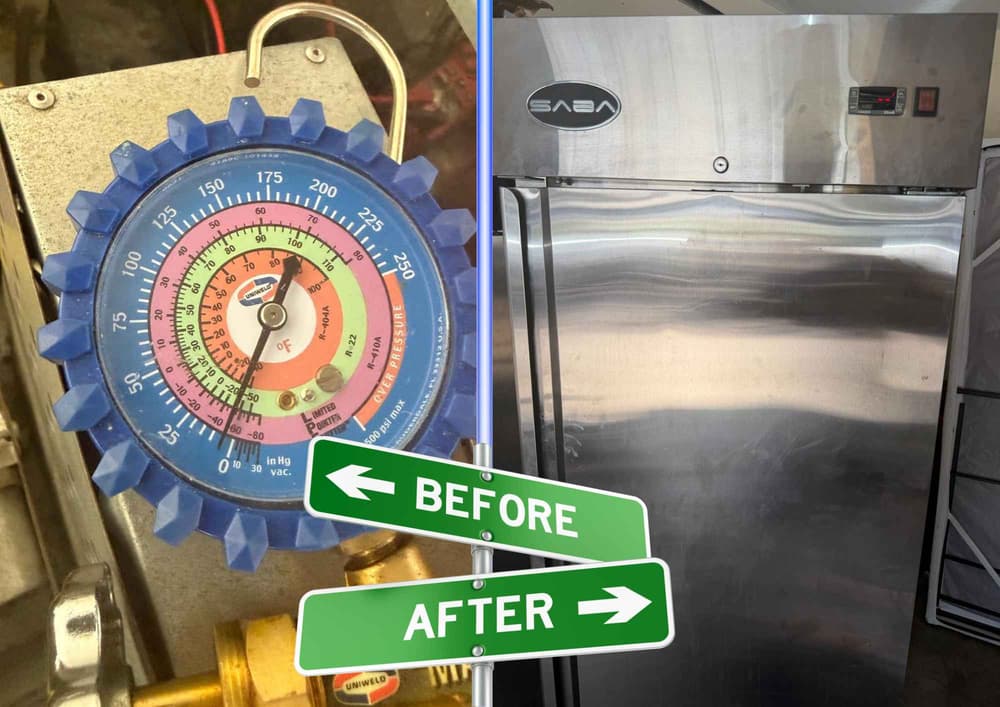
We also keep restaurant freezers alive — your garage chest freezer is in good company
The reach-in above belongs to a Tampa Bay kitchen where a warm freezer means lost inventory by morning. Commercial refrigeration work — EPA-certified, sealed-system included — is a different level of pressure, and it sharpens exactly the skills your home freezer benefits from: reading a frost pattern fast, testing instead of guessing, and fixing the cause so it stays fixed. Restaurant owners: your own page is at commercial refrigeration.
One appliance repair company for the kitchen and the laundry room
Freezer work is one lane of a full appliance repair service. The same technician handles refrigerator repair, ice maker repair, dishwasher repair, washer and dryer repair, and oven and range repair across every major appliance brand — so the failing thermostat in your freezer and the heating element in your dryer get fixed by the same trusted hands, often in one timely visit. What our customers say about that is on the reviews page, in their own words.
A tip that speeds everything up: before you call, find the data plate — a sticker with the model number, usually just inside the door of a standalone chest or upright, or on the inside wall of a combo — and text us a photo. Knowing the exact model tells us which defrost timer, switch, relay or gasket your freezer uses before we arrive, which is how a repair professional turns two visits into one. Mention the senior or large-family discount when you book if one applies; the full breakdown of the repair cost always goes in writing before any work starts.
What freezer repair costs here — and how you're protected
One number up front, everything else in writing after the diagnosis. No trip fees, no guesses, no surprises.
Freezer repair questions Tampa Bay homeowners ask
Perfect Appliance Repair Tampa — Freezer Repair.
— We Stand Behind Our Work —