A walk-in that drifts warm isn't just an inconvenience. In Tampa's heat, it's lost product, lost revenue, and a compliance problem that gets worse by the hour. We can help you today.
If your walk-in cooler is running warm, your freezer is icing up, or you searched for emergency refrigerator repair or walk-in freezer repair near me, you need answers now, not tomorrow. We diagnose first, explain what's actually failing, then fix the real problem. No guessing, and no "just buy a new one."

Kolpak, Nor-Lake, Bally, Master-Bilt — we repair all of them
We know how this morning started for you. Somebody opened the walk-in and felt warm air instead of cold, and the whole day changed shape — last night's prep, the delivery that just came in, the inspection nobody was worried about until an hour ago. That knot in your stomach is real, and we feel it with you every time the phone rings.
Here is the good news. Look at the badge on your door panel: if it says one of these, the technician who picks up has already been inside one this month, and he knows which door hardware, heater cable and defrost part it takes before he loads the truck. Give us one visit and let us bring back the cold — and your peace of mind with it.
Fridge-Safe 7-Point Inspection — What We Check, Step by Step
Every walk-in call starts with the same seven checks, in the same order, whether the complaint is a warm box or a wet floor. It is why our diagnoses hold and our repairs do not come back. Step through what we actually do — what we check, why it matters to your business, what failing looks like, and what the fix usually is.
Temperature reality check
We measure at product level with our own calibrated thermometers — top shelf, bottom shelf, by the door, deep in the back — and time an actual pull-down, not just glance at the display.
The display reads the air at one sensor. Your health inspector reads the product. Those two numbers disagree more often than any owner expects, and the gap between them is where product loss and failed temp logs live.
A box that reads 36°F on the panel while the milk crates by the door sit at 44°F. A pull-down that takes all night after a delivery. A thermometer you hung yourself that never quite matches the display.
Sometimes the fix is mechanical, sometimes it is a sensor sitting in the wrong airstream, sometimes it is how the box is loaded. We tell you which — with numbers you can show an inspector.
Airflow and evaporator coil
The evaporator inside the box: coil condition, fan motors and blades, air pattern across the shelves, and whether product stacking is strangling the circulation you paid for.
Every degree of cooling your compressor makes has to be moved by that coil and those fans. A coil under ice or a dead fan motor means the system is making cold and not delivering it — while your electric meter runs like it is.
A wall of white ice where fins should be. One fan spinning, one still. Boxes stacked to the ceiling against the back wall, and the front of the cooler running warm during the lunch rush.
Ice gets melted and, more importantly, explained — ice is a symptom, never the disease. Fan motors are tested and replaced on the spot when stock allows, and we show your crew the stacking pattern that keeps air moving.
Defrost performance
Timers or board schedules, defrost heaters, termination thermostats, and the drain path that carries meltwater out of the box — the whole self-cleaning cycle your walk-in runs several times a day.
When defrost fails, the evaporator slowly disappears into a block of ice, and the box fails on a delay — usually on a hot weekend, three days after the actual part quit. Catching it at inspection is the difference between a small part and a Saturday emergency.
Icicles hanging from the evaporator housing. Water dripping onto product from the ceiling. A drain line that froze, so every defrost cycle rains inside the box. Frost creeping back within a day of a manual melt.
We test the heaters and termination with a meter, verify the timer or board actually calls the cycle, and clear and heat-trace the drain path so meltwater leaves the box instead of refreezing in it.
Doors, gaskets and curtains
Gaskets tested the way carts abuse them — at cart height, corners included — plus hinges, closers, sweeps, strip curtains, and the door-frame heater that keeps a freezer door from freezing shut.
A walk-in door takes hundreds of hits a day. In Tampa humidity, every gap is a moisture pump: it frosts your coil, sweats your frame, and makes the compressor pay for air conditioning the whole kitchen.
A gasket torn at exactly cart height. A door that drifts open behind the last person out. A sweating, dripping frame — that is the frame heater gone, not "Florida being Florida." Missing strip curtains that walked away one delivery at a time.
Gaskets and sweeps replaced with the correct profile, closers and hinges adjusted so the door shuts itself, frame heaters tested and replaced, and curtains put back — the cheapest cold you will ever buy.
Electrical and start components
Contactors, start capacitors, relays, wiring condition and true voltage at the unit — the components that take the beating when Florida storm season plays with the power.
Half of the "dead compressor" calls we get in summer are a failed start component or a pitted contactor — parts that cost a fraction of what they get mistaken for. A power flicker at 2 AM shows up as a warm box at 6 AM, and the compressor usually is not the villain.
A compressor that hums, clicks and trips the breaker. A contactor chattering like a rattlesnake. Burn marks nobody looked behind the panel to find. Breakers that "just trip sometimes."
We test the start circuit and the compressor windings separately, replace what actually failed, and put a hard-start or surge protection recommendation in writing where the electrical history justifies it.
Condensing unit and refrigerant behavior
The half of your walk-in that lives outside or on the roof: condenser coil condition, condenser fan motors, head pressure under real Tampa ambient, and honest refrigerant diagnostics with gauges — EPA-certified.
In August that condenser is dumping heat into 95°F air on a black roof. A coil wearing a coat of kitchen grease and dust cannot do it, head pressure climbs, capacity drops, and the unit trips exactly when you need it most. And a system that "needs a top-off every few months" does not need refrigerant — it needs the leak found.
A condenser you can no longer see daylight through. A unit that runs fine at night and gives up at 3 PM. The same refrigerant bill every quarter from a company that never once mentioned the word leak.
Coil cleaned properly, pressures read against spec for your refrigerant, and a straight answer on leaks: find and fix, or a written explanation of why the system is at the end of the road — never an endless top-off subscription.
Cycle behavior and your stability plan
Runtimes, cycling pattern, and how the full system behaves over a complete cycle — then everything goes into a written report: what we found, what we fixed, what to watch, and the maintenance interval that fits your kitchen.
A walk-in that short-cycles is eating its compressor; one that never cycles off is losing a race. The pattern tells us which — and the written report is what turns a repair into a plan, including the temp-log habits that make health inspections boring.
A unit that starts every three minutes. A "fixed" cooler that fails again the same season because nobody addressed why it failed. No paperwork when the inspector, the insurer or corporate asks what was done.
You get the findings in plain language, on paper, with photos where they help — and if the box deserves a quarterly or bi-annual maintenance plan, we say so with a per-location price in writing. If it does not, we say that too.
All seven points, on every $129 commercial diagnostic, with the findings in writing. That is the whole trick: we do not guess faster than other companies — we check faster than they guess.
You talk to the technician, not a call center — before, during and after
Perfect Appliance Repair Tampa is owner-operated. The person who picks up (813) 522-0014 is the person who reads your head pressure, and that changes the conversation: describe what the box is doing and you get real triage on the phone — what to shut, what to move, what to leave alone until we arrive. EPA-certified for refrigerant work, licensed and insured, and used to the realities of commercial kitchens: COIs for the landlord, service windows around your rush, documentation your corporate office will accept.
Same-day service in most of Tampa Bay when you call before 2 PM, seven days a week. If we can't fix it, you don't pay — no labor, no parts, no charge.
The most common walk-in cooler and freezer problems — and what each one means
Eight ways a walk-in fails, the likely causes in the order we actually find them on Tampa Bay commercial calls, what your crew can safely check right now, and what we do about it on the visit.
Not holding temperature
The box creeps into the 40s during service, or never pulls down after the overnight.
In the order we actually find them: a dirty or blocked condenser (the number-one summer cause), an iced or airflow-starved evaporator, door and gasket losses under heavy traffic, a refrigerant leak slowly starving the system, and only then the compressor itself.
Look at the outdoor or rooftop condenser coil — if you cannot see through it, there is your first suspect. Check that delivery boxes are not stacked against the evaporator airflow.
Full Fridge-Safe inspection, pressures on gauges, and the actual cause in writing before any part is sold.
Ice all over the evaporator
A block of white ice where the coil should be, sometimes icicles off the housing.
A failed defrost component (heater, termination, timer or board), a door or curtain problem feeding humid air to the coil all day, or a drain that froze and turned every defrost into an indoor rain shower.
Note how fast the ice returns after a manual melt — a day means defrost or humidity, a week points at door habits. Do not chip at the coil; fins bend and coils puncture.
Controlled melt, defrost circuit tested with a meter, drain cleared and heat-traced, and the humidity source closed.
Water on the floor or dripping inside
Puddles in or in front of the box, drips from the ceiling panel, ice patches on the floor.
A blocked or frozen defrost drain, a drain line without heat trace in a freezer, a sweating door frame from a dead frame heater, or panel condensation where insulation has failed.
Put down a mat and keep the area safe — a wet walk-in floor is a worker-comp claim waiting for a shift change. Note where the water appears first.
We trace the water to its source and fix the path, not just the puddle. Slip hazards get priority scheduling.
Door will not seal, sweats, or freezes shut
Fog rolling out at the threshold, a frame dripping with condensation, a freezer door that needs a shoulder in the morning.
Gaskets torn at cart height, a closer or cam-lift hinge out of adjustment, a dead door-frame heater (that is the freezing-shut and the sweating), or missing strip curtains multiplying every open-door minute.
The dollar-bill test around the full gasket, especially the bottom corners where carts hit. Watch whether the door actually closes itself behind staff.
Correct-profile gaskets, hinge and closer adjustment, frame-heater replacement, curtains restored — small parts that move the electric bill.
Short-cycling or tripping the breaker
Starts every few minutes, hums and clicks, or takes the breaker with it.
Failed start components or a pitted contactor (the great compressor impersonators), head pressure spikes from a dirty condenser, a refrigerant issue, or genuine compressor trouble — testing tells them apart, guessing does not.
If it is clicking repeatedly right now, shut it off and move product — repeated hard starts finish off compressors that were still savable.
Start circuit and windings tested separately. Nobody should ever pay for a compressor because a capacitor died.
Runs nonstop, bills climbing
The unit never seems to cycle off, and the utility bill noticed before anyone else did.
A condenser coil that cannot shed heat, gasket and curtain losses, an iced evaporator moving no air, low charge from a slow leak — every one of them makes the system run longer to do the same job.
Listen at close and open: a healthy box cycles. Note whether the compressor area feels much hotter than usual.
We measure runtimes and pressures, clean and correct, and show you the before-and-after numbers — this is the service that usually pays for itself.
Fine at night, warm during the rush
Perfect at 7 AM, struggling by 1 PM, recovered by close.
Door traffic and kitchen heat stacking on top of a system with no headroom left — a partly blocked condenser, a tired fan motor, or a box that was marginal from day one and lost its margin.
Count door-openings during one lunch hour; the number surprises every owner. Check what else vents heat near the condensing unit.
We restore the lost capacity first — coil, fans, gaskets, curtains — and tell you honestly if the box itself is undersized for what the kitchen became.
Temp alarms, failed logs, inspector notes
The monitoring app pinged at 3 AM, the log has gaps, or an inspection wrote the box up.
Sometimes a real cooling problem in its early hours; sometimes a sensor placed in a dead spot or a door left ajar by the closing crew. Both matter — one loses product, the other loses inspection points.
Save the alarm history and note the times — pattern beats anecdote. Overnight alarms with morning recovery usually point at defrost cycles or door habits.
We match the alarm log against the machine behavior, fix what is mechanical, and leave you with sensor placement and logging habits an inspector respects.
Tested first, replaced second — in that order, every time
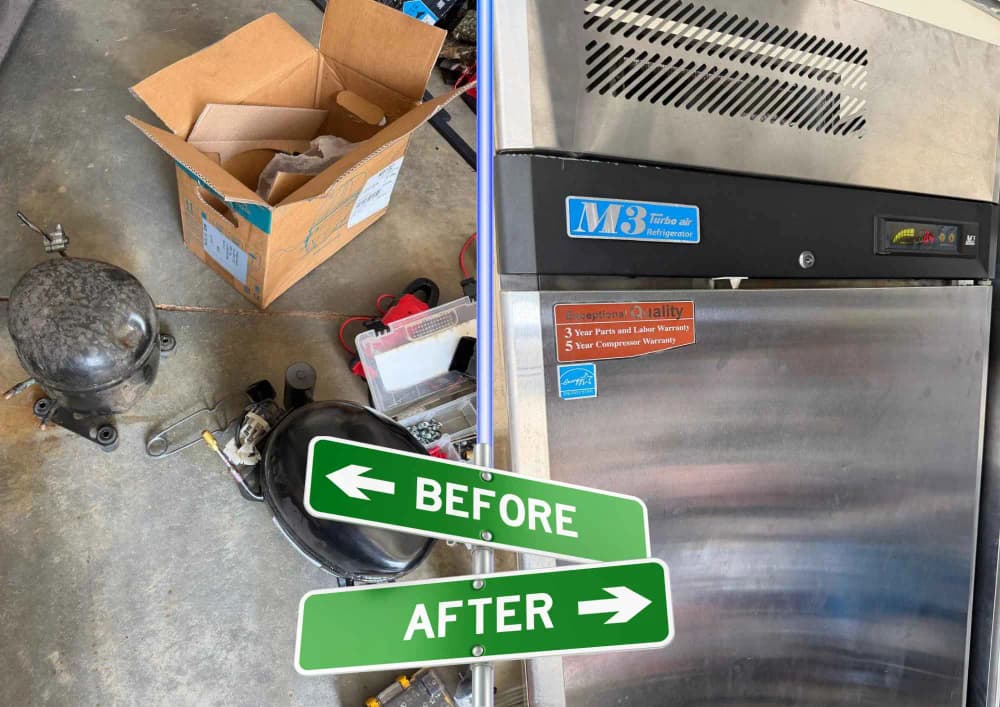
The compressors on the floor in that photo earned their retirement — the windings proved it on a meter before a single part was ordered. That order of operations is the whole difference between commercial refrigeration done right and the "sounds like a compressor" school of quoting. Your equipment gets tested with instruments, the estimate gets written with parts and labor separated, and the old parts are yours to see. On this job the unit was cooling again the same day, with the numbers to show what changed.
From Ybor kitchens to Gulf Coast bars — we know your neighborhood
Commercial refrigeration is local work: alley access, rooftop rules, landlords, rush hours. These are the corridors we serve every week across Hillsborough, Pinellas and Pasco.
SoHo, Hyde Park and Bayshore
S Howard Ave · W Kennedy Blvd · W Swann Ave · W Platt St
The densest bar-and-restaurant strip in South Tampa and our highest-priority commercial ZIP. A warm walk-in on Howard on a Saturday is a revenue event — this corridor gets same-day response first.
Palma Ceia and the Dale Mabry corridor
S Dale Mabry Hwy · W Kennedy Blvd · W Henderson Blvd · W Bay to Bay Blvd
Restaurants, bakeries, groceries and commercial kitchens shoulder to shoulder down Dale Mabry — older boxes working beside brand-new builds, and we service both ends of that spectrum every week.
Gandy and MacDill
W Gandy Blvd · S MacDill Ave · Interbay Blvd · Manhattan Ave
Fast-casual, neighborhood kitchens and retail food south of Euclid. Walk-ins here often live in tight back rooms with starved condensers — airflow is half our job in this ZIP.
Downtown, Water Street and Channelside
Water St · Channelside Dr · Franklin St · E Kennedy Blvd
Hotel kitchens, food halls and event venues with rooftop condensers and real access rules. COIs and after-hours coordination are normal business here, not a surprise.
Ybor City
E 7th Ave · E 8th Ave · N 15th to N 19th St
Historic buildings, tight back-of-house spaces, and walk-ins that work hard seven nights a week. We know the alley access and the landlords' quirks.
Westshore and the airport corridor
N Westshore Blvd · W Kennedy Blvd · W Boy Scout Blvd · W Cypress St
Hotels, corporate cafeterias and chain kitchens with documentation requirements. Written reports and photo invoices come standard.
North Dale Mabry and Carrollwood
N Dale Mabry Hwy
The long commercial spine north of the stadium — restaurants, hotels, grocery and retail food. High-volume boxes with high-volume door traffic; gaskets and door closers earn their keep here.
Seminole Heights and the Fowler corridor
N Florida Ave · N Nebraska Ave · E Hillsborough Ave · E Fowler Ave · Bruce B. Downs Blvd
Independent kitchens and breweries in converted buildings on the Heights side; chain kitchens and campus food service up Fowler. Improvised refrigeration closets deserve better airflow than the architecture gave them — we make it work.
Wesley Chapel and Wiregrass
SR-54 · SR-56 · Bruce B. Downs Blvd · The Grove and KRATE · Shops at Wiregrass
The fastest-growing restaurant market in the region — The Grove, the KRATE container park, the Shops at Wiregrass and every plaza between them. First-generation equipment is hitting its first failures, and we are minutes away.
Dade City
US-301 · 7th St · Meridian Ave · Pasco Ave
Home turf. Downtown cafes on Meridian, groceries and packing houses up US-301 — the shortest response times on this page, and boxes we have known for years.
St. Petersburg and Central Avenue
Central Ave · the Grand Central district
From downtown St. Pete to Grand Central — restaurants, breweries and markets across the bridge get the same same-day standard.
Clearwater and the beaches
Gulf to Bay Blvd · Mandalay Ave
Salt air is a condenser killer — coastal units corrode and clog faster, and we schedule their maintenance accordingly.
Priority commercial ZIP codes for same-day walk-in dispatch: 33606 (SoHo and Hyde Park), 33609 (Kennedy and Dale Mabry), 33611 (Gandy and MacDill), 33602 (Downtown and Water Street), 33605 (Ybor City), 33544 and 33543 (Wesley Chapel and Wiregrass), 33525 and 33523 (Dade City), 33607 (Westshore), 33603 and 33604 (Seminole Heights). Outside these? We still come — these are simply the corridors where the truck already is.
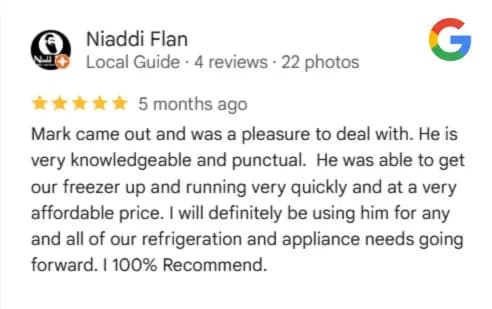
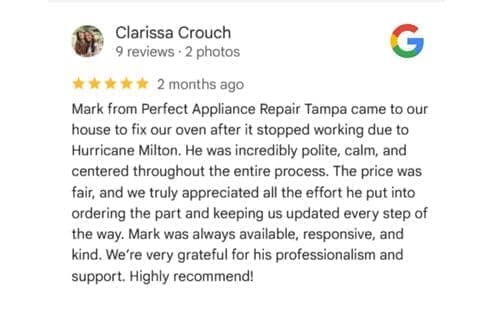
What People Say After Their Freezer Is Cold Again
Real reviews from real Google profiles — the kind of thing we would rather show than say about ourselves. More on the reviews page.
Maintenance plans for kitchens that cannot afford surprises
Every walk-in on this page failed for a reason that an inspection would have caught earlier. Our commercial maintenance plans exist to catch it on schedule instead — with priority when you do need us.
For hard-working kitchens
Four visits a year: condenser cleaning, full Fridge-Safe 7-Point Inspection, gasket and door check, drain service, temperature verification with a written report each visit. Built for high-volume restaurants, bars and grocery.
For lighter duty
Two visits a year with the same checklist — right for offices, cafés, and second locations that run steady but not hard.
Priority when it counts
Priority dispatch ahead of the general queue, discounted labor on repairs between visits, per-location pricing in writing, and service records your inspector, insurer or franchisor will accept. Property managers with multiple locations: ask about master billing.
Plan pricing is per location and goes in writing after we have seen the equipment — every kitchen is different, and honest numbers require eyes on the box.
Who actually built your walk-in — check the name on the door panel
Every walk-in is two machines: the insulated box, and the refrigeration sitting on top of it. The badge on the door panel is usually one of the six below, and the equipment above it says Heatcraft, Bohn, Russell or Larkin, running a Copeland-based condensing unit. We repair both halves — panels, doors, heaters and gaskets on the box; evaporators, condensing units, defrost and controls on the system. Find your badge, then call: the technician who answers has worked on one before.

Kolpak
Walk-in coolers and freezers, modular panel systems, outdoor walk-ins
One of the names we see most on Tampa Bay data plates. Tennessee-built modular panels that hold up well — when a Kolpak fails it is rarely the box itself. It is the door hardware, the heater cable around a freezer door, or the refrigeration up top.

Nor-Lake
Kold Locker walk-ins, coolers and freezers, indoor and outdoor
Wisconsin-built, and the compact Kold Locker boxes are everywhere in c-stores and small kitchens. Typical calls: defrost problems on the packaged refrigeration, door closers, and gaskets chewed up by stocking carts.

Master-Bilt
Walk-in coolers and freezers, modular panels, refrigeration systems
Mississippi-built boxes common in groceries and packing houses around Pasco. Panel seams and floor sections take real abuse in those settings — we reseal, re-gasket and keep the vapor barrier honest so the insulation stays dry.

Amerikooler
Walk-in coolers and freezers — built in Hialeah, Florida
Florida-built, which is why so many Tampa Bay restaurants have one: panels and parts are close, and that shortens repairs. We handle their doors, frame heaters, and the condensing units their boxes usually ship with.

Bally
Custom walk-in boxes, warehouse coolers, blast cells
The heavier end of the trade — custom and industrial boxes, big doors, long panel runs. Bally jobs are usually about doors, heaters and the refrigeration package; the panels themselves are built like a vault.

American Panel
Walk-in coolers and freezers, HurriChill blast chillers — Ocala, Florida
The other Florida builder, up in Ocala. Their walk-ins share kitchens with their blast chillers and we service both: door systems and gaskets on the box side, probes, relays and defrost on the chill side.
Independent service, not a factory network. We repair walk-ins from these manufacturers across Tampa Bay; we do not represent them and we are not their authorized agent. That independence is the point: nobody upstream tells us to quote a replacement when a repair would have done, and the only instruction we follow is to minimize downtime for your business. Do not see your badge? Contact us and send a photo of the data plate to (813) 522-0014 — if it keeps food cold in a Tampa Bay business, we have almost certainly had our hands in one.
Reach-ins, prep tables, ice machines and the rest of your cold line — True, Turbo Air, Beverage-Air, Hoshizaki, Continental, BERG and Marvel — have their own page, with every badge pictured. See all the commercial refrigeration brands we service, or go straight to True, Turbo Air or Hoshizaki repair.
What walk-in repair costs here — and how your business is protected
One number up front, everything else on a written estimate after the diagnosis. No trip fees, no phone guesses, no surprises on the invoice.
Commercial refrigeration repair beyond the walk-in
The walk-in is the heart of the cold side, but a food service operation runs on the whole system — and we diagnose and repair all of it, all makes and models: glass-door merchandisers and display cases, prep tables, under-counter units, reach-ins, and bar equipment, plus commercial ice machines. One technician who already knows your kitchen, one written record across every unit.
The pattern behind our commercial refrigeration services is always the same: fast response, honest diagnosis, and regular maintenance that keeps small findings from becoming product loss. That combination is what actually minimizes downtime — and what keeps the health department visit, the energy costs, and the 2 AM alarm from ever becoming the story of your week. When something does go down, we get you back up and running and put in writing what will keep it that way. Schedule service around your hours, not ours: book online or call (813) 522-0014.
Walk-in cooler and freezer repair questions Tampa Bay businesses ask
Other refrigeration systems we can help with
A walk-in is rarely the only thing holding temperature in your building. Once the technician is on site with gauges out and the truck open, everything else that keeps food cold can be checked on the same visit and written on the same invoice — one trip, one diagnostic, one report. These are the badges we most often find standing a few steps from a walk-in door in Tampa Bay.

True
The reach-in parked beside your walk-in door. Nobody watches it until the day it drifts, and by then it is usually a tired evaporator fan or a hinge that stopped pulling the door shut. Two minutes to check while we are packing the gauges away.
True repair details
Turbo Air
Prep tables and undercounters are where a Turbo Air quietly loses ground in an August kitchen. We take rail temperatures with the same probes we just used inside the box, and tell you which lid gasket is costing you money.
Turbo Air repair details
Beverage-Air
The bar side of the building. Back-bar coolers and milk coolers work all night with a door opening every ninety seconds, so their condensers load up faster than anything else you own. Cheap to check, expensive to ignore.
Bar and back-bar repair
Hoshizaki
If the walk-in went down this week, the ice machine is often next in line — same room, same heat, same water, same condenser nobody has touched. We lift the curtain, look at the scale, and give you an honest read on how long it has left.
Hoshizaki repair details
Continental Refrigerator
Worktops, sandwich units and keg coolers. Honest machinery that pays back a five-minute look: clear the drain, wash the coil, swap one gasket, and it runs another season without asking you for anything.
Prep table repair
BERG
Cafes, churches, c-stores and small independent kitchens. Many current models carry R290, and handling that charge correctly is a technician question rather than a parts question — which is exactly why some shops decline the call.
BERG repair details
Marvel
Front of house, where a warm bottle is something your customer notices before you do. Beverage centers and wine units live inside tight cabinetry, so clearance and condenser access decide the outcome more often than the compressor does.
Undercounter repairAsk us to look at it while we are there: prep tables, glass-door merchandisers, undercounter and worktop units, bar and back-bar equipment, convenience-store coolers, and emergency dispatch when something cannot wait until morning. The full list lives on the commercial refrigeration page.
Perfect Appliance Repair Tampa — Walk-In Cooler and Freezer Repair.
— We Stand Behind Our Work —