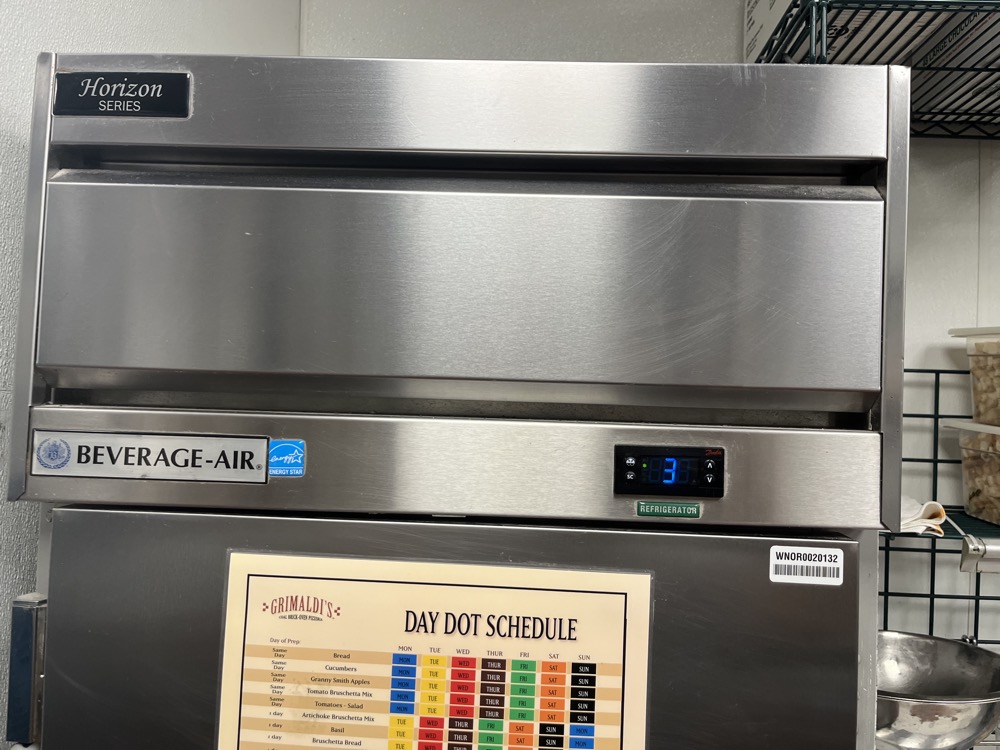
When a prep table runs warm, your line slows down, product temps drift out of safe range, and your kitchen staff feels it fast. In a Tampa Bay commercial kitchen, that doesn't stay a small problem for long — it turns into a food-safety risk and a revenue drain before the shift is over.
If you're searching for prep table repair near me, or you want a technician who actually understands a refrigerated prep table rather than a household fridge, you're in the right place. We diagnose and repair the real fault, explain what failed and why, and get the unit stable again — without guessing and without surprise invoices. Sandwich prep, salad prep table, pizza prep, drawer bases and cold-rail prep stations all get the same treatment: airflow, coils, fans, controls, gaskets, refrigerant and the electrical side checked in order, so you know whether the table can be saved before anyone starts talking to you about repair or replace.
Common prep table problems — pick the one that sounds like yours
These are the exact complaints behind most prep table repair calls in Tampa Bay kitchens. Tap the symptom you are looking at and you will get the same explanation our technician gives on the phone, before anybody opens a panel.
Top rail warm, base is cold
This is the single most common prep table call we get. The base might be cycling fine, but the rail drifts warm — especially during peak hours. The usual suspects are restricted airflow through the rail channels, a failing circulation fan, a miscalibrated temperature sensor, or a partial blockage keeping cold air from reaching the top section. In Tampa kitchens, grease and flour dust build up faster than most operators realize, and that buildup chokes the airflow path between the compressor and the rail. What starts as a 2°F drift in the morning becomes an 8°F problem by the lunch rush. When the rail loses performance, it loses it right where your food sits exposed during service — so it's worth checking airflow, rail temperature, lids, pans, fan operation, coils, and refrigerant before it becomes a full table failure.
Base warm, rail looks okay
When the base compartment can't hold temp but the rail seems borderline acceptable, the problem is usually further upstream — a clogged condenser coil, a failing condenser fan motor, or a compressor struggling under heat load. In a Tampa kitchen where ambient temperatures near the cook line push past 85°F, the condenser has to work significantly harder. If it can't reject heat fast enough, the whole system suffers, and the base compartment shows it first.
Not reaching temp during peak hours
The unit pulls down fine overnight or early morning, then falls behind once the kitchen gets busy. This is a classic capacity-versus-demand problem. Frequent lid opening, high ambient heat, and airflow restrictions expose weak components fast — a marginal fan motor, a partially restricted capillary tube, or a condenser that's 60% blocked with grease. The unit can't recover quickly enough, and temps drift into the danger zone right when you need them most.
Leaking water or puddles on the floor
Water on the kitchen floor is a slip hazard and a health-department concern. Most prep table leaks trace back to a clogged drain line, a cracked or misaligned drain pan, a failed defrost system, overloaded condensation management, or improper drain routing. In Tampa's humidity, condensation problems are amplified — what would be a minor drip in a dry climate becomes a steady puddle here. Don't wait for the inspector to notice it first.
Ice buildup, frost, or fan noise
Frost on the evaporator coil, ice forming around the fan shroud, or a loud humming and grinding from inside the unit usually points to a defrost system failure, a worn fan-motor bearing, a door seal letting humid air infiltrate, or a gasket that's lost its compression. Left alone, ice insulates the evaporator and progressively kills cooling performance until the unit can't function at all.
We service prep tables, sandwich units, pizza prep tables, salad stations, and undercounter cold rails, with same-day service when available.
Fix the cold rail problem — text temp and model tag for a faster diagnosis
Call or text (813) 522-0014Schedule a rush-hour temp diagnosis
(813) 522-0014The 7-Point Prep Table Inspection — walk it with us
This is not a glance at the thermostat and a guess. It is built for what Tampa commercial kitchens actually do to equipment: heat, humidity, grease, flour, high volume and power instability. Every prep table diagnostic includes all seven checks, and we do not leave until we can show you the unit is holding temperature, not just running. Step through them below.
Temperature mapping
We measure rail and base temperatures independently — not just what the controller display claims. A controller can read 36°F while the rail is actually at 48°F. We verify with calibrated instruments and document the real numbers.
Airflow and coil condition
Condenser cleanliness, ventilation clearance, and heat-rejection capacity. In Florida kitchens, a condenser coil can go from clean to more than 50% blocked in 60 to 90 days, depending on the environment. We measure airflow rather than just look at it.
Fans and air channels
Evaporator and condenser fan performance, blade condition, motor amp draw, and obstructions in the air path between the compressor section and the food zone. A fan that's spinning isn't necessarily moving enough air.
Drain and moisture control
Drain-line flow, pan condition, condensation routing, and leak points. Florida humidity makes this a higher priority than in most other states — a slow drain here becomes a puddle fast.
Seals and lids
Gasket compression, lid alignment, hinge condition, and humidity-infiltration points. A worn gasket in a Florida kitchen introduces moisture that turns into frost, which turns into a defrost problem, which turns into a cooling failure.
Electrical stress check
Contactor condition, start-component health, capacitor testing, and signs of power-surge damage. Tampa Bay's lightning activity makes electrical stress a real and recurring risk for commercial refrigeration.
Calibration and verification
Sensor accuracy, cycling behavior, and a final temperature-stability test under simulated load. We confirm the unit is holding temp before we call the job done.
Before you replace the prep table, let's see if it can be saved. Many prep tables get blamed as "bad compressors" when the real issue is restricted airflow, dirty coils, weak fans, worn gaskets, blocked drains, bad controls, or kitchen-heat overload. We test the system first, explain what failed, and give you a clear repair option.
Don't pay for guesswork. Ask for a prep table diagnosis: (813) 522-0014
Six things about prep tables that a general appliance company will get wrong
A prep table is not a small refrigerator with a lid. It is two cooling jobs in one cabinet, sitting in the hottest, greasiest spot in the building, opened a hundred times a shift. Here is what that actually means when something goes wrong — the parts that get people charged twice for the same fault.
A warm rail with a cold base is usually a second refrigeration circuit, not a weak compressor
On most raised-rail tables the pan wells are fed by their own branch — a solenoid, its own expansion valve, and a serpentine wrapped around the rail. The base can hold 36°F all day while that branch is starved. When we see this we stop looking at the compressor and start looking at the branch: a pinched or bent line behind the cabinet, oil logging in a low spot, or a blob of braze narrowing the tube from the day it was built. Replace the thermostat on this one and you will replace it again next month.
A dirty condenser does not only make it warm — it can freeze your lettuce
Everyone knows a blocked coil makes a unit run warm. Fewer people know it can do the opposite. When the condenser cannot reject heat, suction pressure climbs and the unit simply never satisfies, so it runs and runs and the evaporator drags the cabinet below setpoint. If your greens are icing at the bottom of the pans and the unit seems to run non-stop, look at the coil before you touch the controller.
Flour is not dust
Pizza kitchens kill condensers faster than any other line we service, and it is not grease doing it. Airborne flour packs into the fins and then takes on humidity, so it sets like paste instead of blowing out. A grease coil can be washed. A floured coil often has to be combed and chemically cleaned. If you run a pizza line, a washable pre-filter over the condenser intake and a monthly rinse buys years.
The thermostat you keep replacing may not be the problem
Many prep tables sense temperature with a bulb clamped to the evaporator, not hanging in the air. That matters: a restriction or a low charge starves the coil, the coil stays cold, the bulb reads cold, and the unit short-cycles while the food gets warm. It looks exactly like a dead thermostat. Two new thermostats later, the fault is still in the sealed system. We check superheat before we sell you a part.
Never drill a drain hole in the cabinet floor
It is a common shortcut when the factory drain clogs, and it is a bad one. The floor rusts out from the cut edge, the hole opens the food compartment to whatever is under the unit, and a health inspector who spots it can condemn the cabinet. The correct fix is to find the factory cleanout, clear and flush the line, and level the unit — a table that is not level will never drain properly no matter how clean the line is.
The plastic-sheet test, before you pay anyone
Water inside the box has two very different causes: pan condensation dripping off cold surfaces, or the system itself failing and shedding melt. Lay plastic sheeting over the pans at close and check underneath in the morning. Dry under the plastic and wet above it means condensation and airflow. Wet under the plastic means the refrigeration is at fault. Thirty seconds of your time can tell our technician more than an hour of poking.
None of this is guesswork you should pay for twice. Text a photo of the data plate and the controller display to (813) 522-0014 and the technician will tell you on the phone which of these it is most likely to be, before anyone drives out.
The person who answers the phone is the person who opens the panel
No dispatcher, no call centre, no rotating subcontractor. You describe the symptom to the technician who will be standing in front of your line, which is why the triage on the phone is worth something.
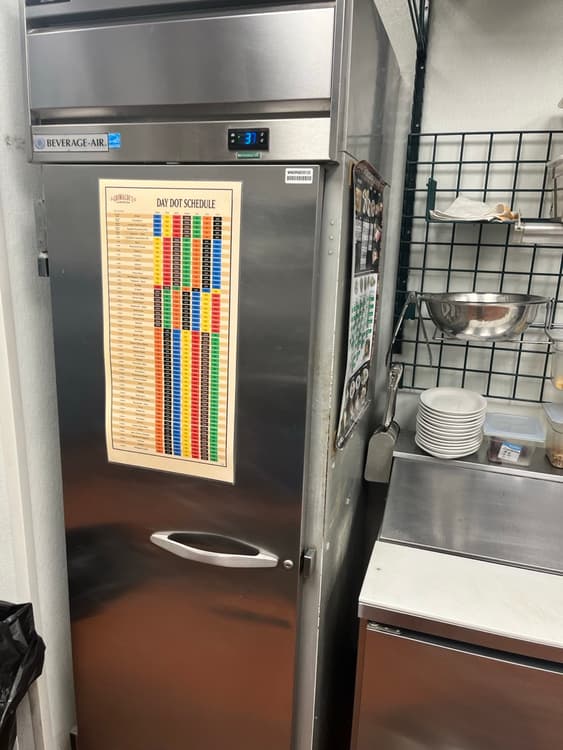

Prep table brands on Tampa Bay make-lines
Find the badge on your table. Each of these behaves differently when it starts to slip, and knowing which one you have changes what the technician puts on the truck before he leaves.

True
TSSU sandwich and salad units, TPP pizza prep
The cabinets outlast the decks, which is why so many Tampa kitchens are running twenty-year-old True tables. The service story is nearly always hardware and airflow: hinges that stopped pulling lids down, a rail gasket flattened by pan traffic, and an evaporator hidden behind a cover held on by plastic thumb screws that defeats half the technicians who open it.
True repair details
Turbo Air
MST sandwich prep, TPR pizza prep, chef bases
The most common prep table on independent lines here. The self-cleaning condenser genuinely helps, but it is not a substitute for a real cleaning in a grease-and-flour kitchen. Watch for the unit that suddenly runs colder rather than warmer once summer starts — on this brand that pattern usually points at the controller, not the compressor.
Turbo Air repair details
Beverage-Air
Elite sandwich and salad prep, chef bases
A long-serving name on the American cook line. The complaint we hear most on these is the unit that sits at 41 to 45°F and ices up at the same time — which is not a borderline unit, it is a unit already failing. Usually the condenser first, then the condenser fan, then a frosted evaporator, in that order.
Bar and back-bar repair
Continental Refrigerator
Sandwich, salad and pizza prep, worktops
Philadelphia-built, heavy stainless, and refreshingly plain underneath. Operators who have run both often say these hold up better than the price suggests. For us that plainness means access: fewer proprietary panels, fewer surprises, and a much better chance the cabinet stays and one component leaves.
Prep tables we service
Hoshizaki
Steelheart prep tables and worktops
Better known here for ice, but the Steelheart prep line turns up in newer builds and it is solid equipment. Because the same kitchens usually run a Hoshizaki ice machine too, we generally end up checking both on one visit — the water and the heat that punish one are punishing the other.
Hoshizaki repair detailsValue lines too, and without the sales pitch. Atosa, Avantco, Arctic Air, Randell, Traulsen, Delfield, Migali, Everest and Omcan fill a lot of Tampa kitchens, and we service all of them. The honest note on the cheaper end: they are not built worse so much as built with less margin for a dirty coil, so in a Florida kitchen the maintenance schedule is doing more of the work. We are independent, so nobody upstream benefits from us telling you to replace instead of repair.
Preventive maintenance that actually prevents repeat calls
Most emergency prep table repairs started as small warning signs weeks or months earlier. Our maintenance approach targets the specific failure patterns we see most in Tampa Bay commercial kitchens. After every repair, we tell you exactly what prevents the majority of repeat breakdowns: a coil-cleaning schedule based on your specific kitchen environment rather than a generic manual recommendation, where the unit should sit for proper airflow and heat rejection, how to reduce rail-temp drift during peak service with simple operational adjustments, which early symptoms mean call now versus monitor this week, and how to extend the life of gaskets, fan motors, and drain systems with daily habits that take less than two minutes. This isn't upselling — it's the difference between one service call and three.
Pricing: realistic ranges after diagnosis
We don't do blind quotes over the phone, because too many failures look identical from the outside but have different root causes and different costs. These are realistic ranges after a proper diagnosis. You get a written estimate before any repair begins, and the $129 diagnostic is applied toward the repair if you approve — no hidden fees, no shop-supplies charge, no surprises.
Real service cases from Tampa Bay kitchens
Atosa prep table — rail warm during lunch rush (Tampa)
A restaurant owner noticed the top rail drifting to 48°F during lunch while the base stayed cold, and staff were pulling product early to compensate, slowing the line. The 7-point inspection found the condenser coil 60% blocked with grease and flour dust, plus a rail circulation fan drawing low amps — early-stage bearing failure. Together they were choking airflow to the rail under load. We cleaned the coil, restored the airflow path, replaced the fan motor, recalibrated the sensor, and verified performance for 30 minutes under simulated peak load. Rail temps held at 36°F through a full dinner service, and the owner got a maintenance schedule built around the kitchen layout and cooking volume.
Arctic Air prep table — leaking water (South Tampa)
A puddle kept forming near the base, sometimes reaching the walkway, with intermittent temperature swings, and staff were worried about an upcoming health inspection. The drain line was clogged from Florida humidity plus food-debris buildup, causing condensation to back up. A secondary issue: a door gasket losing compression on one side, letting humid air in and overloading the condensation system. We cleared and flushed the drain, corrected the routing, replaced the gasket, checked the full moisture path, and verified temperatures. No more water accumulation, stable temps, and the unit passed the following week's health inspection without comment.
Randell prep table — won't reach temperature (Wesley Chapel)
The unit was pulling down very slowly, running almost continuously, and never reaching setpoint during business hours; overnight it barely made temp before morning prep. An electrical stress test found a weak start capacitor and a contactor showing pitting — consistent with a recent surge during a Tampa Bay afternoon storm. The compressor was mechanically healthy but couldn't start efficiently, which drove long run times and poor cooling. We replaced the start capacitor and contactor, ran a full electrical stress verification, and monitored temperature stability over a two-hour observed period. Normal pull-down times returned on the first cycle, and we advised the owner on surge protection for the kitchen's refrigeration circuit to prevent a repeat.
Your prep table is part of production, not just storage
For pizza shops, sandwich lines, salad stations, and busy kitchens: your prep table is part of production, not just storage. When it runs warm, the cook slows down, pans get shuffled around, food safety gets risky, and the shift turns stressful fast. We help Tampa Bay kitchens get the line cold and predictable again. Your food and your kitchen staff are counting on that unit — let's fix it right.
Get my prep line back to normal temp. Call now: (813) 522-0014
Frequently asked questions
Prep table repair near you — the lines we already know
We repair sandwich prep tables, pizza prep tables, salad stations, refrigerated chef bases and cold rails for restaurants, cafés, delis, food trucks, churches and commercial kitchens across Hillsborough, Pinellas and Pasco. These are the corridors we are in every week.
SoHo, Hyde Park and Bayshore
S Howard Ave · W Kennedy Blvd · W Swann Ave
Brunch lines and bar kitchens running two-door sandwich units flat out from eleven to three. A rail that drifts here is not a slow problem — it shows up in ticket times before it shows up on a thermometer.
Palma Ceia and Dale Mabry
S Dale Mabry Hwy · W Henderson Blvd · W Bay to Bay Blvd
Delis, bakeries and family kitchens where the prep table often sits against a wall with barely any clearance behind it. Half our calls on this stretch are solved by giving the condenser room to breathe.
Ybor City
E 7th Ave · E 8th Ave · N 15th to N 19th St
Old buildings, hot back-of-house, and pizza lines that put flour into every coil in the room. We come to Ybor expecting a blinded condenser and we are usually right.
Downtown, Water Street and Channelside
Water St · Channelside Dr · E Kennedy Blvd
Hotel pantries, food halls and event kitchens where the make-line has to hold temperature through a banquet push. Written temperature verification is standard here because somebody upstairs always asks for it.
Gandy and MacDill
W Gandy Blvd · S MacDill Ave · Interbay Blvd
Fast-casual and neighborhood kitchens with tight back rooms. Value-line tables work hardest in this ZIP, and they are the least forgiving of a dirty coil in August.
Westshore and the airport corridor
N Westshore Blvd · W Cypress St · W Boy Scout Blvd
Corporate cafeterias and hotel kitchens on documentation schedules. Photo invoices and logged final temperatures come standard, not on request.
Seminole Heights and Fowler
N Florida Ave · N Nebraska Ave · E Fowler Ave · Bruce B. Downs Blvd
Independent kitchens in converted buildings and campus food service up Fowler. Improvised line layouts mean the prep table is often in the worst possible spot for airflow, and that is fixable.
Wesley Chapel and Wiregrass
SR-54 · SR-56 · The Grove · Shops at Wiregrass
The fastest-growing restaurant market in the region. Newer equipment, first failures, and short drive times from our base — this is where we get there quickest.
Dade City and Zephyrhills
US-301 · 7th St · Meridian Ave · Gall Blvd
Home turf. Small-town delis, pizza shops and c-store kitchens where one prep table is the whole cold line and there is no second unit to move product into.
City pages with more detail: Tampa, South Tampa, Ybor City, Wesley Chapel, Zephyrhills, Dade City. Outside our usual service area? Call or text (813) 522-0014 and we will confirm coverage honestly rather than book a trip we cannot make on time. Same-day emergency service is dispatched across the whole service area when you call before 2 PM.
We also service the rest of your cold storage — glass-door merchandisers, undercounter units, reach-ins and drawer bases, and walk-in cooler repair for the box out back. Need us today? Commercial emergency service is dispatched same-day when you call before 2 PM. See our commercial refrigeration repair page for the full range. Residential unit? See our refrigerator repair page.
Perfect Appliance Repair Tampa — Prep Table Repair. Call or text (813) 522-0014.
— We Stand Behind Our Work —