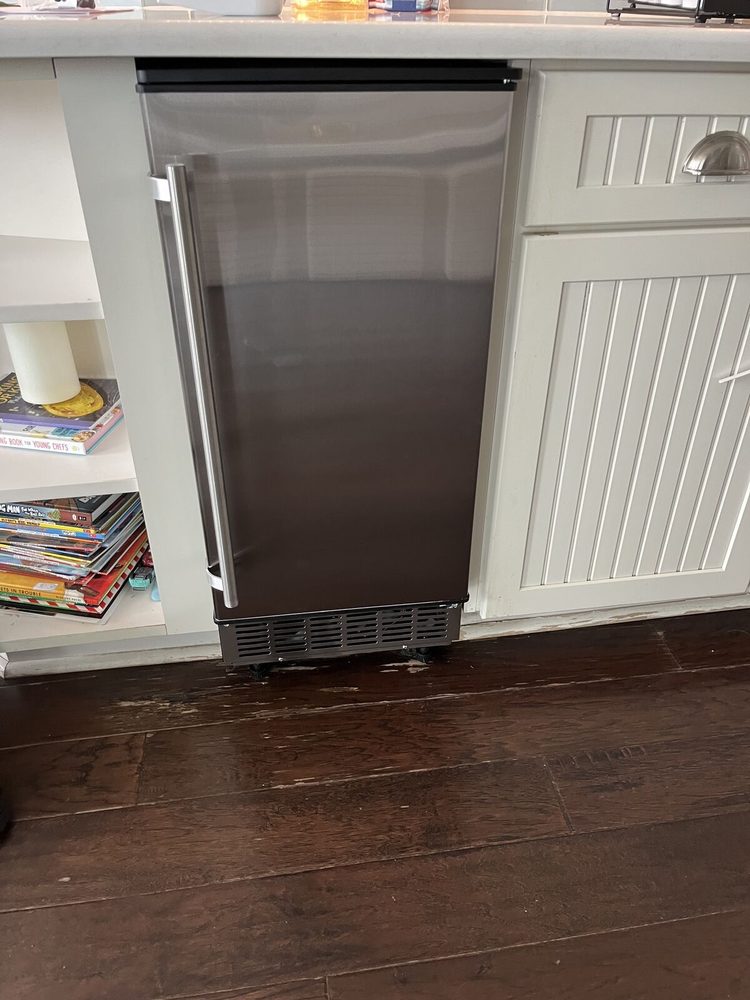
In Tampa Bay, an ice maker problem is rarely just an ice maker problem. Often it's the first warning sign that your freezer or refrigerator temperatures aren't where they should be. That means warm drinks, bags of store ice, water on the floor, a frozen-over ice room, and a freezer that never feels quite right.
It's frustrating, which is exactly why we don't guess and we don't just swap parts to see what happens. We diagnose the full system first, explain what failed in plain language, then fix the real problem. Florida heat makes weak ice makers, poor airflow, clogged drains, bad sensors, and freezer-temperature problems show up fast, especially through the Tampa Bay summer from June to August.
Pick your brand — see what actually fails and how we fix it
Ice makers don't fail randomly. Each brand has its own known weak points — the Samsung ice room that freezes into a block, the Whirlpool sensor that decides the bin is permanently full, the LG that pours water all day but never makes a cube. Pick your brand and read what we find on real Tampa Bay service calls, what owners usually try first, and what actually fixes it. These are the ice maker brands we service most across the Tampa Bay metro area.
Where we see it: RF23, RF28, RF260, RF263 French-door families and their in-door ice room
The ice room freezes into a solid block
The best-known ice maker problem in America, and the one we see most in Tampa Bay. On these French-door models the ice maker lives in a small compartment inside the fresh-food section. Humid air works its way in through the panel seams behind the ice room and around the refrigerant-line openings, condenses on the coldest surfaces, and freezes — first slush in the bucket, then a bucket you can't pull out, then a solid block with the auger buried inside. Florida humidity speeds the whole cycle up: what takes a Michigan kitchen a season takes a South Tampa kitchen a month.
Slushy, wet cubes and water under the crisper drawers
Same root cause at an earlier stage. The tiny drain that carries defrost water away from the ice room clogs or freezes, melt-water has nowhere to go, and it either refreezes in the bucket or runs down inside the cabinet and pools under the crisper trays.
Grinding or buzzing from behind the ice room
Frost reaching the little circulation fan behind the panel. The blades physically shave ice on every rotation. Left alone, the fan motor fails and the ice maker loses its cold-air supply entirely.
The hair-dryer defrost. It works — for four to six weeks. You melt the symptom, the seams that let humid air in are still open, and the block comes back. Some owners repeat this monthly for years.
We run the built-in forced-defrost mode instead of a hair dryer, clear the drain properly and fit a drain-strap extension so melt-water actually leaves, then do the part that makes the repair hold: sealing the ice-room panel seams and line penetrations the way Samsung's own service bulletins describe, and checking the compartment sensor against spec. Sealed correctly, the repair lasts — owners who only defrost are back in a month; ours generally aren't.
Where we see it: WRX735, WRF992 and related French-door models; side-by-sides with in-door ice
Ice maker just stopped — and the cause is inside the door hinge
On French-door models with the ice maker in the freezer door, the wiring harness flexes at the hinge every time the door opens. The copper fatigues and snaps inside insulation that still looks perfect, so the break is invisible. Power to the ice maker becomes intermittent, then gone. We find these by flexing the harness under a meter, not by guessing.
Side-by-side stops harvesting; the status light blinks
The in-door ice system reads the bin level with an infrared beam across the chute — an emitter on one side, a receiver on the other. When the optics boards fail or ice-dust films them over, the control believes the bin is permanently full and politely stops making ice. The boards are condemned far more often than they deserve: a frozen fill tube or a freezer sitting above spec produces the same "no ice" complaint.
Thimble-size or hollow cubes
A tired dual water-inlet valve, or supply pressure below the roughly 20 psi the valve needs to seat and flow properly. The valve meters water by time, not volume — weak flow means a short fill every single cycle.
Replacing the whole ice maker assembly. It's the most-sold "fix" online, and when the real fault is the hinge harness, the optics, or the valve, the brand-new assembly does exactly what the old one did: nothing.
We run the control's service diagnostics to read what the machine itself thinks (there is a specific test that reports bin-level status), verify supply voltage at the optics with a meter, check valve coils and true water pressure, and repair hinge harnesses with proper splices and a slack loop so the same wire doesn't snap again next year.
Where we see it: KRMF and KRFF French-doors; KUIX undercounter ice machines
French-door and side-by-side models
KitchenAid refrigerators are built on the Whirlpool platform, so everything in the Whirlpool panel applies here — the in-door optics system, the hinge-harness fatigue, the same valve. The badge is different; the ice maker is not.
Undercounter clear-ice machines sheeting less and less ice
The KUIX-type undercounter machines make ice by running water over a refrigerated plate, and Tampa Bay's hard water is their natural enemy. Scale builds on the evaporator plate and the water distributor, the sheet gets thinner every month, and eventually the cutting grid or the pump gives out. These machines are repairable and worth repairing — but they need cleaning on a schedule, not once a decade.
Running a single vinegar clean through a heavily scaled machine and expecting full output back. One clean removes surface scale; a plate that's been building deposits for five years needs a proper service.
Full descale of the water circuit, distributor and plate, pump and float check, grid inspection, and a cleaning schedule matched to your actual water hardness so output stays at spec.
Where we see it: Maytag MFI/MSS series; Kenmore-badged units built by Whirlpool
Same platform, same faults
Maytag is a Whirlpool brand, and a large share of Kenmore refrigerators were built by Whirlpool too — the model number's prefix gives it away. So the classic failures are the ones from the Whirlpool panel: optics boards on side-by-sides, hinge harnesses on French-doors, and the dual inlet valve. Parts interchange more often than owners expect, which keeps repairs affordable.
Older freezer-top ice makers that quietly retire
On 10-to-20-year-old units the classic mold-style ice maker head simply wears out — the mold thermostat stops calling for harvest, or the ejector motor stalls. One part, one visit, and a machine from 2010 makes ice like new. These are some of the most satisfying repairs we do.
Assuming an old fridge with a dead ice maker needs replacing. The head unit is a standard, available part on most of these.
Identify the actual builder from the model prefix, test the head, valve and thermostat in sequence, and fit the correct interchange part — not whatever a parts site's "compatible" list suggests.
Where we see it: LFXS, LFXC, LMXS French-doors; InstaView with Craft Ice
Water dispenser works fine — ice maker never fills
The single most misdiagnosed LG ice complaint. These refrigerators use two water valves: a primary at the back of the cabinet and a secondary valve that feeds only the ice maker. When the secondary fails, the dispenser keeps pouring perfect glasses of water while the ice tray stays bone dry. Owners replace filters and reset boards for weeks because "the water obviously works."
The ice compartment frosts up and the fan goes loud
LG's in-door ice room has its own little evaporator fan. Frost from humid Tampa air blocks it, the compartment warms above the roughly 10°F it needs, and production crawls. On InstaView models the Craft Ice sphere maker is even more temperature-sensitive — it wants the freezer near -4°F before it will produce its three spheres a day properly.
Door-hinge wiring fatigue
Same disease as Whirlpool: the harness through the door hinge flexes thousands of times a year and eventually a conductor snaps invisibly. Intermittent ice maker, intermittent dispenser lights, everything tests fine on a still door.
Filter changes and control resets for a fault that is hydraulic or electrical. If the dispenser pours but the ice maker never fills, no filter on Earth fixes that.
We meter both valve coils against spec, check the fill circuit end to end, defrost and inspect the compartment fan, and flex-test the hinge harness. If yours is also clicking or running warm, that's a different LG problem — see our LG compressor page.
Where we see it: GNE and PFE French-doors; Café; Opal countertop nugget makers
Refrigerator ice makers: fill tubes and tired augers
GE's fridge ice makers fail in the classic ways — a frozen fill tube after a door has been left ajar in August, an inlet valve losing its seat, a dispenser auger motor that hums but won't turn. Solid, diagnosable, repairable machines.
Opal nugget makers: the screech of scale
The Opal makes its famous chewable nuggets by extruding ice with an auger — continuously. On Tampa Bay tap water, mineral scale coats that auger fast, and the first symptom is a loud screeching during production. GE's own guidance is a descale as often as weekly on hard tap water. Skip it for a few months and the auger stalls.
Opal says "Add Water" while the tank is full
The circulation pump is running dry or worn, the flow sensor isn't seeing movement, or a descale left an airlock in the loop. Sometimes a proper prime clears it. When the pump itself is gone, honesty matters: GE doesn't sell the internal parts, and the realistic path is an exchange through GE — we'll tell you that at diagnosis rather than charge you to learn it.
Descaling an Opal that's already screeching daily and hoping the damage undoes itself, or repeatedly re-priming a pump that's worn out.
For refrigerators: standard valve, fill and auger diagnosis with proper parts. For Opals: descale, prime, and a straight answer about whether yours is fixable — plus the maintenance schedule that keeps the replacement alive.
Where we see it: Gallery and Professional French-doors and side-by-sides
The fill tube freezes shut — and the freezer is somehow too cold
A worn door gasket lets humid air in, the compressor runs overtime to compensate, the freezer drops well below zero, and the water fill tube ices over at the coldest point. Result: no water reaches the tray, and the harder the fridge works, the worse it gets. Thawing the tube without fixing the gasket is a two-week repair.
Ice maker and dispenser die together
A failed freezer door switch takes both out at once — the control thinks the door never closes. It's an inexpensive switch that gets misdiagnosed as a control board.
Brittle trays and tired heads
On older Gallery units the tray plastic goes brittle and cracks, and the mold thermostat inside the ice maker head stops calling for harvest. Both are head-unit repairs, not reasons to shop for a refrigerator.
Chipping the fill tube clear with a screwdriver — which usually punctures the tube or the heater around it.
Thaw the tube properly, find and fix the air leak that froze it, verify the door switch and valve, and replace the head unit when the thermostat inside it has failed.
Where we see it: Built-in refrigerator ice makers; UC-15 undercounter ice machines
UC-15 making shallow, white, incomplete cubes
The undercounter Sub-Zero sprays water up onto a freezing plate through small nozzles. Tampa Bay mineral content scales those nozzles down to pinholes — the spray weakens, cubes come out shallow and cloudy-white, and harvests shrink. The machine also genuinely cares about water pressure: it wants 20 to 80 psi, and homes on wells or RO systems often sit below that.
"The ice melts in the bin — it must be broken"
The most common false alarm we get on these. The UC-15 storage bin is not refrigerated by design; ice melts slowly in it, and the machine replaces it. Melting ice is the machine working. No ice at all is the service call.
Built-in refrigerator ice makers
Integrated into the refrigeration system with model-specific water valves — they call for the exact OEM part and a careful hand. A generic kit that "fits" a Sub-Zero usually leaks or underproduces, and on an appliance at this level that's an expensive shortcut. We are independent specialists: we service Sub-Zero, we are not Sub-Zero, Inc.
Running store-bought cleaner through a scaled UC-15 once and calling it done, or bin-thermometer panic about melting ice that's actually normal.
Full clean cycle with proper ice-machine cleaner, nozzle and distributor descale, condenser cleaning (these want it every six months in Florida), true pressure measurement at the machine, and OEM parts on the built-ins.
Where we see it: Bosch 800-series French-doors; Thermador, Fisher & Paykel, U-Line, Scotsman
Bosch French-doors
Less failure-prone than the big American platforms, and when they do stop it's usually the familiar trio — inlet valve, frozen fill line, or a control fault after a Florida power event. The parts are dealer-channel, which is where an independent shop with proper accounts earns its keep.
U-Line, Scotsman and other undercounter machines
Same physics as the Sub-Zero UC-15: scale, pressure, condensers. We service these across Tampa Bay's outdoor kitchens and bars, where salt air and heat shorten every service interval.
Waiting. Undercounter machines that have stopped making ice do not heal.
Brand-correct diagnosis, dealer-channel parts where needed, and honest advice when a countertop portable isn't worth the labor a repair would cost.
Don't see your brand, or not sure who really built your refrigerator? Text a photo of the data plate — the sticker inside the fresh-food compartment — to (813) 522-0014 and we'll tell you what you're dealing with before we ever come out.
Start from the symptom — what it usually means
The eight most common ice maker problems, the likely causes for each in the order we actually find them, one safe check you can do yourself, and what we do about it on the visit — with same-day service when you call before 2 PM.
No ice at all
The bin is empty and stays empty. No fill sound, no harvest thump.
Ranked by how often we actually find them: a frozen fill tube (humid Florida air freezing at the water-entry point); a failed water inlet valve or — on LG — the secondary door valve; a broken wire in the door-hinge harness (Whirlpool, KitchenAid, LG French-doors); the ice maker module or motor itself; or a freezer running too warm to trigger a cycle at all.
Confirm the ice maker is switched on, then open the freezer and listen after 10 minutes for a fill. Check the freezer reads 0 to 5°F with a separate thermometer, not the display.
We test the chain in order — supply, valve coils, fill tube, harness under flex, module — and show you the failed link before replacing anything.
Slow production, small or hollow cubes
Ice comes, but half as much as last summer, and the cubes are shells that shatter in the glass.
The ice maker isn't getting its full measure of water each fill. A clogged filter, a faulty water inlet valve, mineral scale in the valve screen, or supply pressure under roughly 20 psi. Hollow cubes are the earliest, cheapest warning the system gives you — a partially failing valve usually finishes failing within weeks, and its next trick is dripping into the housing and freezing there.
If the filter is past six months old, replace it first — in Tampa Bay water that alone fixes a surprising share of slow-ice complaints.
We measure actual flow and pressure at the valve, not guess from cube shape, and replace only what measures out of spec.
Frozen over — slush, stuck bucket, solid block
The ice bucket won't pull out, cubes weld together, or the whole ice room is one block.
Humid air is getting where it shouldn't: Samsung ice-room seam leaks are the textbook case, but worn door gaskets, a blocked defrost drain, or a door left ajar overnight do it on every brand. The ice is the symptom. The air path is the disease.
Run the dollar-bill test around the freezer gasket — if the bill slides out anywhere, there's your moisture pump. Look for slush starting before blocks form.
Proper defrost (forced-defrost mode, not a hair dryer), drain cleared and extended if needed, and the air path sealed so it doesn't come back in a month.
Leaking water
Pooling under or in front of the fridge, water inside under the crispers, or drips from the ice chute.
An inlet valve that no longer closes fully between cycles, a split or frozen-then-cracked fill line, an overflowing tray from a stuck valve, or a blocked defrost drain sending melt-water down inside the cabinet. Slow appliance leaks ruin more Tampa Bay flooring than burst pipes do — the water goes under the fridge where nobody looks.
Shut the ice maker off and, if you can reach it, close the saddle valve on the supply line. Put a towel down and take a photo of where the water appears — it helps us trace the path.
We pressure-test the fill circuit, trace the leak to its actual source, and fix the cause — not just mop and tighten a fitting.
Ice tastes bad, smells, or looks dirty
Cubes taste like the freezer, smell musty, or carry white or dark flecks.
A spent water filter, stale ice absorbing food odors, mineral scale flaking off the tray or — in undercounter machines — off the evaporator plate, or (rarely) mold in the bin or supply line where a machine sat unused. White flecks are calcium: harmless to you, hard on the machine that made them.
Dump the bin, wash it with warm soapy water, replace the filter, and let the machine refill twice. If the taste survives that, the problem is upstream.
We sanitize the bin and lines, descale where scale is the culprit, and check whether your filter schedule matches your actual water — well water in Pasco County needs shorter intervals than the box says.
Grinding, buzzing, or clicking
New mechanical noise from the ice maker or the wall behind it — shaving, scraping, or a rhythmic buzz.
A circulation fan shaving frost (the shaving sound), an auger motor straining against welded-together cubes, a scaled auger screeching in a nugget machine, or an inlet valve buzzing because pressure is too low for it to seat. Each noise points somewhere different, which makes this one of the more diagnosable complaints — if you hear it before it stops making the sound.
Note when it happens: during fill (valve), during harvest (motor/auger), or constantly (fan). A ten-second phone video with sound genuinely helps.
We reproduce the noise, isolate it, and fix the cause plus whatever internal components the noise was chewing through.
Ice exists — the dispenser won't give it to you
Bin is full, chute does nothing, or the paddle clicks without delivery.
A dead auger motor, cubes fused into a bridge above the auger (common after vacations — ice sublimates and welds), a failed chute-flap solenoid, or on Frigidaire a door switch that kills the dispenser and ice maker together.
Empty the bin and break up any fused mass. If loose fresh cubes still won't dispense, it's mechanical or electrical, not the ice.
Motor, solenoid, switch, and control tested in sequence — dispenser trains are quick, satisfying repairs when diagnosed rather than parts-swapped.
It fills — then never drops the ice
You hear water fill, cubes freeze in the tray, and there they sit.
The harvest side has failed: a mold thermostat that never signals "frozen", a stalled ejector motor, a failed tray-twist mechanism, or a compartment that isn't cold enough for the thermostat to ever reach its trip point (they typically want the mold near 9-15°F before harvest).
Verify freezer temperature first — a warm freezer mimics a dead ice maker perfectly. Then look for cubes actually frozen solid in the tray versus half-liquid.
We test the thermostat and motor directly, and on older units replace the head as one part — which is usually cheaper than the two visits a piecemeal approach costs.
The ice in your bin is a report card. Here's how to read it.
Before an ice maker fails completely, the ice itself changes — size, shape, clarity, taste. Technicians read cubes the way mechanics listen to engines. Tap what yours looks like.
Hollow shells
What you see: Cubes look normal, crush like eggshells, float instantly.
Short fills — the tray gets less water than a full cycle needs, freezes from the outside in, and the middle never fills. Valve, filter, or pressure. Early-stage and cheap to fix; ignored, it graduates to no ice at all.
Mini cubes
What you see: Perfectly formed, half the size they used to be.
Same family as hollow shells: metered fill time is normal but flow is restricted. In Tampa Bay the filter and the valve screen are the usual suspects — both are scale magnets on our water.
Cloudy centers
What you see: White, foggy middles; clear edges.
Usually nothing. Dissolved air and minerals concentrate toward the center as water freezes from the outside — restaurant machines make clear ice by freezing in layers, home trays can't. Only worth attention if cubes were clear for years and turned cloudy suddenly, which points at the filter.
White flecks in the glass
What you see: Little white particles floating in your drink.
Calcium and magnesium scale flaking off the tray or plate. Harmless in the glass, corrosive to the machine: the same scale is coating the valve, the fill tube, and — on undercounter machines — the evaporator plate. It's a maintenance flag, not a health scare.
Cubes welded together
What you see: One archaeological mass in the bin.
Either low use (ice slowly sublimates and re-freezes into a block — normal if you barely use ice) or the bin is warming between cycles: a defrost problem, a worn gasket, or a door left ajar. If you use ice daily and still get blocks, the freezer is telling on itself.
Ice melting in an undercounter bin
What you see: The Sub-Zero or U-Line bin never seems full; ice slowly disappears.
On most undercounter ice machines the storage bin is not refrigerated — by design. The machine makes ice faster than it melts. Slow melting is normal operation; a machine that stops replacing what melts is the actual service call.
Is this ice maker worth fixing? Run the honest math.
Pick what you have, how old it is, and what's wrong. This weighs the repair against replacement and gives you the same recommendation we'd give at your kitchen counter. Pricing here is simple: the diagnostic is $69, it's 100% applied to your repair if you approve the work, and every repair is priced on a written estimate after the diagnosis — never before.
Your recommendation appears here.
One part, one visit — and a quiet kitchen makes ice again
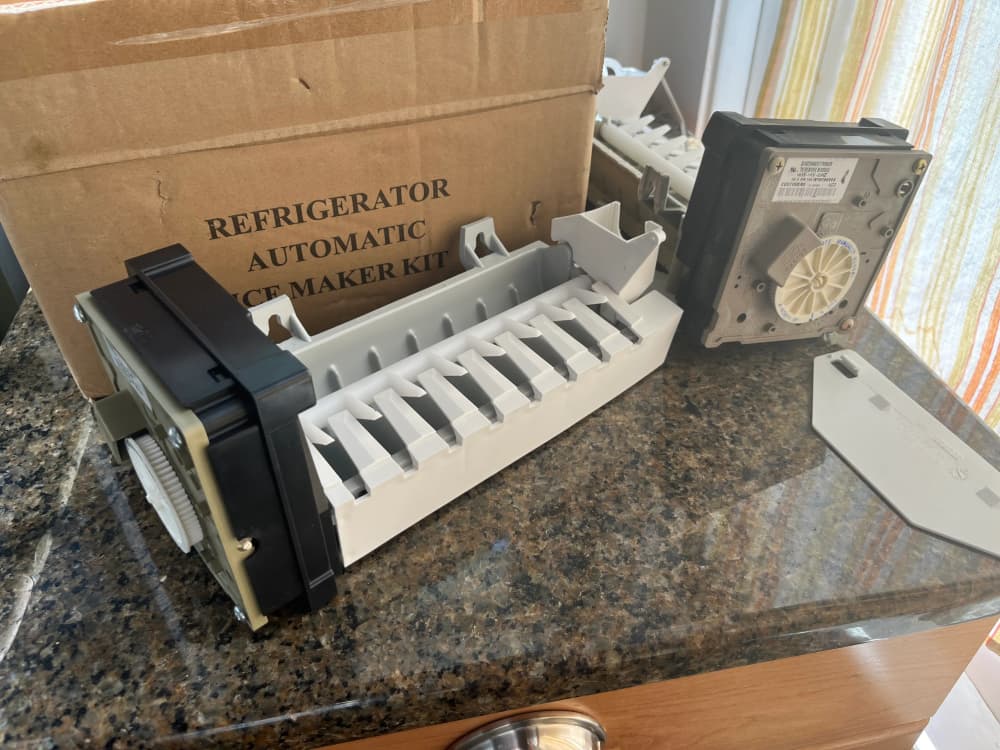
This is what most ice maker repairs actually look like: a new head unit on the customer's counter, still smelling of the box, about to replace one that spent a decade earning its retirement. On the classic freezer-mount design used by Whirlpool, Maytag, Kenmore, GE and Frigidaire for years, the whole ice maker is one serviceable part — the mold, the thermostat, the ejector motor, all in one housing. When it wears out, we fit the correct interchange unit, verify the fill and the first harvest before we leave, and the refrigerator goes back to doing its job like nothing happened.
No drama, no "time for a new fridge" speech. The $69 diagnostic tells us which part it is, and it's 100% applied to your repair if you approve the work.
Our 7-point Florida ice maker inspection
Florida's heat, humidity, and power surges make ice makers work harder than almost anywhere else, and small issues turn into big failures fast. Every ice maker diagnostic runs through the failures we see most in Tampa Bay.
Water supply and pressure
Confirming line flow, supply-valve operation, and adequate pressure for a proper fill.
Filter and fill system
Checking for restriction, housing issues, and fill-tube freezing.
Air-leak assessment
Ice room's door seals, gaskets, and cabinet leaks — the single biggest cause of frost buildup in Florida humidity.
Freezer temperature and airflow
Checking for blocked vents, fan operation, and circulation patterns.
Electrical and control check
Ice maker module, water-inlet-valve solenoid, and control-board signals, since Florida power surges damage these.
Defrost system
Heater, thermostat, and timer or board — because that's what keeps the frozen-over problem from coming back.
Leak source
We trace any leak through the water lines, fittings, drain line, and housing to stop water damage before it spreads.
Then you get a clear explanation and a written estimate before any repair — no pressure, no guessing.
A word on what the electrical half of that inspection really covers, because this is where guesswork gets expensive. The control module runs the harvest cycle on a timing and temperature logic, and it reads the mold through a thermostat or, on newer boards, a thermistor. When an ice maker stops producing ice, any of those three can be the reason — and so can a clogged water line that has nothing to do with electronics at all. We test them in order and flush debris out of the line before a single part goes on the estimate, because fitting a new ice maker onto a starved water line just moves the complaint to next month. And when the real story turns out to be the refrigeration side — an evaporator icing over, low refrigerant, weak water flow from a kinked supply — we say so, since that's a refrigerator repair, not an ice maker part.
On the paperwork side: the estimate is written and flat-rate — the number you approve is the number you pay, with parts and labor listed separately. Every repair leaves with a 90-day labor warranty, and it's a real one: if the same problem comes back inside the window, there's no second diagnostic fee and no "that's a different problem." Business hours are Monday through Saturday, 8 AM to 6 PM, and the same visit can head off future repairs — a filter schedule matched to your water, a calcium check on undercounter units, and a look at the door gaskets that quietly cause half the ice production problems in this climate.
A few quick checks you can do now
No pressure — here are a few safe checks that can save you time and money before you call.
- Make sure the ice maker is switched on, which trips people up more than you'd think.
- Replace the water filter if it's overdue.
- Check the freezer temperature, because ice makers need roughly 0°F to make ice properly.
- Look for obvious ice blockage around the fill area.
- Listen for the water fill cycle, which you should hear every few hours.
If you're dealing with leaking, repeated freeze-over, or no water filling, it's time for a professional diagnostic. Guessing there tends to lead to wasted money and repeated breakdowns.
What we actually fix
Depending on what the diagnosis turns up, common repairs include:
- Replacing the water inlet valve — the most frequent cause of no ice or slow production.
- Clearing a frozen fill tube and addressing the airflow cause behind it.
- Replacing the ice maker assembly or module when the motor, thermostat, or ejector arm fails.
- Correcting the defrost and airflow issues behind Samsung freeze-overs.
- Repairing leaks in water lines, fittings, connections, and cracked housings.
- Fixing dispenser and auger problems where the ice maker works but won't dispense.
- Replacing door seals and gaskets to keep humidity out of the cabinet.
Pricing: realistic ranges after the $69 diagnostic
We keep pricing transparent, and you always get a specific diagnosis and a written estimate before any work begins.
How ice maker repair works
You call or text (813) 522-0014 and talk directly to the technician, not a call center.
We schedule same-day or next-day when possible, so call before 2 PM for the best chance.
We run the $69 diagnostic and 7-point inspection to find the real cause, not just the symptom, then give you a written estimate so you decide with no pressure.
We complete the repair cleanly and professionally with documentation and a warranty. If we can't fix it, you don't pay for labor or parts.
Service areas
Update, September 2026: the same truck now runs a full commercial ice machine route as well. If the machine that quit is a Manitowoc, a Scotsman, a Hoshizaki or another commercial unit in a restaurant, bar or hotel, those brand pages cover the fault patterns, error codes and same-day commercial dispatch — this page stays focused on the ice maker inside your home refrigerator.
We provide ice maker repair across Tampa Bay and the surrounding communities, including Tampa, South Tampa, Wesley Chapel, Lutz, Zephyrhills, Dade City, New Tampa, Brandon, and Riverview. Not sure if you're in our service area? Call or text 813-522-0014 and we'll let you know.
Field notes, September 2026: the three ice maker calls filling the schedule right now
A snapshot from the truck this month, because the pattern of ice maker failures shifts with the season. First: Samsung French-door ice rooms icing over after the long summer — the door has been opened ten thousand times since May, the ice-room seal has taken in months of humid air, and the fix that lasts is the moisture-path repair, not another forced defrost. Second: Whirlpool optics windows fogged or blocked after families restocked freezers for the school year — a five-minute cleaning that saves a service call, which is why we tell you about it on the phone first. Third: undercounter and outdoor-kitchen units coming back to life for fall entertaining after idle summers — stale water, scaled molds and slimed lines, solved with a professional clean-out rather than parts. If your situation matches one of these three, say so when you call: the right parts get loaded before the van leaves Zephyrhills.
And one standing rule that does not shift with the season: before any module or valve is condemned — by us or by anyone else — someone must prove water actually reaches the mold. Filter, fill tube, inlet valve, in that order. Most of the "dead ice maker" verdicts we re-check fail that simple test.
Ice maker repair questions Tampa Bay homeowners ask
Why Florida homes are harder on ice makers
Tampa Bay's humidity creates a specific challenge for refrigerator ice makers. Every time the freezer door opens, humid air rushes in, and that moisture has to go somewhere — often freezing onto the coldest surfaces, which are the ice maker components. Add our lightning storms and power fluctuations, and surges can damage the sensitive control boards and inlet-valve solenoids that modern ice makers depend on, which is why we include an electrical and surge-damage check in every diagnostic.
Many homeowners try the hair-dryer defrost trick they find online. It works temporarily, but the ice returns within a few weeks because the underlying cause — air infiltration, defrost timing, or airflow restriction — was never addressed. Our approach fixes the root cause, not the symptom. As a rule of thumb, if a repair costs less than half of a new refrigerator, repair usually makes sense, and since most ice maker repairs land well under that threshold while new refrigerators start much higher, repair is almost always the smarter financial choice. If replacement genuinely makes more sense for your situation, we'll tell you.
Perfect Appliance Repair Tampa — Ice Maker Repair.
— We Stand Behind Our Work —