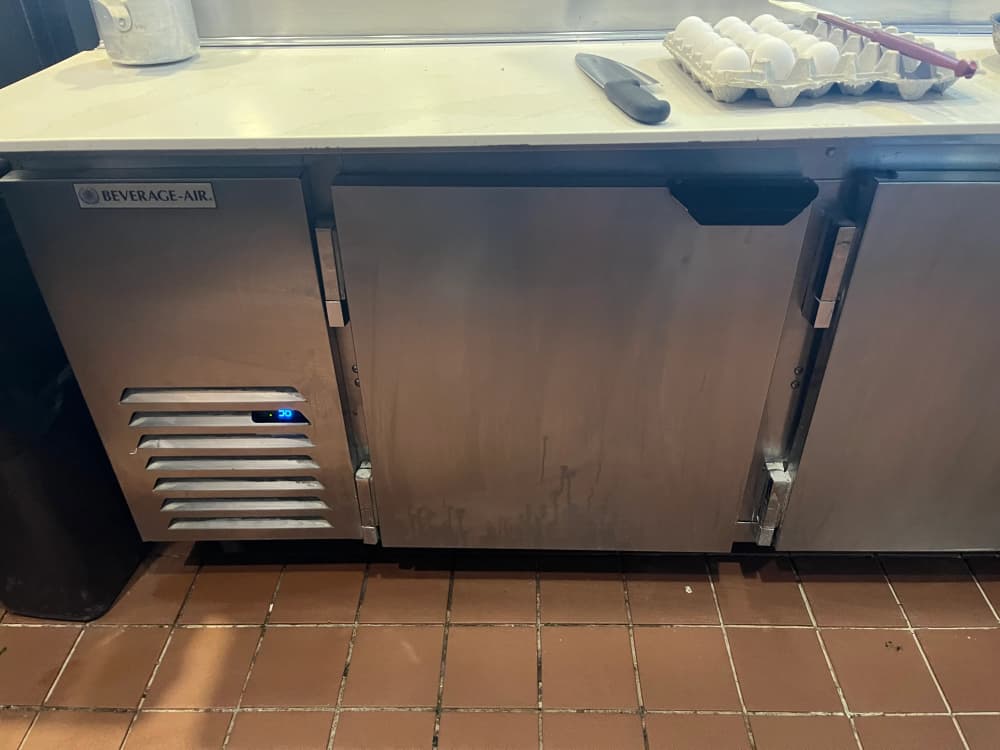
Your under-counter refrigerator or freezer may be small, but your kitchen workflow depends on it every shift. It sits in the hardest spot in your Tampa Bay kitchen — low to the floor, tucked under a prep station or cook line, surrounded by heat, grease, and humidity. It works harder than any other piece of cold storage in the building, and when it stops holding temp, you don't have a backup plan. That cold storage is right where your hands are, right where the workflow depends on it, and right where the problem hits your operation the fastest.
If you're searching for under-counter commercial refrigerator repair near me or under-counter commercial freezer repair near me, this page exists because we specialize in the specific challenges these compact, low-mount units face in Tampa commercial kitchens. Not residential wine coolers. Not beverage fridges. Real commercial worktop and undercounter refrigeration — the equipment your line depends on every shift.
We diagnose under-counter refrigerators, freezers, worktop units, bar units, and cook-line cold storage for Tampa Bay restaurants, bars, cafés, churches, stores, and food-service operators. If you also run walk-in coolers, prep tables, or glass-door merchandisers, we service those too.
One thing worth saying plainly before you read any further: an under-counter cabinet is a full refrigeration system compressed into the smallest box the manufacturer could get away with. It has the same condenser, the same evaporator and the same controls as the tall commercial refrigerators standing behind it — just with none of the room. That is why commercial refrigeration repair on these units takes longer per fault than on a reach-in, and why the common issues that stop them are almost never the ones people guess.
Get an under-counter fridge diagnosis today — (813) 522-0014
Common under-counter failures — pick the one you are looking at
These are the symptoms behind most under-counter commercial refrigerator and freezer repair calls across Tampa Bay. Each one has more than one possible root cause, which is exactly why we diagnose with instruments before recommending anything. Tap a symptom to read what it usually means.
Not cooling / running warm on the cook line
The unit runs — you feel vibration, hear the compressor — but product temps are climbing. This is the signature failure of under-counter units in hot kitchens. Usually the condenser is packed with grease and debris from floor-level intake, the ambient temperature around the unit exceeds its rating, the evaporator fan is losing output from a worn bearing, or the unit has been shoved against the wall, choking its ventilation. Caught early, this is often a straightforward repair — leave it running warm for a week and the damage can compound significantly.
Short cycling — starts and stops, never stabilizes
The compressor kicks on, runs 30–90 seconds, shuts off, then starts again. This rapid cycling is one of the most destructive failure modes for a compressor. Causes: high head pressure from a blocked condenser (the most common in Florida), a failing start relay or capacitor, a pressure switch cutting out under high ambient load, or a refrigerant charge problem. Every failed start draws 5–10 times normal current, heating the windings. A mechanically healthy compressor can be permanently damaged by a week of unaddressed short cycling.
Ice buildup on the evaporator / blocked airflow
A layer of frost or solid ice on the evaporator coil, visible when you pull back the interior panel. Airflow drops, temps rise, and the unit can't recover. In under-counter freezers this is almost always a defrost system failure — heater, termination sensor, or timer/board logic. In refrigerators it's more often a door gasket leak pulling humid Florida air into the cabinet, where that moisture freezes on the coldest surface and accumulates shift after shift. We test both the defrost chain and the seal system to find the actual entry point.
Water leaking / puddles under the unit
Water pooling on the floor is a safety hazard, a health-inspection risk, and a sign the condensation management system is overwhelmed. Common causes: a clogged drain line (especially in Tampa's hard water, where mineral buildup accelerates), cracked or displaced drain tubing, a drain pan overflowing because the defrost cycle is dumping more water than the drain can handle, or condensation forming on exterior surfaces when gaskets fail. Because these units sit low, leaks often go unnoticed until the puddle reaches the walkway.
Loud fan noise / vibration / grinding
Mechanical noise from the cabinet or the compressor compartment. A buzz or hum from a condenser fan motor with worn bearings. A grind from the evaporator fan hitting accumulated ice. A rattle from loose mounting hardware vibrating against the counter above. A click from a start relay failing to engage the compressor cleanly. Each sound points to a different repair path. Describe what you hear when you call — it helps us arrive prepared.
Door not sealing / gasket torn or compressed
Under-counter doors get grabbed, slammed, bumped by knees, hit by carts, and opened hundreds of times a shift. Gaskets wear faster here than on any other commercial refrigeration equipment. A door that doesn't seal creates a constant humidity load that forces the compressor to run longer and harder, accelerates frost buildup, and pushes product temps above safe range during your busiest hours. Hinges sag, closers lose tension, frames shift out of alignment. Sometimes what looks like a cooling problem is actually a door problem.
After a power outage or storm — unit won't start or acts erratic
Tampa Bay's storm season delivers surges, brownouts, and outages that hit commercial refrigeration electronics hard. After a storm, under-counter units may refuse to start, display error codes, cycle erratically, or blow fuses. Control boards, start relays, and capacitors are the most common surge casualties. A proper post-storm electrical stress scan identifies what was damaged before it cascades into compressor failure. If your unit started acting differently after a power event, don't wait — latent surge damage gets worse with each operating cycle.
Tripping breaker / intermittent power loss
The unit trips the circuit breaker repeatedly, or loses power mid-operation. That can mean a failing compressor drawing excessive current, a short in the wiring or a component, a ground fault from moisture intrusion (common in floor-level equipment), or simply an overloaded circuit shared with other kitchen equipment. This one needs immediate diagnosis — a unit that trips breakers is telling you something is electrically wrong, and running it in that condition risks both the equipment and kitchen safety.
A small puddle under the counter can become a kitchen problem fast. Find Source of Leak Today.
Call or Text: 813-522-0014Brands and under-counter lines we service
We work on the full range of commercial undercounter and worktop refrigerators and freezers found in Tampa Bay kitchens, bars, restaurants, convenience stores, and food-service operations.
Heavy commercial workhorses
True Manufacturing — TUC and TWT undercounter lines, the industry standard for reliability and parts availability. Stainless construction, consistent temps, and a repair history we know inside out. Turbo Air — TUR, JUR, and PUR/TUF undercounter series. Strong performers in Florida conditions, with a self-cleaning condenser on select models that buys time between service visits. Traulsen — UHT and similar undercounter and worktop models. Heavy-duty builds that reward proper maintenance with decade-plus lifespans. Beverage-Air — undercounter and worktop lines, everywhere in Tampa Bay restaurants and bars, with a well-documented parts supply chain. Hoshizaki — the undercounter commercial lineup. Precision engineering and tight tolerances; when they fail, they need a technician who understands the specific design logic. Delfield — D series and STD series, an institutional and food-service staple with durable systems and accessible service points.
Solid value and specialty lines
Continental Refrigerator — undercounter and worktop line, reliable mid-range commercial units. Perlick — commercial undercounter and bar units, premium bar-back refrigeration with a tight build and specific service requirements. Summit Appliance — built-in undercounter including ADA models, common in healthcare, assisted living, and accessible commercial installations. Atosa — MGF and TUC undercounter units, a strong value option sold through restaurant suppliers, with parts availability improving as market share grows. Arctic Air — AUC-series undercounter refrigerators, budget-friendly and widely deployed in smaller operations. Avantco Refrigeration — value-oriented undercounter units, fine for lighter-duty applications but less forgiving under heavy load or neglected maintenance.
We also service IKON (IUC-series), Berg (BERU undercounter), PeakCold undercounter commercial, and Westlake house-brand undercounter units.
A note on value and private-label units: we service them, and we'll be straight with you about parts availability and whether repair makes business sense for your specific unit. Some private-label brands have limited parts supply chains — we'll tell you that honestly before you invest in a repair that might not be sustainable long term.
Get the 7-Point Under-Counter Refrigerator Estimate Today
813-522-0014The 7-Point Under-Counter Inspection — walk it with us
This is not a generic checklist. It is a diagnostic protocol built for what actually kills under-counter units in Florida kitchens: an intake at floor level, an ambient the unit was never rated for, and a chassis too tight to work in. Every point targets a real vulnerability. Step through them below.
Airflow and condenser check
We pull the unit out — or access the condenser from the front, depending on model design — and evaluate coil contamination, heat rejection capacity, clearance from walls and adjacent equipment, and condenser fan motor performance and amp draw. In under-counter units the condenser lives at floor level and accumulates contamination three to five times faster than a reach-in. This single check prevents more emergency calls than any other service we perform.
Electrical stress test
Outlet voltage verification, amperage draw under load, and targeted inspection for storm and surge damage: pitted contactors, swollen capacitors, discolored wiring, relay degradation. Tampa Bay's electrical environment is hostile to commercial refrigeration electronics. We check what most technicians skip.
Temperature recovery test
We open the door, simulate a realistic usage cycle, and measure how quickly the box returns to setpoint. That tells us the real capacity of the system under load — not just the static temperature at rest. A unit that reads 36°F with the door closed for an hour but takes 45 minutes to recover after three openings has a problem static testing won't reveal.
Door seal and hinge inspection
Gasket compression test at all four edges, door-close force measurement, hinge pivot condition, closer tension, and frame alignment. On under-counter units, doors take more physical abuse per shift than any other equipment door in the kitchen. A gasket failure that's invisible to the eye can increase compressor runtime by 30% or more and introduce the humidity that starts the frost cycle.
Evaporator and defrost health
Visual and instrumental assessment of ice accumulation patterns, defrost heater continuity (on equipped units), sensor resistance, timer and board defrost logic, and the airflow path through the evaporator section. In Florida's humidity, even a minor defrost underperformance compounds into a full ice-over within weeks.
Drain and leak check
Full drain-path trace from evaporator tray through tubing to discharge. Pan condition, slope verification, blockage testing, and condensation routing assessment. Under-counter units sit close to the floor, so leaks go unnoticed longer and cause more floor damage before someone spots the puddle.
Longevity plan
Based on what we find, we build a simple annual — or semi-annual — service schedule customized to your unit's placement, kitchen environment, cooking volume, and equipment age. This is the plan that prevents most of the emergency calls we see, and it extends the working life of equipment many operators would otherwise replace too early.
Schedule a commercial diagnosis: (813) 522-0014
Six things about under-counter units that get diagnosed wrong
An under-counter unit is not a small reach-in. It sits in the worst air in the building, it is often boxed into joinery that was never designed to ventilate it, and there is no room to work on it. That combination produces a specific set of faults — and a specific set of wrong answers.
Your under-counter unit breathes the floor
This is the whole story in one sentence. The condenser intake sits at ankle height, which is where mop water, floor dust, flour and airborne grease live. Refrigeration technicians will tell you a condenser in a grease zone is the worst place you can put one, and that is exactly where every under-counter unit is installed by design. It is why these units need coil attention far more often than a reach-in standing at head height in the same room.
Front-breathing or rear-breathing decides whether it can be built in
A front-breathing unit pulls and exhausts air through its front grille, so it can sit inside cabinetry. A rear-breathing unit needs open space behind it, and when one gets built into a cabinet it quietly re-inhales its own hot discharge air until the compressor gives up. Marvel puts it plainly in their own manual: ventilation is required from the bottom front, and the area must stay clear. Thirty seconds with a torch tells you which one you own — and whether the install was ever going to work.
The expensive part of a built-in repair is usually not the part
On a unit anchored into an island or a bar run, the labour is the bill. Technicians report jobs where the entire cabinet and case had to come off before a component could be reached. That is why we diagnose before anybody starts taking joinery apart, and why we will tell you honestly when the access cost has overtaken the value of the repair.
Chef bases: taking the legs off the equipment above voids the warranty
A griddle or fryer sitting directly on a refrigerated base is a heat source bolted to a cold box. Manufacturers require the cooking equipment to keep its legs — usually four inches — because setting it flat melts the insulation and automatically voids the warranty. Add grease raining down and drawer slides taking liquid every time a pan is slammed shut, and the drawers become the whole job, because the unit only works as long as they close properly.
Water on the floor under a back bar has three different causes
They look identical and cost very different amounts. One: the evaporator drain is plugged, and it backs up. Two: the condensate pan sitting over the compressor has rusted through, and it leaks onto the floor outside the cabinet. Three: the coil is iced, and the fan is carrying water off it into the case. A technician who does not separate these three will clear a drain that was never blocked.
R290 cannot be retrofitted, and not every shop will touch it
A lot of current under-counter units ship with propane as the refrigerant, in ounces rather than pounds. It cannot be converted from anything else — the unit either left the factory that way or it did not — and it needs a technician who evacuates properly before a torch ever comes out. Some companies simply decline these calls. We do not, and you should ask any company you call whether they will.
You do not have to work this out yourself. Text a photo of the data plate and the front grille to (813) 522-0014 and the technician will tell you on the phone whether you are looking at an airflow problem, an install problem or a sealed-system problem — before anyone drives out.
Inside the cabinet is where the answer is
The display on the front tells you there is a problem. It never tells you why. These are the two things we open first on a beverage centre that is not holding temperature — the load in the cabinet, and the evaporator behind it.
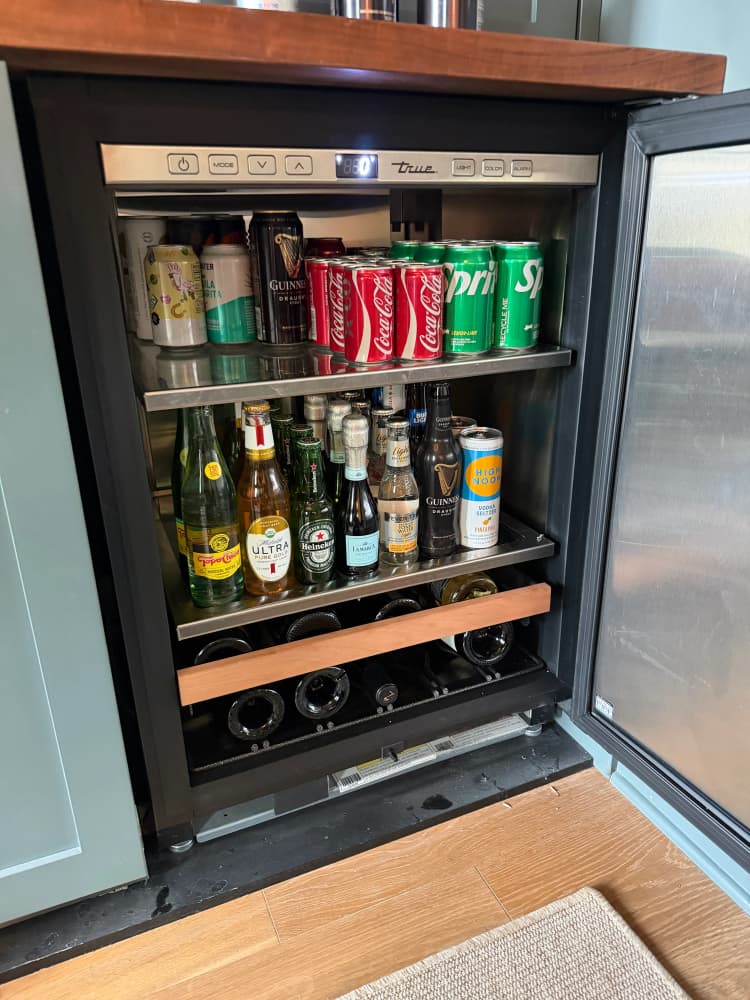
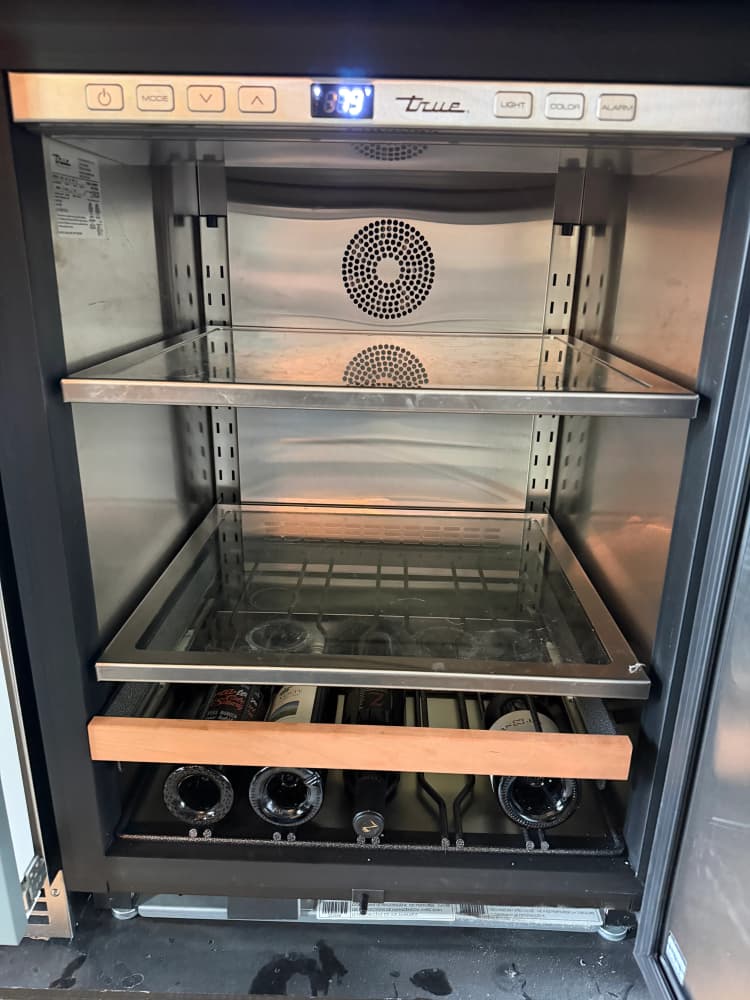
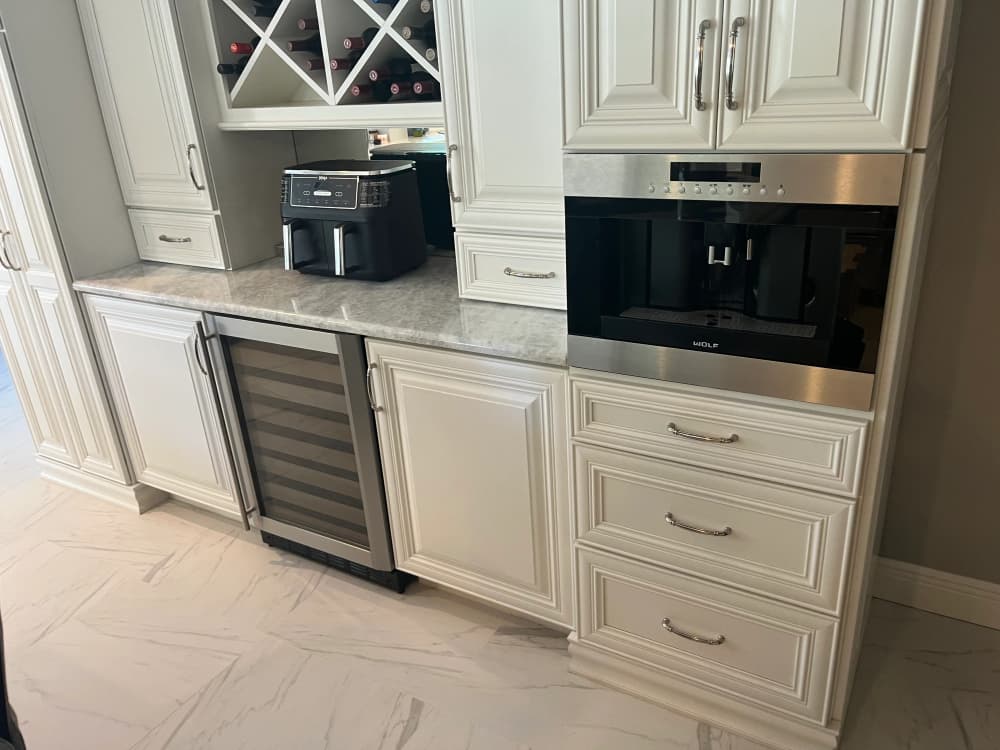
Under-counter brands on Tampa Bay cook lines and bar runs
Find the badge on your cabinet. Each of these fails in its own way, and knowing which one you have changes what goes on the truck before the technician leaves.
True
TUC and TWT under-counter and worktop
The default under-counter in American kitchens and the one we open most often. Parts are everywhere and the cabinets are worth keeping. Expect door hardware, evaporator fans and a condenser that has been eating floor dust for a year.
True repair details
Turbo Air
TUR, JUR, PUR and TUF under-counter series
Common and generally solid in Florida heat. The self-cleaning condenser on some models really does buy time between visits — it does not replace the visit. Controllers and fan motors are the usual parts on our truck for these.
Turbo Air repair details
Beverage-Air
Under-counter, worktop and back-bar lines
The back-bar standard. Doors open every ninety seconds all night, so these see more gasket and condensate work than anything else we service. When water shows up on the floor under one, we check the pan over the compressor before we blame the drain.
Bar and back-bar repair
Continental Refrigerator
Under-counter and worktop cabinets
Heavy stainless and plain underneath, which on an under-counter chassis matters more than usual — plain means reachable, and reachable means the labour on a repair stays sane. Operators who have run both often rate these above their price point.
Prep and worktop repair
Hoshizaki
Steelheart under-counter and worktop
Tight tolerances and precise engineering, which is a compliment right up until something drifts. These reward a technician who knows the design logic instead of swapping parts, and the same kitchens usually have a Hoshizaki ice machine worth checking on the same visit.
Hoshizaki repair details
Marvel
Built-in under-counter, beverage centres, wine units
The built-in end: bars, hospitality suites, offices and high-end back-of-house. These live inside cabinetry, so ventilation from the bottom front is not a suggestion, it is the manufacturer requirement. Evaporator leaks are a known pattern on some models, and getting the unit out of an island is most of the job.
How our commercial refrigeration repair process works
You call or text with symptoms
Warm, icing, leaking, noise, won't start, tripping breaker — whatever you're seeing. Give us the brand and model if you have it, or snap a photo of the data plate. We'll ask a few targeted questions so we arrive prepared.
We schedule a tight arrival window
Same-day or next-day when possible. If we can't make it today, we'll give you the earliest real option — not a vague "we'll get back to you."
We diagnose on-site
Not a glance-and-guess. Calibrated temperature readings, electrical measurements, airflow assessment, and component testing. We explain what failed and why, in normal words, not technician jargon.
You get a written estimate before any major work starts
Clear numbers. Parts listed separately from labor. No hidden shop-supplies fee, no mystery charges. You approve or decline — no pressure.
Repair, verification, and a maintenance recommendation
We fix the failure, verify temps and cycling are normal, check for secondary issues, and give you a simple plan to keep it from happening again. The $129 diagnostic is applied to your repair.
Pricing: real service cases, not blind quotes
We don't give prices over the phone, for the same reason a doctor doesn't diagnose over the phone — too many different failures look identical from the outside. Below are typical ranges after proper on-site diagnosis.
Fix It Today
813-522-0014Real service cases from Tampa Bay kitchens
True TUC under-counter — running warm on the cook line (Tampa)
A line cook reported product temps climbing to 48°F during lunch service. The unit sat directly under the flat-top grill station, compressor running almost continuously, digital display reading 38°F while product didn't feel cold. We found the condenser coil more than 65% blocked with a dense layer of grease and flour dust — the unit had been inhaling grease-laden air at floor level every shift. The fan was running but moving too little air through the clogged coil, and the internal sensor was reading cabinet air rather than product, an 8°F discrepancy. The compressor itself was mechanically healthy but running at elevated head pressure. We did a full condenser deep cleaning, restored the airflow path, repositioned the unit four inches off the back wall for ventilation, recalibrated the sensor, and verified cycling under simulated rush. Product-zone temps held at 36°F through a full dinner service, cycling returned to normal, and head pressure dropped 15 psi. Given the cook-line proximity, the owner went on a semi-annual maintenance schedule.
Beverage-Air under-counter freezer — ice wall and water on the floor (South Tampa)
A bar manager found an ice wall on the evaporator, temps drifting above 0°F, and water pooling near the unit. Staff had been chipping ice off the coil every other day for two weeks before calling. The defrost heater had failed — open circuit, zero continuity — and the accumulated ice was insulating the evaporator and killing cooling capacity. When staff chipped the ice, the sudden melt overwhelmed a drain line already partly clogged with mineral deposits from Tampa's hard water. We also found a three-inch section of the left door gasket with no compression, introducing humid air that accelerated the frost. We replaced the defrost heater, ran a full manual defrost to clear the ice wall, cleared and flushed the drain line, replaced the gasket, verified the defrost logic, and monitored temperatures for an hour. Temps held at -5°F with no water accumulation, and we showed the owner the early frost indicators so the next occurrence gets caught in days, not weeks.
Turbo Air under-counter — short cycling after a storm (Wesley Chapel)
After a late-afternoon thunderstorm, the unit started cycling rapidly — on for 45 seconds, off for 30, product slowly warming. The breaker had tripped once during the storm and been reset by staff. Our electrical stress test found a failed start capacitor: swollen and reading below its rated microfarads. The compressor couldn't reach full starting torque, so the overload protector was cutting power to protect the windings. The failure was consistent with a voltage spike from the storm; the windings themselves tested within spec. We replaced the start capacitor, inspected the start relay (passed), verified overload continuity, ran a full electrical stress scan for additional surge damage, and observed cycling and temperatures for 90 minutes. Normal cycling returned on the first start, and product recovered to setpoint within two hours. We advised the owner on surge protection for the refrigeration circuit to prevent future storm-related failures.
Hoshizaki under-counter — door won't seal, temps drifting (Dade City)
A café owner reported temps gradually climbing over a month, no obvious noise, the unit "just not as cold as it used to be." Staff had tried turning the thermostat down, with no effect. The primary door gasket had lost compression along the bottom edge — invisible to a visual check but failing the dollar-bill test — and the gap was admitting humid air continuously. The compressor was running 40% longer per cycle to compensate. The condenser was moderately dirty, a contributing factor rather than the root cause, and the thermostat and sensors were accurate; the system was simply fighting a leaking door. We replaced the gasket, adjusted the hinge to restore proper close alignment, cleaned the condenser as preventive work, and ran a temperature recovery test to confirm the fix. Compressor runtime dropped 35%, temps held steady, and energy use came down noticeably. The owner said the unit sounded different — it wasn't running all the time anymore.
Under-counter commercial refrigerator and freezer repair — FAQ
Annual maintenance isn't optional — it's how you keep this equipment alive
For units on a hot cook line or in a high-grease environment, I recommend service twice a year. For lighter-duty placements, once a year is the minimum. Without it, you're not asking whether the unit will fail — you're asking when. And the answer in Florida is always sooner than you think.
Almost none of the commercial refrigeration issues we get called out for started on the day of the call. They started as a coil nobody rinsed and a gasket nobody replaced, and they turned into an emergency repair three or four months later. Planned service and repair on your refrigeration units costs less than one lost weekend of product — that is the whole argument, and it is why we hand you a schedule instead of a sales pitch.
The rest of your commercial refrigeration, while we are already under the counter
An under-counter cabinet is rarely the only thing in your building holding temperature, and whatever killed this one is working on the others right now. Dirty condenser coils, a kitchen running at 90°F and a drain nobody has looked at produce the same refrigeration problems in every box on the line. Once the technician is on site with gauges out, anything else can be checked on the same visit and written on the same invoice — one trip, one diagnostic, one report.
Reach-in refrigerators and freezers
The tall commercial refrigerators standing against the wall. Same refrigeration system, easier access, and usually the first place we look when a whole kitchen starts drifting rather than one cabinet. Full range of commercial refrigeration service on the hub page.
All commercial refrigeration repair →Walk-in coolers and walk-in freezers
The box out back, and the refrigeration sitting on top of it. If your under-counter unit is struggling because the walk-in is warm and staff are stuffing product wherever it fits, the repair needs to start there instead.
Walk-in cooler repair →Prep tables and worktops
Sandwich, salad and pizza make-lines. A warm rail over a cold base is its own fault entirely, and it is the single most misdiagnosed problem in commercial refrigeration.
Prep table repair →Glass-door merchandisers
Retail-facing coolers where a foggy door costs you sales before it costs you product. Anti-sweat heaters, seals, LED lighting and the condenser behind the kickplate.
Merchandiser repair →Commercial ice machines
Hoshizaki, Scotsman, Manitowoc, Ice-O-Matic and Follett. On Tampa water, scale decides how long an ice machine lives — and the same neglected condenser that warmed your under-counter unit is usually on the ice machine too.
Ice machine repair →Bar refrigeration and back-bar
Back-bar coolers, keg boxes, bottle coolers and glass frosters. Doors open all night, so gasket and condensate work dominates — and water on the floor here has three different causes.
Bar equipment repair →When it cannot wait until morning
Commercial emergency service for the calls where product is actively at risk. If a unit stops working mid-service and warm air is the only thing coming out of it, that is a dispatch, not an appointment.
Emergency service →Residential fridge repair
Some of these under-counter units live in homes rather than kitchens. If yours is a household appliance service rather than a commercial one, the residential side of the business handles it at the residential diagnostic rate.
Refrigerator repair →Our technicians work across the whole spread of commercial refrigeration systems in one building — from a single commercial refrigeration unit tucked under a bar to the walk-in systems out back — so the repair and service advice you get accounts for how the equipment interacts, not one cabinet in isolation. Fast diagnostics matter more than fast quotes here: refrigeration issues that look identical from the outside almost never share a cause, and the service professionals worth paying are the ones who can tell you which is which before they order a part.
One honest limit. We are a repair company, not a refrigeration installation contractor. If a cabinet is genuinely finished we will tell you plainly and help you understand what to look for — but we do not sell you a replacement, which is exactly why our repair-or-replace advice is worth listening to. Schedule service or call (813) 522-0014 and describe what it is doing.
Under-counter repair near you — bar runs, cook lines and built-ins
We service under-counter refrigerators and freezers, worktops, chef bases, back-bar coolers and built-in beverage centres across Hillsborough, Pinellas and Pasco. These are the corridors we work every week.
SoHo, Hyde Park and Bayshore
S Howard Ave · W Kennedy Blvd · W Swann Ave
The densest bar run in South Tampa. Back-bar coolers here open all night and live under wooden bar tops with almost no ventilation gap — clearance is half of every call we take on this strip.
Palma Ceia and Dale Mabry
S Dale Mabry Hwy · W Henderson Blvd · W Bay to Bay Blvd
Restaurants and high-end homes side by side, which means commercial worktops and built-in beverage centres on the same street. Two very different service problems, same technician.
Downtown, Water Street and Channelside
Water St · Channelside Dr · E Kennedy Blvd
Hotel bars, lobby pantries and event kitchens. Built-in installs, access rules and documentation requirements — we schedule around service, not through it.
Ybor City
E 7th Ave · E 8th Ave · N 15th to N 19th St
Historic buildings and hot back-of-house. Under-counter units in Ybor breathe the dirtiest air of anywhere we work, and the coil condition when we open them proves it.
Gandy and MacDill
W Gandy Blvd · S MacDill Ave · Interbay Blvd
Neighbourhood kitchens and fast-casual with equipment stands and chef bases under the cook line. Heat from above plus dust from below is the whole failure story here.
Westshore and the airport corridor
N Westshore Blvd · W Cypress St · W Boy Scout Blvd
Hotels and corporate dining on maintenance contracts. Logged temperatures and photo invoices come standard for these accounts.
Carrollwood and North Dale Mabry
N Dale Mabry Hwy · Ehrlich Rd
Long commercial spine north of the stadium, plus a lot of built-in beverage centres in the neighbourhoods either side of it.
Wesley Chapel and Wiregrass
SR-54 · SR-56 · The Grove · Shops at Wiregrass
New builds, new equipment, and the first round of failures arriving now. Shortest drive times on this page after Dade City.
Dade City and Zephyrhills
US-301 · 7th St · Meridian Ave · Gall Blvd
Home turf. Small kitchens where one under-counter unit is the entire cold line and there is nowhere to move the product while it is down.
City pages with more detail: Tampa, South Tampa, Ybor City, Carrollwood, Wesley Chapel, Zephyrhills, Dade City. Outside our usual service area? Call or text (813) 522-0014 and we will confirm coverage honestly rather than book a trip we cannot make on time.
Perfect Appliance Repair Tampa — Under-Counter Commercial Refrigerator Repair
— We Stand Behind Our Work —