Do this right nowKeep the doors shut and do not keep unplugging and replugging it — every forced restart is harder on the compressor than the last.
The click-click-click pattern is the overload relay tripping: the compressor tries to start for a few seconds, overheats or stalls, and the protector cuts it off. The first suspect is the cheap one — a failed start relay or capacitor, a twenty-minute swap — and only if the clicking continues with a healthy start device is the compressor itself condemned. A surprising share of "dead compressor" verdicts from other companies turn out to be an inexpensive start device. We test before we condemn.
Parts usually on the truckStart relays, capacitors, overloads for the common platforms
Typical visit45–75 minutes for a start-device fix
The clockFridge food: about 4 hours from failure. Full freezer: about 48 hours, doors closed. The food-safety tool below runs your exact numbers.
Do this right nowMove milk, meat and medication to the freezer side or a cooler with ice — the freezer buys you time the fridge side no longer has.
One cold source is still working, so the cold is not reaching the fresh-food side. On most kitchen refrigerators that means the evaporator fan, a defrost failure that has iced the airway shut, or a damper stuck closed. On frost-prone models — Samsung French-doors are famous for it — ice behind the back panel chokes the airflow slowly over weeks and then finishes the job overnight.
Parts usually on the truckEvaporator fan motors, defrost heaters and thermostats, dampers
Typical visit60–90 minutes, longer if a coil has to be thawed
The clockFridge food: about 4 hours from failure. Full freezer: about 48 hours, doors closed. The food-safety tool below runs your exact numbers.
Do this right nowCheck the outlet with a lamp and look for a tripped breaker or GFCI before you call — a meaningful share of these calls end right there.
If the outlet is live and the cabinet is dark, the fault is the control board, its power supply, or the cord and connections — and after a Tampa Bay storm the board leads the list by a wide margin. Lightning takes out boards, relays and capacitors while frequently leaving the compressor itself untouched, which is why a surge-killed refrigerator is usually very repairable.
Parts usually on the truckControl boards and start components for common brands
Typical visit60–90 minutes
The clockFridge food: about 4 hours from failure. Full freezer: about 48 hours, doors closed. The food-safety tool below runs your exact numbers.
Do this right nowNote your model number — families starting LFXS, LFXC, LMXS, LMXC, LRMVS, LRFVS, and Kenmore Elite 795 are LG-built and share one pattern.
The LG linear-compressor pattern is the most common true emergency we see: clicking every few seconds, fresh food warming first, freezer holding a little longer. Two things matter before anyone pays for a compressor. First, some of these are actually a failed start component or a seized condenser fan mimicking compressor death. Second, on many models the compressor part is still covered by LG's 10-year limited warranty — confirm coverage for your serial before authorising anything.
Parts usually on the truckStart components, condenser fans; compressor work quoted after testing
Typical visit60–90 minutes to a firm written verdict
The clockFridge food: about 4 hours from failure. Full freezer: about 48 hours, doors closed. The food-safety tool below runs your exact numbers.
Do this right nowLay towels and pull the unit forward if you can — the floor is the expensive part in this failure, not the fridge.
A blocked defrost drain is the usual cause: meltwater from every defrost cycle backs up, refreezes in the trough, and eventually finds the kitchen floor. It is one of the cheapest repairs on this page and one of the most expensive to ignore, because standing water destroys wood flooring and cabinet toe-kicks long before it hurts the refrigerator.
Parts usually on the truckDrain heaters and grommets for common platforms
Typical visit45–60 minutes
The clockFridge food: about 4 hours from failure. Full freezer: about 48 hours, doors closed. The food-safety tool below runs your exact numbers.
Do this right nowThat light means the compressor ran over 24 hours without reaching temperature. If you have already vacuumed the condenser and it keeps returning, stop cleaning and call — the next suspect is not dust.
The Vacuum Condenser message is a service reminder, not a verdict — a loaded condenser is the first suspect and a cleaning fixes many of them. But the pattern that matters is the light returning within days while the fridge section drifts warm and the freezer holds: on the 600-series that is the classic signature of a slow evaporator leak in the fresh-food circuit, and it needs a leak search and gauges, not another vacuuming.
Parts usually on the truckCondenser cleaning kit, thermistors; sealed-system work quoted after testing
Typical visit60–90 minutes to a documented verdict
The clockFridge food: about 4 hours from failure. Full freezer: about 48 hours, doors closed. The food-safety tool below runs your exact numbers.
Do this right nowDo not empty the freezer — on a dual-compressor Sub-Zero it is running on its own healthy sealed system and will protect the frozen food while we fix the other circuit.
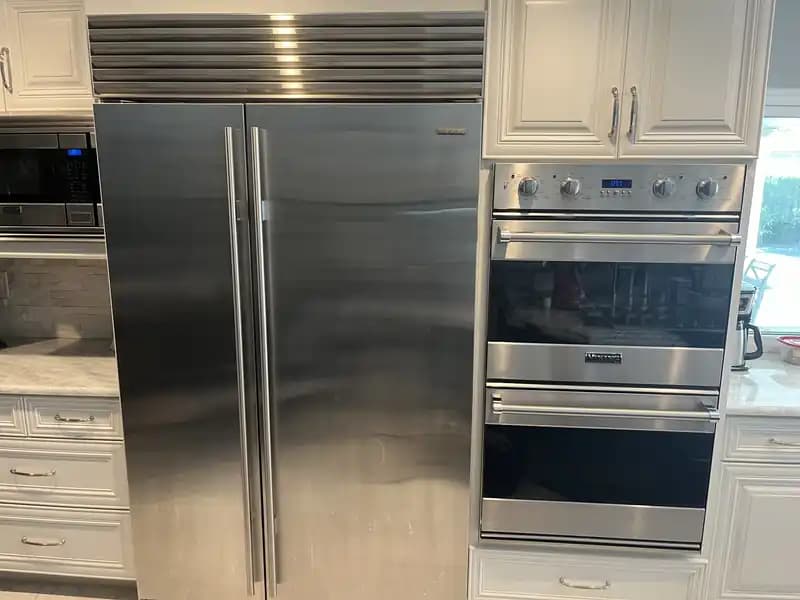
This is the failure Sub-Zero's dual-compressor, dual-evaporator design was built for: the 600 and 700 series run two independent refrigeration circuits, so one side failing tells us the fault lives entirely in that circuit — its thermistor, its evaporator, its charge — while the other keeps working. It also means the diagnosis is narrower and faster than on a single-system refrigerator, and the freezer buys you time a kitchen fridge would not.
Parts usually on the truckThermistors, fan motors; circuit-specific sealed-system work quoted after testing
Typical visit60–120 minutes
The clockFridge food: about 4 hours from failure. Full freezer: about 48 hours, doors closed. The food-safety tool below runs your exact numbers.
Do this right nowCheck nothing is blocking the toe-kick grille, then leave it running — continuous running with the doors shut is stressful but not immediately destructive.
A Sub-Zero that cannot cycle off is either not reaching setpoint (condenser, charge) or not believing it has (sensors). The 600-series cabinets carry more than one thermistor — cabinet and evaporator — and the evaporator probe is the one non-specialists routinely miss: we have taken over jobs where a board, a relay and the visible thermistor had all been replaced and the ten-dollar evaporator probe was the fault the whole time.
Parts usually on the truckBoth thermistor types, relays, overloads for 500/600/700 platforms
Typical visit60–90 minutes
The clockFridge food: about 4 hours from failure. Full freezer: about 48 hours, doors closed. The food-safety tool below runs your exact numbers.
Do this right nowWrite down when it happens — time of day and how long it stays down. That pattern is diagnostic gold when we arrive.
A section that quits and revives after resting is usually a compressor overheating and tripping its overload — and the underlying cause is a restriction or low charge in that circuit, not the fan everyone checks first. Each thermal trip shortens compressor life, so "it fixes itself" is the most dangerous version of this fault: it is the one that turns a repairable leak into a compressor job while you wait.
Parts usually on the truckGauges and electrical test equipment; repair quoted from measurements
Typical visit90–120 minutes — the fault has to be caught in the act
The clockFridge food: about 4 hours from failure. Full freezer: about 48 hours, doors closed. The food-safety tool below runs your exact numbers.
Do this right nowKeep their invoice. What was and was not done — flush, filter-drier, evacuation, weighed charge — decides what we do next.
A compressor swap without the supporting procedure is the most common botched Sub-Zero repair we take over. After a burnout, debris and acid remain in the lines: the correct sequence is a nitrogen sweep until the discharge runs clear, a new filter-drier every time the system is opened, evacuation to a deep vacuum, and a weighed-in charge — not a top-up by feel. Skip any of those and the new compressor inherits the old one's death. We do sealed-system work to procedure and document each step on your invoice.
Parts usually on the truckFilter-driers, nitrogen, vacuum pump and scale on every sealed-system call
Typical visitHalf a day for a sealed-system rescue, quoted in writing first
The clockFridge food: about 4 hours from failure. Full freezer: about 48 hours, doors closed. The food-safety tool below runs your exact numbers.
Do this right nowMove TCS food to working refrigeration now and log the move — the FDA cold-holding line is 41°F, and product above it is on a four-hour clock the inspector will ask about.
A reach-in or prep table stuck in the 50s has usually lost capacity rather than died: a condenser matted with kitchen grease, a door or lid that stopped sealing, or a rail airflow path blocked by overfilled pans. The frost pattern on the evaporator is the tell — partial frost points at low charge, a fully iced coil points at airflow or defrost. We treat commercial calls with inventory at stake as priority scheduling.
Parts usually on the truckCondenser fans, gaskets, evaporator fans for True, Turbo Air and Beverage-Air platforms
Typical visit60–90 minutes on site
The clockFridge food: about 4 hours from failure. Full freezer: about 48 hours, doors closed. The food-safety tool below runs your exact numbers.
Do this right nowSwitch it off at the plug. Repeated stalled starts cook the windings, and never jumper or poke at a suspect capacitor — a shorted one can fail violently.
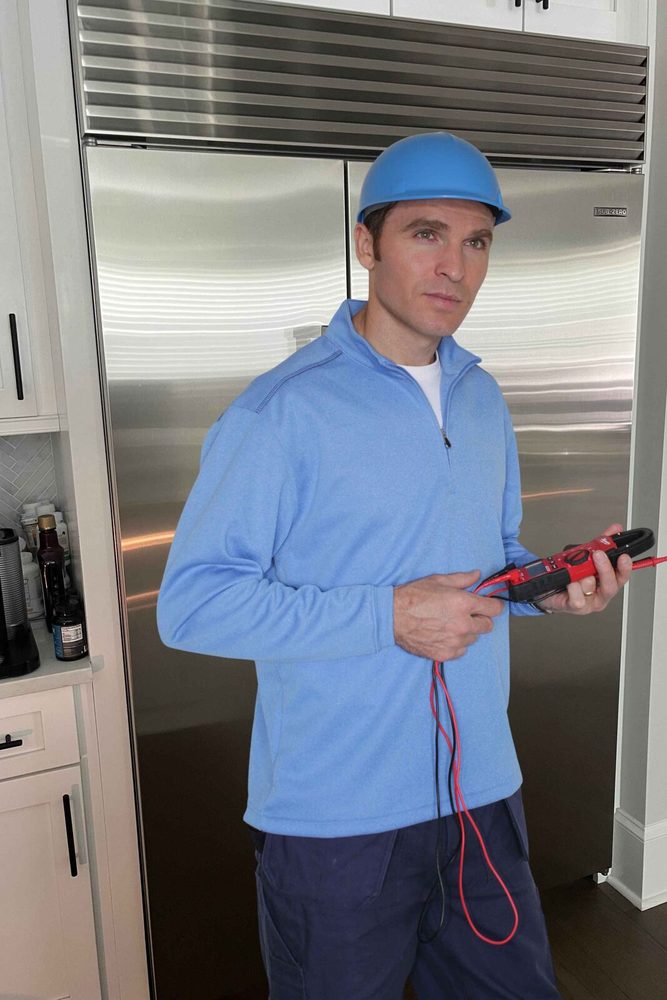
Start capacitor, start relay and overload are the trio to test with a meter before anyone says the word compressor — a shorted capacitor reads near-zero ohms, an open one reads infinite, and either one produces exactly the symptoms of a dead compressor at a tenth of the price. This is the single most over-diagnosed failure in commercial refrigeration.
Parts usually on the truckStart components for the common commercial platforms
Typical visit45–75 minutes
The clockFridge food: about 4 hours from failure. Full freezer: about 48 hours, doors closed. The food-safety tool below runs your exact numbers.
Do this right nowPull the product up out of the wells and check it — frozen rail product is a quality loss now and a texture complaint later.
A commercial box that will not cycle off is usually a temperature control with welded-shut contacts or a probe reading falsely warm. The test is simple: turn the dial to off and listen for the click; no click and no cycling means the control, not the refrigeration. It is an inexpensive part with an outsized cost when ignored, because non-stop running kills compressors.
Parts usually on the truckTemperature controls and probes for common True and Turbo Air models
Typical visit45–75 minutes
The clockFridge food: about 4 hours from failure. Full freezer: about 48 hours, doors closed. The food-safety tool below runs your exact numbers.
Do this right nowConsolidate into working boxes, coldest product lowest, and note the time — the inventory clock and the health-code clock both started when it failed.
Mid-service failures are load failures: the box that held overnight could not absorb a full rail, a hot line and a hundred door openings, which means it had already lost its margin — condenser, gaskets, or a tired fan — before today. We prioritise commercial downtime because the real cost is not the part: it is the inventory, the halted service, and the inspection exposure stacking up per hour.
Parts usually on the truckThe common margin-killers: fans, gaskets, cleaning equipment, start components
Typical visitPriority scheduling; 60–120 minutes on site
The clockFridge food: about 4 hours from failure. Full freezer: about 48 hours, doors closed. The food-safety tool below runs your exact numbers.
Do this right nowKeep the door shut and strip-curtains closed; check the evaporator inside for ice before you call — "iced solid" versus "clean coil" changes the diagnosis completely.
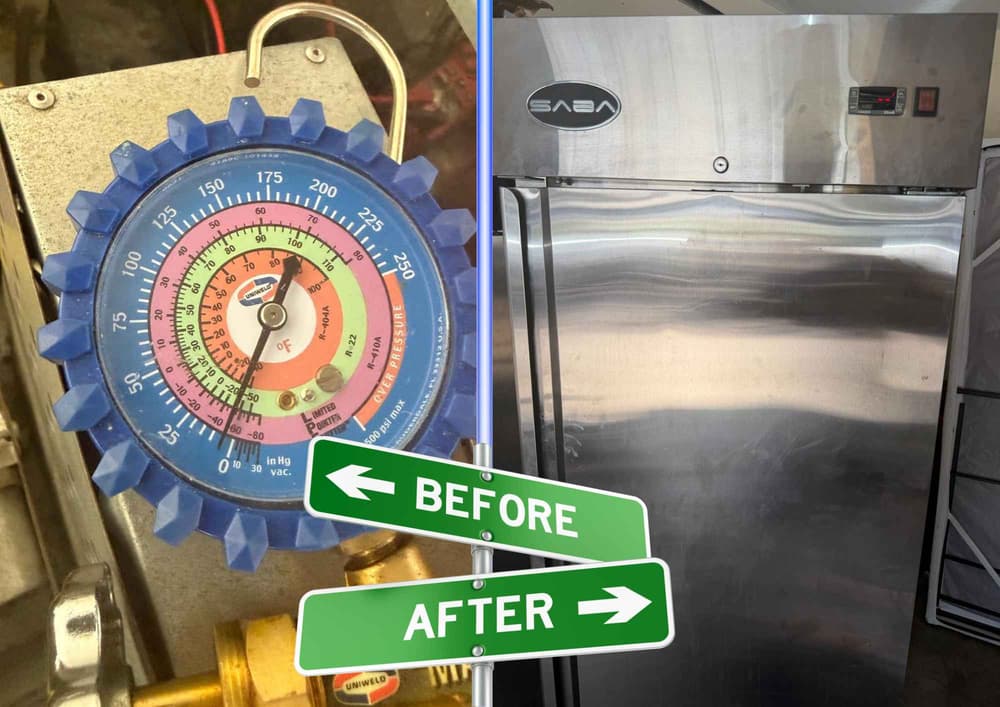
A walk-in stuck high is either starved or leaking: a clogged filter-drier, a TXV problem, a low charge from a leaking flare joint, or an evaporator iced over from a defrost fault or a door that never quite closes. These are gauge-and-thermometer diagnoses — suction and discharge pressure, superheat across the coil, temperature drop across the drier — not guesses, and we bring the instruments to make them.
Parts usually on the truckFilter-driers, defrost components; refrigerant work quoted from measurements
Typical visit90–150 minutes
The clockFridge food: about 4 hours from failure. Full freezer: about 48 hours, doors closed. The food-safety tool below runs your exact numbers.
Do this right nowDo not chip ice off the coil with anything sharp — a punctured evaporator turns a service call into a sealed-system job.
Recurring ice on a walk-in evaporator means the defrost cycle is losing to the moisture load: failed defrost heaters or timer, a door or gasket letting humid Florida air pour in, or a system running continuously because a control never cuts out. Left alone, the ice blanket insulates the coil, the box warms, and the compressor runs itself to death fighting a blocked coil.
Parts usually on the truckDefrost heaters, timers, door gaskets and sweeps
Typical visit90–150 minutes plus controlled thaw time
The clockFridge food: about 4 hours from failure. Full freezer: about 48 hours, doors closed. The food-safety tool below runs your exact numbers.
Do this right nowCheck the water supply valve and the filter first — no water in means no ice out, and it is the one fix that costs nothing.
On Hoshizaki, Manitowoc and Scotsman machines the fault tree runs: water in (inlet valve, filter, float), heat out (condenser, ambient), then the harvest cycle (sensors, board). The failure that halts a bar is rarely the compressor — it is a simple inlet valve or a scaled-up water system. Diagnosis is model-specific, so have the model and serial ready when you call and we arrive with the right parts.
Parts usually on the truckInlet valves, water filters, harvest components for the big three ice-machine brands
Typical visit60–120 minutes
The clockFridge food: about 4 hours from failure. Full freezer: about 48 hours, doors closed. The food-safety tool below runs your exact numbers.
Do this right nowMove stock past its load line back down — over-stacked shelves block the air curtain that does the actual cooling.
Merchandisers fail at the glass and the airflow: anti-sweat heater circuits that quit and put condensation on the door, blocked return grilles that stratify the cabinet, and condensers loaded with store dust. All of it is visible revenue — a fogged door stops selling long before the product spoils — which is why we treat retail cases as commercial priority calls too.
Parts usually on the truckDoor heaters, gaskets, evaporator fans for common merchandiser platforms
Typical visit60–90 minutes
The clockFridge food: about 4 hours from failure. Full freezer: about 48 hours, doors closed. The food-safety tool below runs your exact numbers.