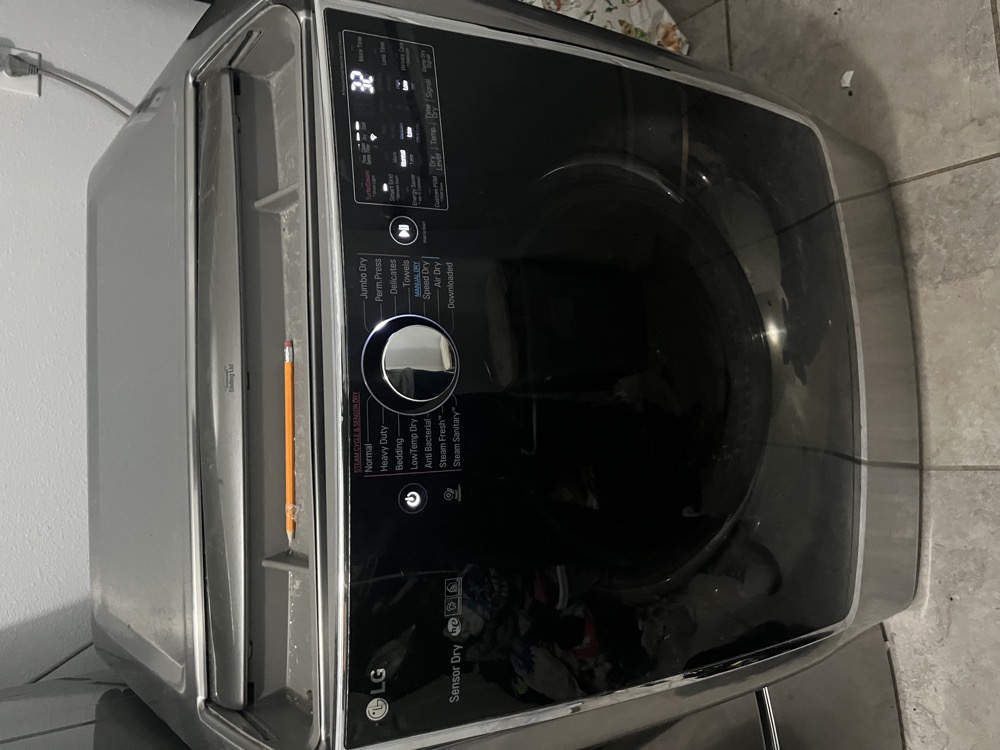
Why is my LG dryer not heating?
Here is the thing about LG dryers: the electronics are the best in the business. After years of working on every brand across Tampa Bay, LG control boards and sensors are the ones we replace least. So when an LG dryer tumbles but won't heat, the cause is usually not the smart parts — it's power delivery, airflow, or one inexpensive sensor. In rough order of what we actually find on service calls:
- nP code — the dryer isn't receiving full 240V power. A half-tripped breaker, a worn wall outlet, or a stressed cord. This one is so common (and so misdiagnosed) it gets its own section below.
- Blown thermal fuse — almost always caused by a restricted vent, which Tampa humidity accelerates.
- Thermistor out of range — the tE code family; a small, inexpensive sensor.
- Heating element burned out (electric DLE models).
- Gas valve coils or igniter (gas DLG models).
- Flow Sense d-codes — d75 to d95 are not a breakdown at all: they're the dryer warning you the duct is clogging up.
Not sure your machine is even the problem? The brand-agnostic dryer not heating guide walks the universal checks; this page covers what's specific to LG.
LG dryer error codes, decoded
LG dryers tell you more through the display than any other brand — if you know how to read it. Tap a code:
The nP code: it's usually your outlet, not your dryer
Electric LG dryers run on two 120V legs. The motor, drum and display happily run on one; the heater needs both. When the machine senses the heater leg is missing, it throws nP — and because everything else works, owners (and some techs) go hunting inside the dryer for a failure that isn't there.
The definitive cautionary tale is a years-long thread on r/appliancerepair about an LG DLEX3700W. The owner tested every component — element, fuses, thermistor, even the belt switch — all good. Spent $350 on a new control board. Still nP. The root cause turned out to be the wall outlet: worn contacts had stopped gripping one blade of the plug, so the heater leg lost connection the moment the plug was fully seated. A replacement outlet cost under $20. Years later, other owners keep replying to that thread confirming the same fix — stretched outlet contacts, cords installed twisted so they torque the receptacle, even a scorched terminal cleaned up with abrasive.
So before anyone orders parts for an nP code: flip the double-pole breaker fully off and on (a half-tripped breaker looks "on" — and after a Tampa summer lightning storm, single-leg trips are common). Then unplug the dryer and look at the outlet and plug blades for heat discoloration or looseness. The real test — voltage on both legs under load, with the plug seated — is a two-minute meter check we do on every nP call. It is the cheapest fix in this entire guide, and the most missed.
Where is the reset button on an LG dryer?
There isn't one — no LG dryer has a reset button, despite what the search results promise. What LG support calls a reset is a power cycle: unplug the dryer (or turn off its breaker), press and hold the Start/Pause button for about five seconds to drain residual charge, wait a minute, and restore power. That clears a hung board and is always worth one try. What a power cycle will never fix: a blown thermal fuse (a one-shot physical part), a burned element, or the outlet problem behind an nP code. If the dryer runs cold again on the next cycle, stop resetting and start testing.
Flow Sense says your vent is the real problem
LG's Flow Sense system is the most underrated feature on these machines: it measures exhaust back-pressure and warns you (d75–d95) while the duct is clogging, before parts start dying. Take it seriously, especially here. Tampa's humidity makes lint bond to duct walls; building code allows a maximum of 35 feet of duct, minus 5 feet for every 90-degree elbow, and plenty of local homes — especially with dryers in the garage and long runs to an outside wall — sit right at that limit. Nationally, fire departments respond to roughly 14,000 to 16,000 dryer fires a year, and failure to clean the vent is the leading factor in about a third of them. A d-code costs you a cleaning; ignoring it costs a thermal fuse, then an element, and occasionally much more.
Element, thermistor and gas parts: what they cost
When a part really has failed, here is the honest picture. LG heating elements are pricier than most: the common 5301EL1001J assembly lists around $243, which is why correct diagnosis matters more on LG than on a Whirlpool where the element runs $90. The thermistor (6323EL2001B on many models) is at the opposite end — one of the cheapest parts on the machine, which makes a tE code good news in disguise. Gas DLG models use valve coils and an igniter, both modestly priced and both stocked. LG-specific parts that aren't on the truck ship in 3 to 5 days, so a return visit lands inside the same week. Every price goes in writing before work starts.
How to fix an LG dryer not heating
- Write down the error code before clearing anything — nP, tE1, tE3, a d-number, PS or HE. It cuts the diagnosis in half.
- Flip the double-pole breaker fully off, then on (electric models). A half-tripped leg is invisible at a glance and free to fix.
- Inspect the outlet and plug. Unplug the dryer and look for scorch marks, discolored blades, or a plug that seats loosely. On nP codes this is the prime suspect.
- Power cycle properly. Unplug, hold Start/Pause five seconds, wait a minute, plug back in — the only "reset" an LG dryer has.
- Act on any Flow Sense d-code: clean the full duct run and the outside cap, then re-run a cycle.
- Verify gas supply (DLG models): valve at the wall fully open.
- Run Smart Diagnosis via the ThinQ app if the dryer is connected — it can name the failing circuit remotely.
- Test heat on a short timed-dry cycle. Air at the exhaust should be hot within 2 to 3 minutes. Still cold? A component test with a meter is next — that's the $69 visit, applied to the repair.
Should you repair or replace an LG dryer?
Repair, in almost every case. LG dryers are among the machines we argue for repairing: the electronics that fail on other brands are LG's strong suit, washers and dryers on this platform have very few chronic problems, and the typical lifespan runs 10 to 13 years. A no-heat LG under 10 years old is nearly always a one-part fix — and if the fault turns out to be the outlet or breaker, the dryer was never broken at all. The exception is the same as any brand: a machine past 12 years stacking a big-ticket part (that $243 element) on top of bearing or motor wear. Our repair-or-replace guide runs the numbers, and we'll tell you honestly on-site which side of the line you're on — a $69 diagnostic that ends in "buy new" is money better spent than a $400 repair that shouldn't have happened.
When to call an LG repair tech
Call when the breaker, outlet inspection, power cycle and vent are ruled out and the machine still runs cold — at that point a component has genuinely failed and needs a meter, not guesswork. Same-day service across Tampa Bay when you call before 2 PM: (813) 522-0014. The $69 diagnostic is applied 100% to the repair when you approve the written price, and every repair carries a 90-day labor warranty. For anything else LG in the house — the famous compressor issue included — see LG appliance repair Tampa.
LG Dryer No-Heat FAQ
What does the nP code mean on my LG dryer?
The heater circuit isn't seeing full 240V power. The dryer itself is usually fine — check the double-pole breaker, then the outlet and plug for wear or scorching. It's the most commonly misdiagnosed LG dryer code, and the usual fix costs under $20 in materials.
Where is the reset button on an LG dryer?
LG dryers don't have one. The "reset" is a power cycle: unplug, hold Start/Pause about five seconds, wait a minute, restore power. If no heat returns, a component needs testing — resets don't fix blown fuses or worn outlets.
What do tE1 and tE3 mean?
Thermistor (temperature sensor) faults — tE1 on the drum/exhaust side, tE3 at the blower. The sensor is one of the cheapest parts on the machine and a quick swap. Good news, as dryer codes go.
My Kenmore Elite dryer shows these same codes — why?
Kenmore Elite dryers with model numbers starting 796 are built by LG, so everything on this page applies to them, codes and parts included. Check the sticker inside the door frame.
How much does an LG dryer heating repair cost in Tampa?
National averages for dryer repair run about $100 to $300. On LG the spread is wider than most brands: a thermistor or outlet-side fix sits at the bottom, while a full element assembly (about $243 list for the part alone) sits near the top. You get the exact written price before work starts, with the $69 diagnostic applied to it.
Related services
Book same-day service or read more about the exact repair:
Call or text (813) 522-0014 or book online — Perfect Appliance Repair Tampa covers Tampa, South Tampa, Wesley Chapel, Zephyrhills, Dade City, and surrounding Tampa Bay.
Anatoli Didenco is the owner-technician of Perfect Appliance Repair Tampa, with 20+ years of hands-on technical experience in refrigeration and appliance repair across Hillsborough, Pinellas, and Pasco Counties. He specializes in refrigerators — particularly Sub-Zero, Wolf, and premium built-in systems — and sealed-system and compressor work. He personally answers the phone and shows up at the door. Read more on the About page.
Perfect Appliance Repair Tampa serves Tampa, South Tampa, Wesley Chapel, Zephyrhills, Dade City, and the surrounding Tampa Bay area. Reviews are available on the company’s Google Business Profile and BBB listing.
We Stand Behind Our Work.