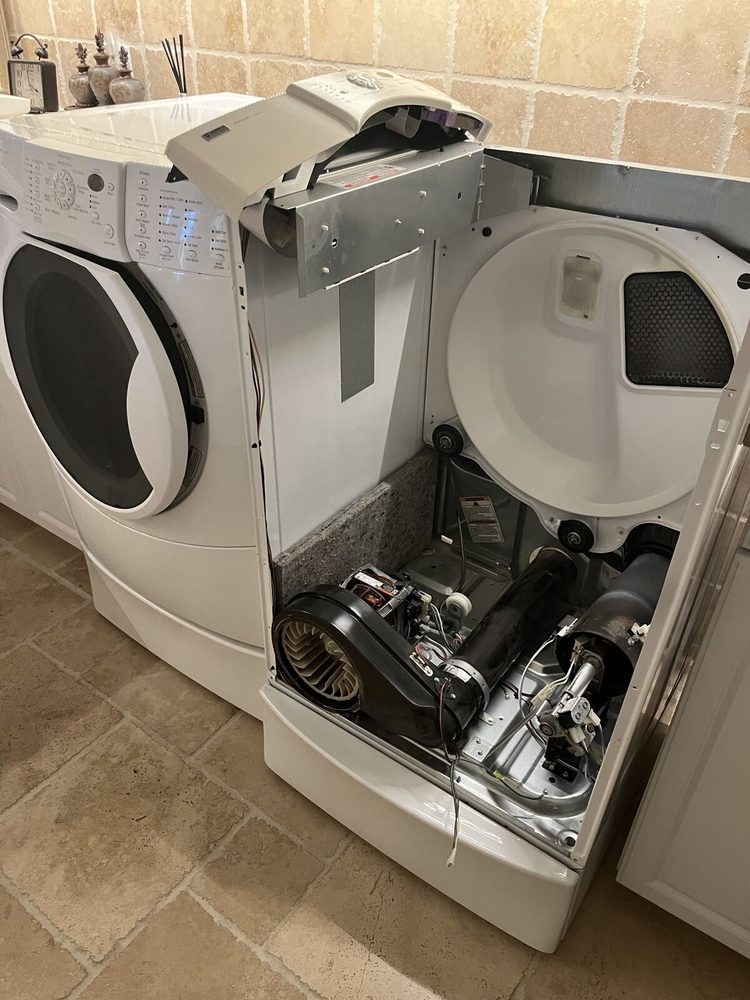
Why does my dryer run but not heat?
After 20 years on the bench, a dryer that tumbles but produces no heat comes down to one of six causes more than 90% of the time — and the two most common fixes cost nothing. Before you think about dryer parts at all, check the circuit breakers and the lint screen. The reasons why your dryer isn't heating range from a half-tripped breaker to a clogged dryer vent, and most are fixable the same day. A veteran technician's pinned advice on r/appliancerepair estimates that roughly half of no-heat calls turn out not to be a broken machine at all, and our own Tampa call sheets agree. The six real causes of a dryer not heating, in the order we actually find them:
- Only one leg of 240 volts reaching the unit — a half-tripped breaker (electric)
- Blown thermal fuse, almost always from a clogged vent
- Burned-out heating element (electric dryer)
- Failed gas valve solenoids or igniter (gas dryer)
- Cycling thermostat failure
- Airflow so restricted the dryer is not drying even though heat works
Pick your symptom to jump straight to the likely cause:
Start with the free checks: circuit breakers and the lint screen
Electric dryers run on 240 volts delivered as two 120V legs through a double-pole breaker. The motor runs fine on one leg; the heating element needs both. When one leg trips, the dryer gets less than 240 volts: it tumbles, lights up, sounds completely normal — and dries nothing. Tampa's summer lightning does this to panels constantly (Florida leads the country in lightning claims, and TECO logged over 1,100 lightning-related outages in a single recent year — plenty of near-misses trip a single leg on the way). Flip the dryer breaker fully OFF, then fully ON. The "Before You Call A Tech For Your Dryer" thread on r/appliancerepair gives the same advice, and any honest shop will walk you through it by phone. If the breaker trips again immediately, stop: that's a short, and it's a job for a qualified electrician, not an appliance tech. While you're at it, make sure the dryer is plugged into an outlet firmly — a worn receptacle that has lost its grip on one blade produces exactly the same symptom (LG machines even have a code for it; see the LG guide below).
The second free check is the lint screen. A clogged lint screen alone can cut airflow enough to stretch drying time and put stress on the heating system, and dryer-sheet residue can glaze the mesh even when it looks clean — if water pools on the screen instead of running through, wash it with dish soap and a brush. Clean the lint trap every single load; it's the cheapest dryer maintenance there is.
What fails most often — and what repairs cost
When it genuinely is a failed part, the distribution is well documented. Sears Home Services' repair data for Whirlpool-built dryers (the most common platform in American homes) breaks down no-heat repairs like this:
And the money: national cost guides put most dryer repair between $100 and $300, with heating-element jobs running roughly $150 to $350 parts-and-labor and the overall average landing around $230. The parts themselves are modest — thermal fuses run $10 to $30 list on most brands, elements $30 to $250 depending on brand (LG at the top, Whirlpool near the bottom). What you're paying for is the correct diagnosis: the no-heat symptom looks identical whether the cause is a $17 fuse, a $250 element, or a breaker that costs nothing. That's why our $69 diagnostic applies 100% to the repair — finding the right cause is the job.
The six causes, one by one: how to test and replace each
Dryer thermal fuse blown
The thermal fuse is a one-time safety device that cuts power to the heating circuit if the dryer overheats. Once it blows, the dryer runs but produces zero heat. You can't reset it. Replace it. It is one of the least expensive parts in the dryer and takes about 20 minutes to swap on most machines. Test the old one with a multimeter set to continuity. No beep means it's blown. In Tampa's humid climate, lint sticks to vent walls faster than in drier states, so a clogged dryer vent is usually what causes the thermal fuse to blow in the first place. Fix the vent or it'll happen again.
Dryer heating element failure
Electric dryers use a coiled heating element to generate heat. Over time, the coil can develop a visible break or burn mark. When that happens, the dryer runs but no heat reaches the drum. Pop the panel at the back of the dryer and look for a gap or darkened spot on the coil. You can also test it with a multimeter. The element should show resistance. If it reads open, it's shot. Replacement elements are stocked for most brands and the job is straightforward DIY. Parts are widely available for Whirlpool, GE, Samsung, and LG units. Gas dryers don't have a heating element, so skip this one if you're on gas.
Dryer gas valve solenoids failed
Gas dryers use a set of solenoid coils to open the gas valve and let fuel reach the burner. When a solenoid fails, the igniter will glow orange. You can see it through the burner cover. But the flame never lights or holds. The dryer runs, gets no heat, and the igniter keeps cycling. Solenoid kits usually come as a set of two or three coils, so you replace them together rather than one at a time. They're not a hard replacement if you're comfortable disassembling the dryer, but this is a gas component, so if you're unfamiliar with gas appliances, call a dryer repair tech.
Cycling thermostat failed
The cycling thermostat regulates heat inside the drum by switching the heating circuit on and off. When it fails open, the dryer never gets heat. When it fails closed, the dryer overheats and the thermal fuse blows. A failed cycling thermostat usually means the dryer either produces no heat at all or heats for a few minutes and then stops. Test it with a multimeter at room temperature. It should show continuity. It's a small oval or round disc mounted near the exhaust duct: a mechanical part, easy to access and quick to swap.
Dryer igniter failure
The igniter on a gas dryer heats up to light the burner. If it fails, no combustion happens, no heat reaches the drum. Unlike a solenoid failure where the igniter glows, a dead igniter won't glow at all. Visual inspection usually tells you quickly. A crack or break in the igniter element means replace it. Igniters are brand-specific, so the part has to match your model. The repair requires pulling the burner assembly, which is manageable for a confident DIYer. A dryer repair tech can handle it in under an hour if you'd rather not dig into the burner housing yourself.
Only one leg of 240V power reaching the dryer
Electric dryers run on 240V, which is two 120V legs coming from the breaker panel. The motor only needs one leg to run, but the heating element needs both. If one leg of the 240V circuit trips or the breaker isn't fully seated, the dryer tumbles with no heat. Check the breaker panel first. A double-pole breaker that's partially tripped may look "on" but isn't. Flip it fully off, then back on. If the breaker keeps tripping, you've got a wiring issue or a dead breaker, and that's an electrician call. Don't overlook this one. It's free to check and surprisingly common.
Electric dryer vs gas dryer: different heat source, same logic
An electric dryer makes heat with a resistance element on 240 volts; a gas dryer makes it with a burner fed by the gas supply, lit by a glow igniter, and gated by solenoid valves. Everything else — drum, vent, thermostats, thermal fuse — is the same machine, so the troubleshooting differs in exactly one branch. Electric: power first (breaker, outlet), then fuse, then element. Gas: confirm the gas supply first — after a move or a water heater job it's surprisingly common that the valve is closed — then watch the burner through the lower access panel: no glow means igniter, glow-without-flame means solenoids. Gas component work should go to a licensed technician; a mistake there isn't a spare-part problem.
Find your brand's playbook
The six causes above are universal, but the part locations, error codes and quirks are brand-specific. We keep a detailed guide for every major platform:
- Samsung dryer not heating — the hidden Vent Blockage Test (InS / C8 / C9), the reset-button myth, and real part prices.
- LG dryer not heating — the nP code that's usually your outlet, tE thermistor codes, and Flow Sense d-codes.
- Whirlpool, Kenmore 110 & Amana dryer not heating — Duet moisture sensor, Cabrio thermal fuse, Amana radiant sensor.
- Maytag dryer not heating — Bravos, Centennial and the Whirlpool-platform differences.
- GE & Hotpoint dryer not heating — Profile thermostat-plus-element pairs and smart-model board resets.
Kenmore owners: the first three digits of the model number name the real builder — 110 is Whirlpool, 796 (most Elite) is LG, 417 is Frigidaire. Check the sticker inside the door before buying any part.
Speed Queen: when the 25-year machine stops heating
Speed Queen owners are usually surprised to need this page at all — these are commercial-grade machines rated for a 25-year life. The good news: their most common no-heat cause is the mildest one. Speed Queen uses heavy-duty safety thermostats that can trip on a one-time overload or a brief vent restriction, and restoring airflow plus a power cycle sometimes brings heat back with no parts at all. When a part has genuinely failed — thermostat, thermal fuse, or the heavy commercial element that routinely lasts 15 to 20 years — parts come through the Alliance Laundry supply chain and the simple mechanical layout makes it a short visit. On a machine with a 25-year design life, a heating repair is almost always worth doing, even at year 18.
Frigidaire and Electrolux: the thermal limiter, and the Affinity trap
Frigidaire (an Electrolux brand) calls its thermal fuse a thermal limiter, but it's the same one-shot device in the same place — exhaust duct or element housing — and it blows for the same reason: a clogged vent. The trap on this platform is the Affinity front-load series, where a control board failure produces a no-heat symptom identical to a dead element, often with no error code. Buying an element for an Affinity with a dead board is one of the most expensive DIY mistakes we see. Board output testing comes before any parts on that model line — which is exactly what a proper diagnostic visit is for.
How to troubleshoot a dryer with no heat (DIY steps)
Before calling a dryer repair tech, run through these four checks. They cover the most common causes and don't require special tools beyond a basic multimeter.
- Check and replace the thermal fuse. Unplug the dryer. Access the exhaust duct side of the machine. On most dryers, the fuse sits on the exhaust duct near the burner or heating element housing. Test with a multimeter set to continuity. No beep: replace it. The fuse is a one-time device and can't be reset.
- Inspect the heating element (electric dryers). Remove the back panel and look at the coil. Any visible break or burn mark means it's done. Confirm with a multimeter. An open reading means no heat. Replacement parts are inexpensive and easy to find for most brands.
- Clean the dryer vent. A clogged vent caused the thermal fuse to blow in the first place. Disconnect the duct from the wall, vacuum it out, and check the exterior cap for lint buildup. Tampa humidity makes lint cling to duct walls faster. Skip this step and the new fuse will blow again in a month.
- Check the breaker (electric dryers). Go to the panel and flip the double-pole breaker fully off, then back on. If the dryer now heats, you had a partial trip. If it trips again, stop. That's an electrical issue.
Gas valve solenoids and igniter work are doable at home, but if you haven't worked on gas appliances before, it's worth having a dryer repair tech handle those components.
The Tampa layer: humidity, long ducts, and lightning
Three local factors make Tampa Bay dryers fail differently than the national average. First, humidity: damp air makes lint bond to duct walls, so lint buildup that takes three years up north takes one here — annual professional dryer vent cleaning is the single best money a Tampa homeowner spends on this appliance. Second, our housing stock loves garage laundry installs with long duct runs to an outside wall. Building code caps a dryer duct at 35 feet, minus 5 feet for every 90-degree elbow, and plenty of local runs sit right at the limit — which means less margin before airflow trouble starts. This isn't just about drying time: US fire departments respond to roughly 14,000 to 16,000 dryer fires a year, and failure to clean is the leading factor in about a third of them. A clear vent is how you prevent fires, not just heating issues — and if the top of the dryer runs hot to the touch or you smell scorching, stop using the dryer until the vent is cleared. Third, lightning: Florida leads the nation in lightning claims, and every storm season we get a run of "dryer died" calls that end at the breaker panel with a single tripped leg.
Is it worth fixing a dryer that doesn't heat?
Usually, yes — and more often than for almost any other appliance problem. Dryers are mechanically simple, the average machine lasts about 13 years, and every common heating failure is a single modest part. The 50% rule settles it: if the written repair price is under half the cost of a comparable new dryer, repair wins. A $150 to $250 heating repair on a 6-year-old machine buys years of remaining life. The math only flips past 11 or 12 years when a heating failure stacks on top of bearing noise, a tired motor, or a control board — our dryer repair-or-replace guide walks the full decision, and we'll give you the honest side of the line during the visit. If the noise came first and the heat quit later, start with the dryer making noise guide — the two problems share a root cause more often than you'd think.
If the dryer is still not heating: when to call a tech
DIY gets you far when a dryer will not heat, but a few situations call for a professional dryer repair tech.
Gas components. If the solenoids or igniter need replacing and you haven't worked on gas appliances before, don't guess. A mistake with a gas line is not a spare-part problem. Call a tech who carries those parts and knows the burner assembly.
Thermal fuse keeps blowing. Replace the fuse, it blows again in a few weeks. That's a symptom, not the fix. The vent is probably blocked further back than a shop vac can reach, or the cycling thermostat is failing and letting the machine overheat. A dryer repair tech can pressure-test the vent and check the full heat circuit.
Dryer under 5 years old. A newer machine with no heat is worth a full diagnosis. Could be a simple part, but could also be a control board issue. The cost math usually favors repair over replacement at this age.
Where the money goes: a thermal fuse is the smallest of these repairs, one part and about 20 minutes of labor. A heating element is more, because the part itself is bigger. Gas solenoid or igniter work sits in between and depends on the model. Set the written repair price next to what a new dryer costs today and the decision usually makes itself. $69 diagnostic, 100% applied to your repair if you approve the work. Call (813) 522-0014 when you are ready, or book online — the fastest way to get your dryer working again, usually the same day.
Dryer Not Heating FAQ
How do I reset a dryer that won't heat?
Most dryers — Samsung, LG, Whirlpool, GE included — have no reset button. The only "reset" is a power cycle: unplug (or flip the breaker fully off), wait 60 seconds, restore power. It clears a hung control board, and the breaker flip itself fixes the half-tripped-leg problem. If the dryer still runs cold afterward, a part has failed and needs testing, not resetting.
Can a dryer still dry clothes without heat?
Technically it will tumble and air-dry — which is why a broken heater often goes unnoticed for a load or two while drying time quietly triples. If clothes come out cold and damp after a full cycle, the heating circuit is down; if they come out warm but still damp, the problem is airflow, not heat.
How much does it cost to fix a dryer that is not heating?
Nationally: most repairs land between $100 and $300, heating-element jobs about $150 to $350, average around $230. The parts are cheap; the value is in the diagnosis, because a $17 fuse and a $250 element produce the identical symptom. We put the exact price in writing before work starts, and the $69 diagnostic applies fully to the repair.
How can I tell if my dryer heating element is broken?
Unplug the dryer, pull the back panel, and look at the coil: a visible break or burn mark means it's done. Confirm with a multimeter — a good element reads roughly 8 to 20 ohms across the terminals; a broken coil reads infinite (OL). Test and replace as one job, and check what killed it — a restricted vent stresses the new element the same way it killed the old one.
Do I have a bad plug or do I need an electrician?
Split it this way: scorch marks or looseness at the outlet or plug, a breaker that re-trips, or missing voltage at the receptacle — qualified electrician. Everything past the cord — fuse, element, thermostat, burner — appliance tech. If a dryer outlet shows heat damage, stop using it; that's how outlet fires start.
How often should I clean the vent to prevent heating problems?
Lint screen: every load. Your dryer needs a full vent cleaning once a year in Tampa (humidity accelerates lint buildup) — or immediately if loads take a long time to dry, the top of the dryer runs hot, or a Samsung C8/C9 or LG d-code appears. It's the cheapest insurance against fuses, elements — and fires.
Related services
Book same-day service or read more about the exact repair:
Call or text (813) 522-0014 or book online — Perfect Appliance Repair Tampa covers Tampa, South Tampa, Wesley Chapel, Zephyrhills, Dade City, and surrounding Tampa Bay.
Anatoli Didenco is the owner-technician of Perfect Appliance Repair Tampa, with 20+ years of hands-on technical experience in refrigeration and appliance repair across Hillsborough, Pinellas, and Pasco Counties. He specializes in refrigerators — particularly Sub-Zero, Wolf, and premium built-in systems — and sealed-system and compressor work. He personally answers the phone and shows up at the door. Read more on the About page.
Perfect Appliance Repair Tampa serves Tampa, South Tampa, Wesley Chapel, Zephyrhills, Dade City, and the surrounding Tampa Bay area. Reviews are available on the company’s Google Business Profile and BBB listing.
We Stand Behind Our Work.