An oven that will not heat is one of the few failures where the customer is almost always right that something is badly wrong, and almost always wrong about which part it is. I hear "I think the oven is dead" on most of these calls. What I usually find is one dead component sitting in an otherwise healthy machine.
This guide is built from the no-heat oven and range calls I actually run across Tampa Bay — what failed, what it cost, and how to narrow it down before anybody comes out. Start with the tool below. What still works in your kitchen tells you more than any error code does.
An oven suddenly going cold feels like a broken oven in the total sense, and it almost never is. The common reasons why your oven stops heating are not a mystery, and there are fewer of them than most articles suggest. Whether you have a gas or electric oven settles half the answer before you check anything: a faulty glow-bar igniter on one, a broken heating element on the other. The rest comes down to a control board, a temperature sensor, or a tripped circuit breaker that never got reset properly. Everything below is how to tell which of those you have, and what each one costs to put right.
Start here: what still works?
This is the first thing I work out on the phone, and it is the single fastest way to cut four possible causes down to one. An oven and a cooktop share a cabinet but very little else — separate circuits, separate controls, separate parts. So the question is never just "does it heat." The question is which half of the machine still heats. When the oven is not heating but the cooktop is, that single fact eliminates most of the list before anyone picks up a meter. Pick the line that matches your kitchen.
Cooktop burners heat, the oven does not
Good news first: your power supply and your control board are almost certainly fine. Both legs of the 240-volt feed are alive, or the gas is flowing, because the burners prove it. The failure is downstream, inside the oven cavity itself.
Electric oven: this is the bake element, and it is the most likely single answer on this whole page. Open the door and look at the loop on the floor of the cavity. A failed element usually shows a blister, a split, or a bright burn scar where it arced. Sometimes it looks perfect and has still gone open internally — a meter reading of roughly 15 to 40 ohms says it is alive, no reading at all says it is finished.
Gas oven: this is the igniter. The cooktop burners light off a spark, which is a completely different system from the oven's glow-bar igniter, so working burners tell you nothing about the oven side. See the igniter section for the 90-second test.
The broiler heats, but bake does not
When the top element glows and the bottom one stays cold, you have already done the hard part of the diagnosis yourself. Two separate elements, two separate circuits, one of them working. That rules out the breaker, the power supply, and in most cases the board — a board that had failed outright would not run the broiler either.
It is the bake element, or the wire and terminal feeding it. Pull the range out and check the two spade connectors at the back of the element before you order anything, because a burnt terminal block looks identical to a dead element from the front and costs a fraction to fix.
This is the most homeowner-friendly repair on an electric range: two screws inside the cavity, two push-on wires, no gas, and nothing that requires pulling the appliance apart.
The oven heats, but never reaches the temperature you set
Heat is being made, so the element or igniter is at least partly alive. What has broken is the machine's ability to know how hot it is, or its ability to make heat fast enough to get there.
Three real candidates. The temperature sensor, a thin probe in the upper back corner of the cavity, should read about 1,080 ohms at room temperature and climb steadily as it warms; a sensor that has drifted tells the board to shut off early. A weak element still glows but no longer draws full current. And on a lot of ovens it is simply calibration drift, which is free to correct in the settings menu.
If yours stalls at a specific number every time — 175, 250, 300 — that pattern is worth reading about on its own. See when the oven stops short.
The oven is fine, but a surface burner is not
One in five of the no-heat calls we take on ranges turns out to be the cooktop rather than the oven, and the part is almost always the infinite switch — the switch behind the knob that runs a surface element.
It is not a thermostat. It cycles the element on and off in a repeating pattern, and the ratio of on-time to off-time is what your knob setting actually controls. When one fails you get a burner stuck permanently on high, or a burner that clicks and does nothing, or one that works everywhere except low.
Test it by swapping: if the front-left burner is dead, move that element into the right rear position. If it heats there, the element is fine and the switch is the fault. It is an inexpensive part, and it is why we never quote a cooktop fault at oven prices.
Nothing heats anywhere, but the display and clock work
The display running proves the 120-volt control circuit is alive. It proves nothing about the 240 volts the heating elements need — and that is the important distinction, because a US electric range is fed by two 120-volt legs. Lose one leg and you get exactly this: a fully lit clock, a working light, and no heat at all.
So the order is: the breaker first, then the board. Reset both halves of the double-pole breaker firmly — the two switches must move together. On a gas range, this same pattern usually means the safety valve or the board's relay to it, not the igniter.
This is also where the control board shows up, and it is the one repair on this page I would not want you buying blind. Boards are model-specific, frequently superseded, and the wrong one can take other components with it.
Completely dead — no display, no light, nothing
Before anything else, this is the cheapest problem on the page to rule out. A double-pole breaker can trip in a way that does not look tripped; push both switches fully off, then fully on. Check the outlet behind the range with something else if you can reach it. On a wall oven, look for a dedicated breaker that is not in the obvious place.
If power is confirmed and it is still dead, you are looking at a thermal fuse that has opened, a failed board, or a broken feed. The fuse is a one-time safety device — cheap part, awkward access, and always worth asking about before anyone quotes you a board.
What actually fails when an oven will not heat
Manufacturer articles list ten common causes of an oven not heating and then give you no way to rank them. That is not how it looks from the van. The reasons why your oven may not be heating come down to four parts, they account for essentially every no-heat oven and range call we run in Tampa Bay, and they do not come up anywhere near equally.
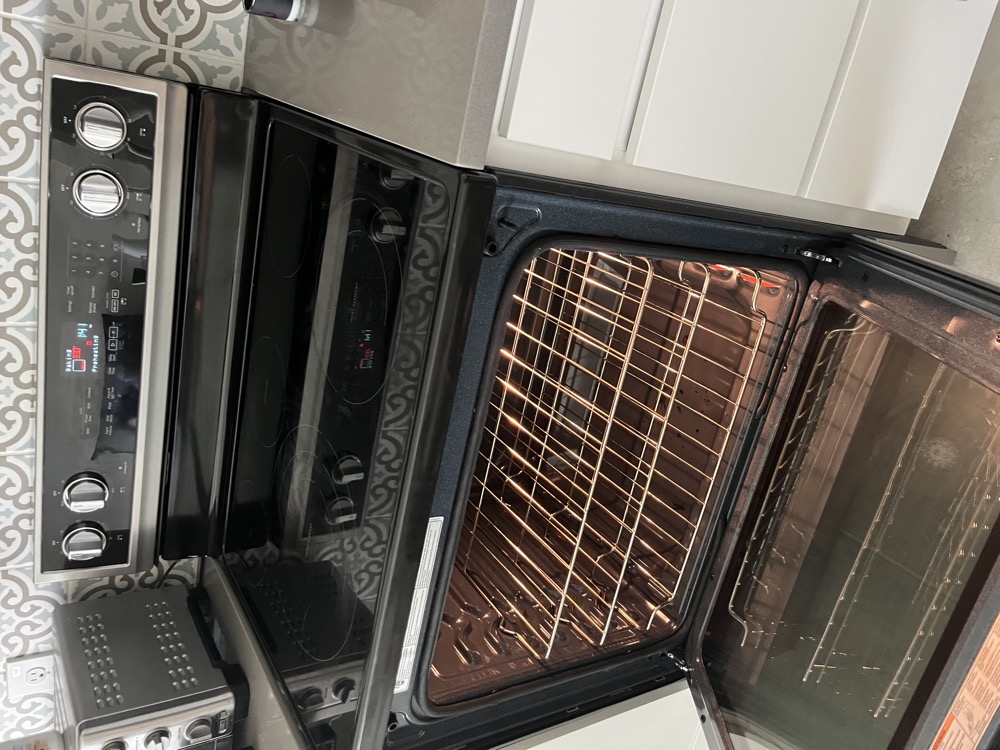
The heating element — 35% of what we replace
An oven element is a steel tube with a resistance wire running through it, packed in insulation. Push current through it and it glows. It has no moving parts and nothing to maintain, and it still fails more often than anything else in the oven, because every heat cycle expands it and every cool-down contracts it, and metal only tolerates that so many thousand times.
Most electric ovens have two: the bake element on the floor of the cavity, and the broil element across the ceiling. They fail independently, which is exactly why "does the broiler still work" is such a useful question.
What failure looks like. Often you can see it — a swollen blister, a crack, or a bright silver burn mark where the tube arced through. When an element fails dramatically it can flash and pop the breaker, which is alarming but not dangerous in a properly wired range. When it fails quietly, it simply goes open circuit inside and looks completely normal.
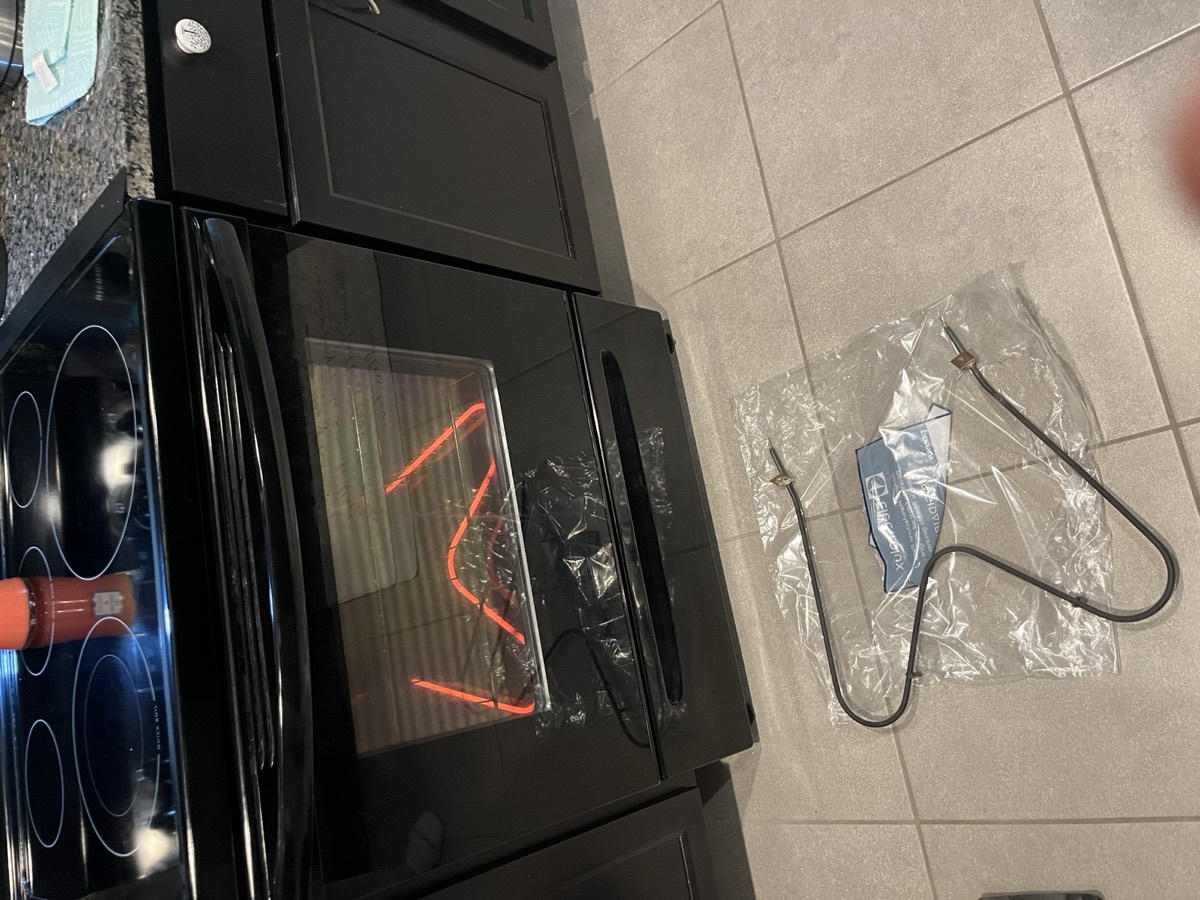
The quickest sanity check costs nothing. A healthy element should glow red along its entire length within a couple of minutes of the oven being switched on. One that glows red in patches, or stays dark while the oven pretends to work, has failed and will need to be replaced. Watch it through the door rather than with the door open, because an open door changes what the oven does.
The test. With the power off at the breaker, a healthy element measures roughly 15 to 40 ohms across its terminals, depending on wattage. An open reading means the element is done. It is a five-second test and it is conclusive — there is no in-between for an element that reads open.
Whether to do it yourself. On a freestanding electric range, a bake element is genuinely a homeowner job: two screws inside the cavity, two push-on connectors, no gas, no disassembly, no programming. The one thing to check first is those connectors, because a burnt terminal will destroy a new element in the same way it destroyed the old one. On a built-in wall oven it is a harder job, since the unit usually has to come out of the cabinet. If you want to see what the finished job looks like, here is a real oven heating element replacement from our own call log.
The gas oven igniter — 25% of what we replace
This is the part gas-oven owners have never heard of and the one that fails most on their machine. A gas oven does not use a spark. It uses a glow bar: a ceramic igniter that heats until it is orange, and the gas safety valve only opens once enough current is flowing through it. The igniter is both the ignition source and the switch that lets gas out — which is a safety design, and also why a weak igniter stops the oven completely.
The symptom that fools everybody. The igniter glows. It looks perfect. The burner never lights. Because the valve opens on current, not on brightness, an igniter can be visibly glowing and still too weak to pull the valve open. People replace boards and valves over this.
The 90-second rule. Turn the oven on, and time how long it takes from the igniter starting to glow to the burner actually lighting. Under about 45 seconds is healthy. Past 90 seconds, the igniter is weak and will fail soon even if it is still working today. A meter on the circuit tells the rest: a healthy igniter draws roughly 3.2 to 3.6 amps, and below about 3 amps the valve will not reliably open.
Do not let it run weak. A slow igniter means unburnt gas is being released into the cavity for longer than it should be before it lights, and the delayed ignition can arrive as a thump. It also cooks the valve. If your oven takes noticeably longer to get going than it used to, that is the part talking to you.
Igniters are the one gas repair with an honest DIY path on many freestanding ranges — the part is inexpensive, the swap is around twenty minutes, and it involves no work on the gas line itself. If the job requires disturbing any gas connection, stop and call somebody. Here is a documented oven igniter replacement from a recent Tampa call, if you want to see what is involved.
The control board — 20% of what we replace
The control board is the only expensive part in this article, and it is the one most often replaced when it did not need to be. It is the oven's brain: it reads the sensor, decides when to close the relay that feeds the element or opens the gas valve, and runs the display. When it genuinely fails, it usually fails in one of two recognisable ways.
The first is a dead relay. The board's own electronics still work, so the clock is lit and the buttons respond, but the relay that switches power to the bake circuit has welded or burned. You get a perfectly normal-looking oven that never makes heat. The second is an error code, and codes are worth writing down because most of them point at a specific circuit rather than at the board itself.
Why I test before I quote a board. A board is model-specific, frequently superseded by a newer number, and often the single most expensive part in the machine. Replacing one to fix a fault that was actually a 20-dollar sensor is the most expensive mistake in oven repair. Every board I sell gets there by elimination: element tested, sensor tested, supply voltage confirmed at the board's own terminals, and only then the board. You can see one that genuinely needed it in this oven control board replacement.
Florida adds a real factor here. We are the lightning capital of the country, and summer storm surges take out appliance boards across Tampa Bay every year. If your oven died during a storm, or died the same week the garage fridge started acting strange, that is a power-quality story rather than a wear story — and a whole-home or plug-in surge protector is a cheaper conversation than the next board.
The surface burner switch — 20% of what we replace
Strictly, this one is not an oven fault at all, and that is exactly why it belongs on this page. One in five calls that come in as "my range will not heat" turns out to be a cooktop burner, and the part is the infinite switch — the switch body behind the knob that controls a surface element.
It has a confusing name and a simple job. It is not a thermostat and it does not measure anything. It pulses the burner on and off on a repeating cycle, and turning the knob changes how much of each cycle is on-time. Low is not a lower voltage; low is the same full power for a smaller slice of each cycle. That is why an electric burner on low visibly glows and fades.
What a failed one does. Three patterns, all common. A burner stuck on full heat regardless of the knob, which is a welded contact and worth turning off at the breaker today. A burner that clicks but never heats. Or a burner that works on high and nowhere else.
The swap test, free and conclusive. On a coil range, lift the dead element out and plug it into a working position. If it heats there, the element is fine and the switch is the fault. If it stays cold in a good position, the element is the fault. On a smoothtop you cannot do this, and it is a meter job.
The two cheap parts worth ruling out first
The oven temperature sensor. A thin metal probe in the upper back corner of the cavity, and the reason a lot of ovens "heat wrong" rather than not at all. It should read about 1,080 ohms at room temperature and rise steadily as it warms — roughly two ohms for every degree Fahrenheit. A sensor reading far off at room temperature is telling the board a lie, and the board acts on the lie: shutting off early, running long, or refusing to start a cycle. It is a low-cost part and it unclips from the back wall in minutes. One detail worth knowing: the probe has to sit in its correct position, standing clear of the cavity wall. A sensor bent back against the metal reads the wall rather than the air, and that alone can end up preventing the oven from heating to the number you actually set.
The thermal fuse or thermal cutoff. A one-time safety device that opens permanently if the cavity overheats, which cuts power to the heating circuit entirely. Cheap part, awkward access — usually the appliance has to come out and the back panel off. It is worth naming out loud whenever an oven is completely dead with no error code, because it is the failure most likely to be misdiagnosed as a board.
One more thing that is free to check and gets missed: the door. An oven door that is not sealing and working properly — one that no longer closes flush, or has a crushed gasket — will let enough heat out that the oven never satisfies its own thermostat or temperature sensor, and runs forever without reaching temperature. Hinges sag over years of being leaned on. Before you spend anything, close the door on a sheet of paper at a few points around the frame and see whether it pulls out easily.
The self-clean cycle, and why it causes so many of these calls
If your oven stopped heating within a day or two of running a self-clean cycle, you have almost certainly already found your cause. This is one of the most dependable ways there is to break an appliance that was working perfectly.
A self-cleaning oven locks its door and runs the cavity to somewhere around 900°F to reduce baked-on food to ash. That is far hotter than it ever gets while you are cooking, and all that heat has to go somewhere. It goes into the thermal fuse, which is built to open before the cabinet is damaged and frequently does exactly that. It goes into the door lock motor. And it soaks into the control board sitting in the console directly above the cavity. Those oven parts are perfectly happy at 350°F for twenty years and distinctly unhappy at 900°F for four hours.
This is why so many Thanksgiving-week calls open with the same sentence: "I cleaned it on Sunday so it would be ready." The oven may complete the cycle without complaint and then refuse to heat once everything cools down. If you use self-clean at all, run it a couple of weeks before you actually need the oven, ventilate the kitchen, and never run two cycles back to back. A damp cloth and some patience causes none of these oven problems.
When the oven heats but stops short of the temperature you set
This is the pattern people search for most specifically and find the least help on — an oven that stalls at 175, or will not climb past 250, or reaches 300 and quits. It is a different diagnosis from a cold oven, and the number it stops at is a real clue.
An oven not heating properly is a genuinely different complaint from an oven not heating at all. This is an oven not getting up to temperature rather than one refusing to start, and the difference decides the whole diagnosis. Here the machine is working — it simply never gets hot enough, or will not hold the correct temperature once it arrives, or stops heating up properly halfway through a preheat. Before assuming a malfunction, check the temperature settings themselves. An oven left in demo mode after a showroom or a delivery, a Sabbath mode nobody remembers enabling, or a calibration offset somebody entered years ago will all miss the set temperature every time with nothing actually broken. I have driven out for that more than once.
Start by trusting nothing about the display. Put a standalone oven thermometer on the middle rack, set 350, and read it after 20 minutes. You are separating three cases:
- The display and the thermometer roughly agree, both low. The oven is genuinely not making enough heat. On electric, that is usually one of two elements gone while the other carries on — check whether the broiler is doing the work. On gas, it is a weak igniter that opens the valve slowly and lets the burner cycle off too early.
- The display says 350, the thermometer says 300. The oven thinks it has arrived. That is a sensor reading high, or plain calibration drift. Almost every modern oven has a temperature offset in the settings menu, and if the gap is under about 25 degrees this costs nothing to correct.
- It climbs normally, then stalls hard at the same number every time. A repeatable ceiling points at something switching off deliberately — a board relay dropping out as it warms, a sensor whose reading runs away as it heats, or a thermal cutoff at the edge of opening. This is the one that needs a meter and a heat cycle to catch.
Brand patterns worth knowing: a stall right around 175 to 200 shows up often enough on Samsung ranges to be worth checking the bake element and its relay specifically, and Whirlpool-family ovens that will not pass 100 or 250 usually come back to the element or the sensor rather than the board. In both cases, the honest answer is that the symptom narrows it to two or three parts and a meter settles it — anybody promising you the answer from the number alone is guessing.
Brands we work on, and what usually goes wrong on each
We are an independent shop, not a factory service centre for anybody, so we work on all of these and we have no reason to talk you into one brand's parts over another's. Find your model family below — it is printed on the model tag, which on a freestanding range lives on the frame behind the bottom storage drawer, and on a wall oven on the door frame once the door is open.
| Brand | Model families we see most | What tends to fail first |
|---|---|---|
| Samsung | NX58, NX60 gas ranges · NE58, NE59, NE63 electric · NV51 wall ovens | Bake element and its board relay. The classic complaint is an oven that will not climb past roughly 175 to 200. |
| Whirlpool | WFE electric ranges · WFG gas ranges · WOS, WOD wall ovens | Bake element, then the temperature sensor. Boards are usually innocent until proven otherwise. |
| GE | JB, JBS electric · JGB, JGBS gas · PGS, PSB Profile · JT wall ovens · Café CGS | Glow-bar igniter on the gas models — the single most-replaced GE part we carry. Elements on electric. |
| Frigidaire | FFEF, FCRE electric · FFGF, FCRG gas · GCRE, FGGH, FGEH Gallery · FPEF Professional | Igniters on gas, bake elements on electric, and surface burner switches more often than most brands. |
| LG | LRE electric ranges · LRG gas ranges · LSE slide-in · LWS, LWC wall ovens | Igniter on gas, element on electric. LG boards are among the pricier ones, so testing before quoting matters here. |
| KitchenAid | KFEG, KFED electric · KFGG gas · KOSE, KODE wall ovens · KSGB commercial-style | Elements and sensors. On the double wall ovens, the upper and lower cavities fail independently. |
| Maytag | MER electric ranges · MGR gas ranges · MEW wall ovens | Bake element first, igniter on gas. Shares most parts with the Whirlpool family. |
| Kenmore | Model numbers starting 790, 665 or 110 | Kenmore never built anything. The first three digits identify the real manufacturer, and that decides which parts fit — always quote us the full number. |
| Bosch | HEI, HEIP electric · HGI, HGS gas · HBL, HBE wall ovens · 300, 500 and 800 Series | Sensors and door hinges. Bosch elements last well; a sagging door that leaks heat is the more common complaint. |
| Electrolux | EI30, EI36 ranges · EW, ECWS wall ovens | Elements and boards. Shares a parts family with Frigidaire, which usually helps availability. |
| Amana | AER electric ranges · AGR gas ranges | Elements and igniters. Simple machines, cheap parts, quick visits. |
| Jenn-Air | JGRP, JDRP Pro-Style · JES, JGS slide-in · JJW wall ovens | Igniters on the pro-style ranges, boards on the wall ovens. |
| Thermador | PRG, PRD Pro Harmony and Grand · POD, POM wall ovens · MED, MES Masterpiece | Igniters and safety valves on the gas ranges. Parts are ordered, not stocked, so diagnosis accuracy matters more. |
| Wolf | GR gas ranges · DF dual fuel · SO built-in ovens · M Series | Igniters and thermostats. Built to be repaired rather than replaced, which is the whole reason people buy them. |
| Viking | VGR gas ranges · VDR dual fuel · VSOE, VESO wall ovens · 3, 5 and 7 Series | Igniters, safety valves and door hinges. Heavy doors are hard on hinges over a decade. |
| Miele | H 6000 and H 7000 series wall ovens · HR ranges | Sensors and boards. Everything is model-specific and ordered in. |
| Bertazzoni | MAS Master · PRO Professional · HER Heritage series ranges | Igniters and thermostats on the gas ovens. |
Two brand notes worth having. Sub-Zero does not make ovens — if you have a Sub-Zero kitchen, the cooking half is Wolf, and that is the page you want. And on Sub-Zero, Wolf and Viking we carry a 12-month parts and labour warranty rather than the 90-day labour warranty that applies to standard brands, because those are the machines we do the most specialised work on.
What an oven repair actually costs in Tampa
Here is our whole pricing structure, and it fits in two sentences. The visit is $69, which covers a proper diagnosis and goes entirely toward the repair if you approve the work. If we cannot fix it, you do not pay the $69 at all.
The ranges below are parts and labour together, for the repairs on this page. They are planning numbers, not quotes — the real figure gets written on your invoice after the machine is on a meter, and it is a number, not a range. But nothing on this list has ever surprised somebody who read this table first.
These numbers are also what makes the repair or replace question straightforward for most people. Every repair on this page costs a fraction of a new oven, so unless the machine is genuinely old, having a repair technician restore it is the cheaper path by a wide margin. The calculator below runs that arithmetic honestly, including the two or three cases where we would tell you not to bother.
| Repair | Typical all-in | Notes |
|---|---|---|
| Diagnostic visit only | $69 | Waived entirely if we cannot fix the machine. Applied in full if we can. |
| Thermal fuse or cutoff | $119–$159 | Cheap part, awkward access. The appliance usually has to come out. |
| Surface burner switch | $129–$169 | The cooktop repair that arrives as an oven complaint. |
| Door hinge or gasket | $129–$179 | Fixes the oven that runs forever and never gets there. |
| Temperature sensor | $139–$179 | Often the real answer when a board was suspected. |
| Bake or broil element | $149–$189 | Our most common repair, and usually same-visit. |
| Gas oven igniter | $169–$219 | Stocked for most common ranges, so normally one visit. |
| Oven control board | $199–$229 | The top of our range. Quoted only after everything cheaper is eliminated. |
Five checks worth doing before you call anybody
You can troubleshoot an oven that will not heat considerably further than most people expect without owning a single tool. All five checks below are free, all five take under ten minutes, and between them they solve or correctly diagnose a real share of the calls we get. None of them requires taking anything apart.
- Reset the circuit breaker properly. An electric range runs on a double-pole 240-volt breaker — two switches joined together. One leg can fail while the other holds, which is what gives you a working clock and a cold oven, and a tripped circuit breaker does not always look tripped. Push both fully to off, then fully to on. On gas, confirm the shutoff valve behind the range is genuinely open.
- Look at the element. Pull the racks and study the loop on the floor of the cavity, then the one on the ceiling. You are looking for a blister, a split, or a bright silver burn scar. This one check identifies about a third of all no-heat calls without a single tool.
- Time the igniter, if it is gas. Turn the oven on and watch. From the igniter beginning to glow to the burner catching should be under about 45 seconds. Past 90 and the part is weak, even if it still lights today.
- Put a thermometer in it. A supermarket oven thermometer on the middle rack, set to 350, read at 20 minutes. It separates "not heating" from "heating wrong", and those are two completely different repairs.
- Write down the error code and the model number. The code narrows the circuit; the full model number decides which parts fit. Have both ready when you call and you will usually get a straight answer on the phone instead of a guess.
What not to touch yourself
Most of this page is written to help you do things. This part is written to stop you.
Do not flip a switch, do not turn a light on or off, do not test anything. Get everyone out of the house, and call your gas company from outside. An electrical switch throwing a spark in a room with gas in it is the one scenario where troubleshooting becomes dangerous instead of useful.
Once the gas company has cleared the house, then it is an appliance question, and usually a safety valve or an igniter that is letting gas out before it lights.
Beyond that, three lines I would not cross in my own kitchen:
Anything on the gas supply side. The line, the manifold, the safety valve, the fittings. Swapping a glow-bar igniter does not require touching any of these, and the moment a job does, it belongs to somebody licensed and insured for it.
An oven that keeps eating elements. Two elements in two years is not bad luck, it is a symptom. Something is delivering too much current, or a terminal is arcing, or the supply is unstable. Replacing the part a third time just buys another few months and another bill.
Buying a control board on a guess. This is the most expensive mistake available to you on this page. Boards are model-specific, often superseded, and usually non-returnable once the anti-static bag is open. If nobody has put a meter on the element, the sensor and the supply voltage, nobody yet knows it is the board. Contact a professional before you spend that money, even if the professional turns out not to be us.
What the trade asks first — and why
If you post "my oven will not heat" in r/appliancerepair, where working technicians answer, you will not get a list of ten causes. You will get a question back, and it is nearly always the same one: make, full model number, gas or electric, convection or not. The second question, on electric, is usually whether the element glows at all.
That is not gatekeeping. It is the actual diagnostic order, and it is worth understanding because it is exactly what the ten-cause listicles leave out. Gas or electric eliminates half the possible parts immediately. The model number decides which parts physically fit and which known faults apply. And "does it glow at all" splits a total failure from a partial one, which are different repairs at different prices.
So when you call us and lead with "Whirlpool WFE515S0ES, electric, the broiler works and the bottom does not" — you have done the same work those technicians are asking for, and the conversation starts three steps further along. That is the whole reason the tool at the top of this page asks what still works before it asks anything else.
What happens when we come out
A no-heat visit runs the same way every time and takes about an hour. We turn on the oven and watch what it actually does before touching anything, because the first minute tells us whether the oven is heating at all or heating badly — and those are two different repairs. Then we inspect the heating element and its terminals, take temperature readings from the sensor both cold and hot, and confirm supply voltage at the board itself rather than at the wall outlet.
Only after that does anybody say a part name out loud. Whether your oven needs an element, an igniter, a sensor or a board depends entirely on what those readings say. How fast we can get your oven back into service depends mostly on whether the part rides on the van, and elements, igniters, sensors and the common burner switches usually do — which is why most of these finish in one visit.
You get a written number before any work starts, and the $69 diagnostic comes off it. If the oven still cannot be fixed once it is open, or the repair stops making financial sense, we will tell you plainly and you pay nothing at all. We would rather lose the job than sell you a board to restore your oven when a new range is the better buy.
Not sure which one you have? Call or text (813) 522-0014 with your model number and what still works, and we will tell you what it most likely is before anybody gets in a van.
Same-day and next-day slots across Tampa, South Tampa, Carrollwood, Brandon, Valrico, Wesley Chapel, Zephyrhills and Dade City. Book online or read more about oven and range repair.
Questions we get asked on these calls
Why is my oven on but not hot?
The control side is alive and the heating side is not. On an electric oven that is usually a failed bake element or a lost leg of the 240-volt supply; on a gas oven it is usually an igniter too weak to open the safety valve. The display lighting up only proves the 120-volt control circuit works, which is a different circuit from the one that makes heat.
How do I tell if my oven's heating element is bad?
Look at it first — a failed element often shows a blister, a split, or a bright burn mark. If it looks fine, test it: with the power off at the breaker, a healthy element reads roughly 15 to 40 ohms across its terminals. An open reading with no continuity means the element has failed internally, and that result is conclusive.
Why does my stove work but not my oven?
Because they are largely separate systems that happen to share a cabinet. The cooktop burners have their own switches and, on gas, their own spark ignition, while the oven has its own element or glow-bar igniter. Working burners actually rule out several things — your power supply and gas supply are both fine — which narrows the fault to inside the oven cavity.
Is it worth fixing a 7-year-old oven?
Almost always yes. At seven years a range is mid-life, and every repair on this page costs a fraction of a replacement. The arithmetic only gets difficult past about 15 years, or when the quote climbs toward half the price of a new machine. High-end ranges are worth repairing considerably longer, because they were designed around parts being replaced.
How much does it cost to fix an oven that will not heat?
Our diagnostic is $69 and it comes off the repair if you go ahead. The common repairs land between $119 and $229 all in, parts and labour together — elements and igniters at the lower end, control boards at the top. If we cannot fix it, there is no fee at all.
Can I replace an oven heating element myself?
On a freestanding electric range, yes, and it is one of the few appliance repairs I will say that about. Two screws inside the cavity, two push-on connectors, power off at the breaker first. Check the terminals for burn damage while you are in there. A built-in wall oven is a harder job because the unit generally has to come out of the cabinet.
Why does my oven only heat to 175, or stop at 250?
A repeatable ceiling means something is cutting the heat off deliberately rather than nothing working at all. The usual candidates are a partly failed element still producing some heat, a temperature sensor whose reading drifts as it warms, or a board relay dropping out once it is hot. Put an oven thermometer in and compare it with the display — if they disagree it is a sensor or calibration problem, and if they agree it is a heat production problem.
Can a power surge damage my oven?
Yes, and in Tampa Bay it is a real factor rather than a theoretical one. We are in the most lightning-prone part of the country, and summer storm season reliably takes out appliance control boards. If your oven died during or just after a storm, or several appliances started misbehaving in the same week, treat it as a power-quality problem — a surge protector is far cheaper than the next board.
Get it fixed
The repair page for this problem: oven and range repair — what we carry on the van, how the $69 diagnostic works, and same-day availability.
Your brand: Samsung · Whirlpool · GE · Frigidaire · LG · KitchenAid · Maytag · Kenmore · Bosch · Electrolux · Amana · Jenn-Air · Thermador · Wolf · Viking · Miele · Bertazzoni
Related reading: Dryer not heating covers the same no-heat logic on the other machine that makes heat. What appliance repair costs in Tampa explains how we price work. How to choose a repair service is worth five minutes before you call anyone, including us.
Call or text (813) 522-0014 or book online — Perfect Appliance Repair Tampa covers Tampa, South Tampa, Carrollwood, Brandon, Valrico, Wesley Chapel, Zephyrhills, Dade City, and the surrounding Tampa Bay area.
Anatoli Didenco is the owner-technician of Perfect Appliance Repair Tampa, with 20+ years of hands-on technical experience in refrigeration and appliance repair across Hillsborough, Pinellas, and Pasco Counties. He specializes in refrigerators — particularly Sub-Zero, Wolf, and premium built-in systems — and sealed-system and compressor work. He personally answers the phone and shows up at the door. Read more on the About page.
Perfect Appliance Repair Tampa serves Tampa, South Tampa, Wesley Chapel, Zephyrhills, Dade City, and the surrounding Tampa Bay area. Reviews are available on the company’s Google Business Profile and BBB listing.
We Stand Behind Our Work.