
Published April 7, 2026 · Updated August 15, 2026
Your refrigerator just stopped cooling, and the first question on your mind is the honest one: what is this going to cost me? This guide is how I answer that question at real kitchen counters across Tampa Bay every week — what makes one repair minor and another a big job, what you can check yourself, and when putting money into an old fridge stops making sense.
Need help right now? Call (813) 522-0014 — same-day appointments are often available. The diagnostic visit is $69, and you get a written repair estimate before any work begins.
In this guide:
- How much does refrigerator repair cost in Tampa?
- Why can’t anyone quote an exact price over the phone?
- Is it the compressor?
- Which repairs are usually minor and which are the big ones?
- What can you safely check before you call?
- Can waiting make the repair more expensive?
- How does the $69 diagnostic work?
- The one upgrade that prevents the biggest repair bills
- What breaks where: Tampa neighborhoods and their refrigerators
- Repair or replace: how a technician decides
- Frequently asked questions
How much does refrigerator repair cost in Tampa?
Here’s the truthful answer, and it’s more useful than a made-up number: the spread is wide, because “refrigerator repair” covers everything from a worn door gasket to a full sealed-system job — and the biggest common repair can run roughly ten times the smallest one. The cost to repair a refrigerator depends far less on the symptom than on which part actually failed. What you can expect to pay comes down to three cost factors: the part, the labor to reach and replace it, and the refrigerator brand and type you own.
If you search “average refrigerator repair cost,” you’ll find national figures all over the map. Averages don’t fix your fridge — a diagnosis does. That’s why the process here is simple: a $69 diagnostic visit, then an exact written estimate with parts and labor separated, before any repair work starts. You decide with a real number in front of you, not a phone guess.
With that said, here’s what refrigerator repairs actually run in the Tampa market. Every job starts at $69 — and some end there, because when the diagnostic finds a surge-locked control board that a reset clears, a blocked vent, or a settings problem, the visit itself is the fix. When a part is involved, these are the honest working ranges:
| Repair | Typical range (parts + labor) |
|---|---|
| Diagnostic visit — every repair starts here | $69 |
| Door gasket / seal | $75–$250 |
| Thermostat or temperature sensor | $100–$300 |
| Defrost system (heater, sensor, timer) | $100–$300 |
| Ice maker repair or module replacement | $100–$400 |
| Evaporator or condenser fan motor | $100–$450 |
| Water leak, valve, or clogged defrost drain | $75–$350 |
| Control board | $200–$600 |
| Compressor replacement | $400–$1,200 |
| Sealed-system leak repair | $400–$1,200+ |
These are typical ranges, not quotes — your exact number comes in writing after diagnosis. Premium built-ins can run above these ranges, and are still usually far cheaper to repair than to replace.
And one rule of thumb to hold onto from the start: repair usually wins when the problem is isolated, the fridge is under 10–12 years old, and the estimate comes in under half the price of a comparable new refrigerator. More on that decision below.
Technician note. Refrigerator repairs really come in two tiers. Tier one is electrical, airflow, and water: sensors, fan motors, defrost parts, gaskets, valves, control boards. Tier two is the sealed system: compressor, evaporator, condenser, refrigerant. Most calls I run in Tampa Bay are tier one — and the expensive mistake is paying for tier-two work when the real problem was tier one, because "warm fridge" looks exactly the same from the kitchen either way.
Why can’t anyone quote an exact price over the phone?
Because the symptom you see is not the failure that causes it.
Take the most common call we get: “My refrigerator isn’t cooling.” Behind that one sentence there could be blocked airflow (sometimes free to fix), a failed evaporator fan motor, a bad thermostat or sensor, a defrost failure icing over the coils, a control board problem, or a genuine sealed-system fault. Those are completely different repairs with completely different price tags — for the identical symptom.
So when a repair service quotes you a firm price over the phone, they’re either guessing or planning to revise the number at your kitchen counter. An honest sequence looks like this: diagnosis with instruments — temperature probes, amperage readings, gauge readings where needed — then a named failed component, then a written estimate. An estimate without a diagnosis is a guess formatted as a price.

Is it the compressor?
This is the fear behind most calls, so let’s deal with it directly: usually, no.
Most refrigerators that come back to life in Tampa do it with a tier-one repair — a defrost part, a fan motor, an ice maker module, a sensor, a board. A few patterns from the field:
- Freezer cold, fridge warm. This is the most misdiagnosed symptom in the area. It’s almost always airflow or defrost — ice or a failed evaporator fan blocking circulation between the freezer and the fresh-food section — not the sealed system. Don’t approve compressor work until defrost and airflow have been definitively ruled out.
- Clicking every few minutes and no cooling on an LG. That’s the classic sign of a failed linear compressor — the known weak point of LG’s 2014–2017 French-door generations, and in Tampa I see it most on the LFXS, LMXS, and LFXC families. Two things to know before you pay anyone: the correct fix is the updated-design compressor kit rather than the original part, and LG covers the compressor under a 10-year sealed-system warranty on most post-2014 models. Our LG compressor replacement guide explains how to check yours.
- A “compressor problem” that ends at $69. Not every compressor symptom is a compressor. A clicking start relay, a surge-locked board that a reset clears, or cooling loss caused by blocked airflow can all imitate one — and when the diagnostic visit itself resolves it, the bill is exactly $69. That’s the cheapest possible version of the scariest symptom, and it happens more often than people expect.
- Running constantly but still cooling. Often dirty condenser coils or a leaking door gasket making the compressor compensate — caught early, that’s maintenance, not a major repair.
Which repairs are usually minor and which are the big ones?
Without quoting numbers a phone call can’t promise, here’s how the work honestly sorts itself, from a technician’s side of the toolbox:
Usually minor. Door gaskets, thermostats and temperature sensors, defrost heaters, evaporator fan motors, most ice maker repairs, a clogged defrost drain, a leaking water valve. Small parts, reasonable labor — these are the everyday fixes, and they’re the majority of what I see in Samsung, Whirlpool, Frigidaire, GE, and KitchenAid kitchens across Tampa Bay.
The middle of the range. Control boards. The part costs more, and in Tampa boards fail most often after lightning storms — more on that below.
The big ones. Compressor replacement and sealed-system leak repairs. This is real refrigeration work: gauges, a vacuum pump, EPA-certified refrigerant handling, OEM parts. It’s the most expensive category of refrigerator repair, and it’s exactly where the repair-or-replace question deserves a careful answer instead of a sales pitch.
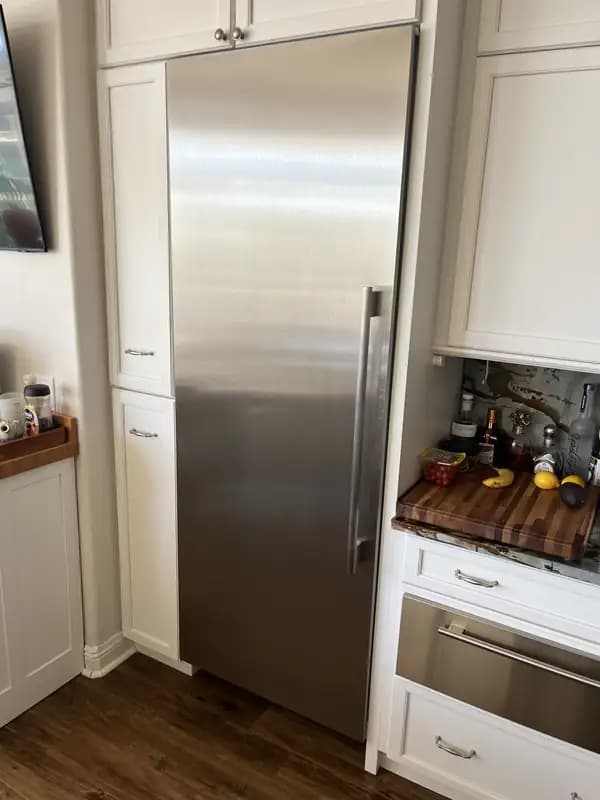
Built-in and specialty units. A panel-ready built-in column, a Sub-Zero, a wine cooler — the labor is more involved because the unit has to come out of cabinetry, and premium brands need OEM parts (aftermarket sealed-system parts on a Sub-Zero are a false economy that leads to repeat failures). The repair costs more, but so does the refrigerator it saves. We service these regularly — see Sub-Zero and built-in repair and wine cooler repair.
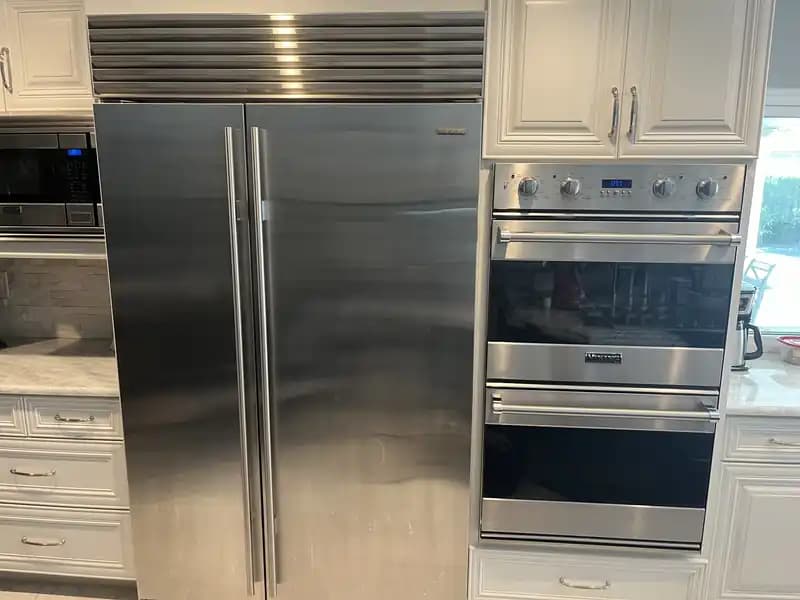
A Sub-Zero deserves its own note, because it’s the clearest example of “from $69 to a real project.” The most common Sub-Zero calls I run — a clogged condenser that needs cleaning, or a tired condenser fan motor on a unit past its first decade — start at the $69 visit, with fan motor replacements landing in the same $100–$450 range as any quality fan motor job. These units run dual compressors and are built to be serviced for twenty-plus years, so major sealed-system work usually doesn’t enter the conversation until well past the 10-year mark — an age where many mass-market refrigerators are already replacement candidates, sometimes after trouble in their very first years. That’s the quiet financial logic of premium built-ins: more per repair, far more years per dollar.
What can you safely check before you call?
None of this requires tools or opening panels, and it can either save you a service visit or make the visit faster and more accurate.
- Power. Check that the outlet works (plug in a lamp) and the breaker hasn’t tripped. After a storm, unplug the fridge for five minutes and plug it back in — a surge can lock the control electronics in a fault state that a simple reset clears.
- Settings. The fresh-food section should be at 37–40°F, the freezer at 0°F. Settings get bumped during cleaning and by kids more often than you’d think.
- Airflow. Food pressed against the back wall or blocking the vents creates “warm fridge, cold freezer” symptoms that cost nothing to fix.
- The door seal. Close a dollar bill in the door. If it slides out with no resistance, the gasket isn’t sealing and the compressor is running overtime to compensate.
- The error code. If the display shows a code, photograph it before doing anything else. A power cycle can clear it, and that code tells a technician which subsystem to look at first.
And the safety line: unplug the refrigerator before touching anything behind or underneath it, and leave refrigerant, wiring, and board-level work alone. That’s not gatekeeping — it’s where DIY gets expensive. The costliest jobs I see are refrigerators that arrived at a big repair through a chain of forum-guided part swaps: a board bought online that didn’t fix it, a forced test mode that masked the real symptom, weeks of running half-broken while the compressor quietly absorbed the damage.
Not sure what your fridge is telling you — a code, a sound, a puddle? Describe it and we'll tell you what it usually means in a Tampa home. A photo of the display code helps.
Can waiting make the repair more expensive?
Yes — and in Florida, faster than anywhere else in the country.
A refrigerator running warm doesn’t just stay broken at the same level. The compressor strains the whole time it fights a problem somewhere else in the system, so a part-level fix left alone for weeks can grow into a compressor-level bill. The margin is measured in days, not months.
There’s also the cost that never shows up on a repair invoice: the groceries. In Tampa summer heat, food starts spoiling within hours once a fridge stops cooling. Waiting several days for the cheapest possible appointment can cost more in a lost freezer full of food than the difference you saved. If your refrigerator is completely down, that’s what our emergency refrigerator repair service exists for.
How does the $69 diagnostic work?
Simple and transparent. A technician comes out, inspects the refrigerator with instruments, identifies what failed and what test confirmed it, and gives you a written repair estimate with parts and labor listed separately. If you approve the repair, that $69 is applied to it — and nothing else gets added on top: no trip fee, no shop fee, no upsells. If you decide not to repair, the $69 covers the diagnostic visit and you owe nothing further. What you’re buying is certainty: the real problem and the real number, before you commit to anything.
Standard repairs come with a 90-day labor warranty.
Whichever appliance repair company you call in Tampa Bay, hold them to that same structure: a diagnosis that names the component and the test that confirmed it, parts and labor separated in writing, a warranty on the work. “I poked around and it seems like the compressor” is not a diagnosis — it’s a guess you’d be paying for.
"Mark came out the same day I called and was very professional and knowledgeable. He showed me what was wrong with my freezer and fixed it. He saved me a lot of money because I thought I would have to buy a new one." — Chuck Riley, Google review
What determines the final repair price?
Once the diagnosis is done, the estimate comes down to a few honest variables:
The part, and whether it’s OEM. A sensor is a small part; a compressor is a serious one. On premium brands, OEM parts cost more once — the wrong part costs more twice.
Labor and access. A top-freezer with rear coils in an open kitchen is a quick job. A counter-depth unit in a tight alcove, or a built-in that has to come out of cabinetry, takes real time.
The brand’s warranty fine print. LG’s 10-year linear compressor coverage is the famous one. Manufacturer warranties on other brands typically cover the first year in full, and some cover sealed-system parts longer. It’s always worth checking before paying out of pocket.
Refrigerant type. Many newer refrigerators run R-600a (isobutane), which is flammable and requires specific training and equipment for sealed-system work. Not every company in Tampa Bay is set up for it — ask before you schedule.
Parts availability. Certain Samsung and LG model lines lose parts support 8–10 years in. When a part is discontinued, that fact alone can settle the repair-or-replace question.
Why is Tampa so hard on refrigerators?
Understanding this explains half the repair bills in the area.
Lightning. Tampa Bay sees 100+ lightning days a year — the most in North America. Control boards are the most common surge casualty I diagnose, and board replacements cluster right after summer storms. A quality appliance-rated surge protector costs a fraction of one board and is the single cheapest insurance you can buy for a modern refrigerator.
Humidity. Year-round humidity means longer compressor cycles, faster door gasket wear, and defrost systems fighting more moisture than they were designed for. Defrost and ice maker failures are simply more common here than in dry climates.
Heat, garages, and salt air. A garage refrigerator in a Tampa August works brutally hard, and dirty condenser coils in that environment put the compressor on a countdown. Near the water, salt air corrodes coil fins and connections faster than inland.
The one upgrade that prevents the biggest repair bills
If I could get every Tampa Bay homeowner to do a single thing after reading this guide, it’s this: put real surge protection on your refrigerator. In a market with 100+ lightning days a year, the control board is the most common storm casualty I diagnose — a $200–$600 repair — and quality surge protection costs a fraction of that, once.
What to buy depends on what’s in your kitchen:
- Standard plug-in refrigerators — Samsung, LG, Whirlpool, GE, Frigidaire. A point-of-use surge protector specifically rated for large appliances: joule rating above 1,000, clamping voltage below 400V, and ideally a time-delay relay. That last feature matters more than the marketing suggests — it protects the compressor from the voltage jolt at the exact moment power returns after an outage, which is when compressors get hurt.
- Premium built-ins — Sub-Zero, Thermador, Viking, Monogram. These carry more electronics, and the outlet usually sits behind cabinetry where a plug-in unit is impractical to reach and check. For these kitchens the proportionate answer is protection at the electrical panel — a whole-home surge protector installed by an electrician — with an appliance-rated point-of-use unit as a second layer where the outlet is accessible. When the refrigerator is a five-figure built-in, panel-level protection is cheap insurance.
- Garage and outdoor-kitchen units. They see the dirtiest power and the hardest duty cycle in the house. Protect them first, not last.
One honest caveat: no plug-in device stops a direct lightning strike. What surge protection reliably prevents is the accumulated damage from the dozens of smaller spikes every Tampa storm season delivers — the ones that quietly cook control boards and inverter electronics over time. Either way, it’s worth knowing the signs your refrigerator took storm damage.
What breaks where: Tampa neighborhoods and their refrigerators
After enough years on Tampa Bay’s roads, you learn that the repair map follows the housing map. Knowing your neighborhood’s pattern tells you what to maintain — and what a realistic repair bill looks like before anyone arrives.
South Tampa, Davis Islands, Harbour Island — Sub-Zero country. Waterfront kitchens, premium built-ins, and salt air that corrodes condensers faster than anywhere inland. The money-saving moves in South Tampa are condenser cleaning every six months (not the annual schedule the manual suggests) and panel-level surge protection. Most Sub-Zero calls here start — and often end — at the $69 diagnostic: cleaning, gaskets, fan motors, long before anything approaches sealed-system money.
Wesley Chapel, Wiregrass, New Tampa — Samsung territory. Newer subdivisions full of Samsung French-door refrigerators, which means one thing above all: ice makers. In this humidity, ice bridging and fill-tube freeze-overs are the everyday call in Wesley Chapel — caught early they sit at the low end of the price table, ignored they climb toward defrost-system money. If yours is acting up, start with our Samsung ice maker guide.
Dade City, Zephyrhills, Land O’ Lakes — LG and hard water. More LG refrigerators per mile, plus well water around Dade City that scales up inlet valves and fill tubes within months. Two patterns dominate: mineral-clogged water systems at the low end of the table, and the LG linear compressor story above — where the 10-year warranty can turn the biggest repair on this page into a much smaller one. Zephyrhills side-by-sides — Whirlpool, Kenmore — add the classic uneven-freezer defrost complaint, which is almost never the sealed system.
Carrollwood, Westchase, Brandon — the mixed middle. GE, Whirlpool, KitchenAid, and Frigidaire in roughly equal numbers, where the money-savers are the universal ones: clean coils, healthy gaskets, surge protection, and calling the same week a symptom appears.
And if the refrigerator that’s down is at your business — the reach-in at a restaurant, the merchandiser at a store — the same map applies with revenue on the line next to the groceries. We run commercial refrigeration repair for True, Turbo Air, Hoshizaki, Traulsen, Manitowoc, and Scotsman equipment — same $69 diagnostic logic, same instruments, faster clock.
Repair or replace: how a technician decides
Skip the “replace after 10 years” rule — it’s too blunt to be useful. Here’s the framework I actually use at the kitchen counter:
Repair when the problem is isolated — a fan motor, sensor, gasket, defrost part, ice maker — and the sealed system is intact; when the unit is under 10–12 years old without a history of major failures; when the estimate is under roughly half the price of a comparable new refrigerator; or when it’s a premium built-in like a Sub-Zero, Monogram, or Thermador, where a new unit costs many times the repair and the existing one is built to be serviced for decades.
Replace when the sealed system is failing on an ordinary standard-depth unit that’s 12+ years old; when parts are discontinued; when several major systems are failing at once; or when an old fridge’s energy costs and repeated breakdowns are quietly adding up to a second bill every month and a new fridge is honestly the cheaper path.
A 10-year-old refrigerator is not automatically “old.” If a well-maintained 10-year-old fridge needs a fan motor, fixing it is usually the right money. For the deeper version of this decision, see Is It Worth Repairing a Refrigerator? and How Long Do Refrigerators Last in Tampa?
"First to repair my Sub-Zero wine fridge with refrigerator drawers and most recently my Samsung dryer… He is thorough and methodical in his assessment of the problem and explains what needs to be replaced and why. Repairs are completed quickly and his pricing is fair." — Sung Family, Google review
How to keep refrigerator repair costs down
Five habits do most of the work in this climate:
- Act on early signs the same week. Warm spots, new noises, slow ice production — small problems compound fast here. Here are 20 signs your refrigerator needs repair.
- Clean the condenser coils every 6 months — every 4 if you have pets. More expensive repairs trace back to dirty coils than to any other preventable cause.
- Keep the door gaskets clean and test them. Wipe the folds with a damp cloth and run the dollar-bill test seasonally. Our door seal maintenance guide covers it step by step.
- Put an appliance-rated surge protector on the fridge. In a 100-lightning-day market, this is not optional equipment.
- Photograph error codes before power-cycling. Free diagnostic information that regularly saves a second service visit.
One myth worth retiring: most generic “fridge maintenance” advice — deep-cleaning schedules, deodorizing, polishing — is housekeeping, not repair prevention. Coils, gaskets, airflow, and surge protection are the four things that actually move the repair bill.
Frequently asked questions
How much does it cost to fix a refrigerator that’s not cooling?
That symptom alone can’t price the job — not cooling is the one complaint with the widest range of causes, from free (blocked vents) to the top tier (sealed system). Most not-cooling calls in Tampa end as tier-one fridge repairs: defrost, fan motor, or sensor work. The refrigerator not cooling page walks through how we handle these visits.
What is the most common refrigerator repair?
In Tampa Bay: defrost system failures, ice maker problems, fan motors, and storm-damaged control boards. All of them sit in the everyday tier of repair costs, and all of them get cheaper the earlier they’re caught.
What is the most expensive refrigerator repair?
Sealed-system work — compressor replacement or a refrigerant leak. It requires gauges, a vacuum pump, certified refrigerant handling, and OEM parts — typically $400–$1,200 or more installed — which is why it’s the top tier of refrigerator repair costs and the point where the repair-or-replace conversation gets serious.
How much does a refrigerator compressor cost to replace?
Typically $400–$1,200 installed, but check two things before accepting that number. On post-2014 LG models the 10-year sealed-system warranty often covers the compressor itself, and on any brand a compressor symptom can end at $69 when the real cause turns out to be a relay, a surge-locked board, or blocked airflow. That’s exactly why the diagnosis comes before the estimate.
Is a 10-year-old refrigerator worth repairing?
It depends entirely on what failed. A sensor, fan, gasket, defrost part, or ice maker — usually yes. A sealed-system failure on an ordinary standard-depth unit at that age — usually no. That’s exactly the question the $69 diagnostic answers before you spend real money.
Is it cheaper to repair or replace a refrigerator?
If the estimate comes in under roughly half the cost of a comparable new refrigerator and the sealed system is healthy, repair usually wins — especially for built-ins, where replacement costs many times the repair. Age, condition, repair history, and even energy costs all factor in. The full framework is in Is It Worth Repairing a Refrigerator?
Does a home warranty cover refrigerator repair?
Sometimes. Manufacturer warranties typically cover the first year in full, and some brands cover sealed-system parts longer — LG’s 10-year linear compressor coverage is the big one. Home warranty plans are a separate contract: they charge their own service fee and use their own repair network, so read your policy before booking any independent technician.
Do you repair built-in and specialty refrigerators?
Yes — built-in columns, Sub-Zero and other premium built-ins, wine coolers, and ice makers are regular work for us, not exceptions.
How fast can someone come out?
Same-day appointments are often available, and refrigerators that have stopped cooling are treated as urgent — in this heat, groceries don’t wait. Call (813) 522-0014 early in the day for the best slot, or see emergency refrigerator repair.
Related services
Book a diagnostic or read more about the exact repair:
- Refrigerator repair
- How long refrigerators last in Tampa — and what cuts their life short
- Refrigerator light not working? Bulb, switch, or LED board
- Different types of commercial refrigerators
- Ice maker repair
- Emergency refrigerator repair
Call or text (813) 522-0014 or book online — Perfect Appliance Repair Tampa covers Tampa, South Tampa, Wesley Chapel, Zephyrhills, Dade City, and surrounding Tampa Bay.
Anatoli Didenco is the owner-technician of Perfect Appliance Repair Tampa, with 20+ years of hands-on technical experience in refrigeration and appliance repair across Hillsborough, Pinellas, and Pasco Counties. He specializes in refrigerators — particularly Sub-Zero, Wolf, and premium built-in systems — and sealed-system and compressor work. He personally answers the phone and shows up at the door. Read more on the About page.
Perfect Appliance Repair Tampa serves Tampa, South Tampa, Wesley Chapel, Zephyrhills, Dade City, and the surrounding Tampa Bay area. Reviews are available on the company’s Google Business Profile and BBB listing.
We Stand Behind Our Work.