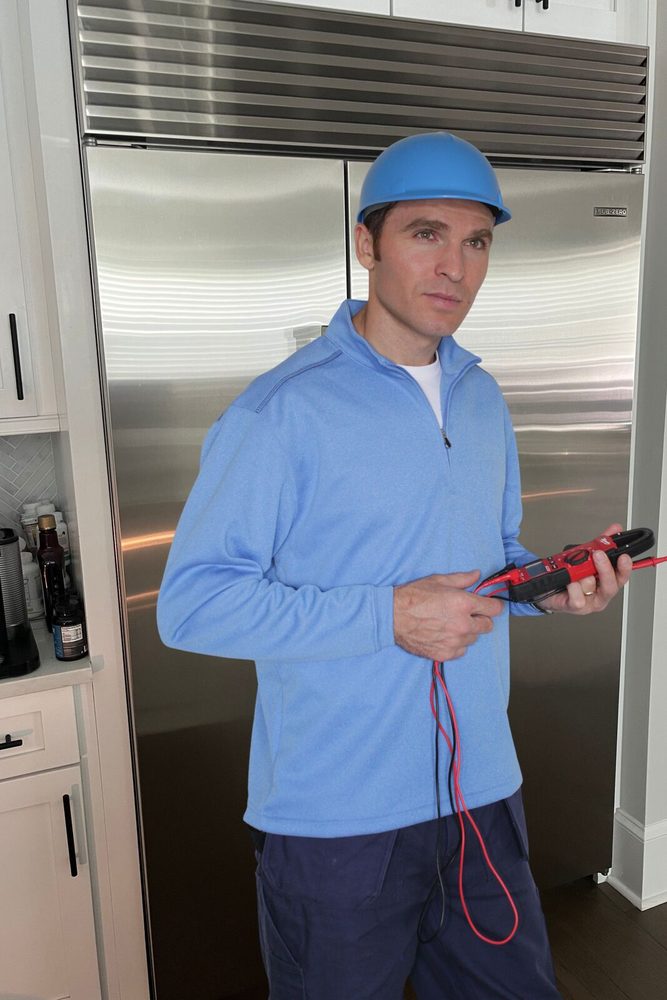
Before you read anything else: you have about four hours
A refrigerator that has stopped cooling is the same thermal situation as a refrigerator with no power. Federal food-safety guidance is specific about that window, and it is shorter than most people assume.
What to do in those four hours, in order: stop opening the doors — every look costs you minutes. Move anything you genuinely cannot replace into a cooler with ice. Put a real thermometer on the middle shelf so you are working from a number instead of a guess. Then work the checks below. FoodSafety.gov's rule for what comes after is blunt and worth repeating: when in doubt, throw it out, and never taste food to decide whether it is safe.
And know what is sitting in there. After twenty years of opening other people's refrigerators, my working number for a full family fridge and freezer is $300 to $400 of food — roughly a fifth to a third of what a new mid-range refrigerator costs. That is a figure from my own service calls, not a published statistic, and yours will differ. But it changes the arithmetic more than people expect: lose the contents twice while putting off a repair and you have spent more than the repair, with nothing to show for it. It is also why "wait and see if it comes back" is usually the most expensive option on the table.
The short version (read this in 60 seconds)
If your refrigerator is not cooling, do not jump straight to “bad compressor.” That is one possibility, and it is nowhere near the most likely one.
Nearly every no-cool call I run in Tampa Bay resolves to one of three questions, in this order. Can it move air? Blocked vents, a dead evaporator fan, a frost-choked evaporator, a stuck damper, a torn gasket. Can it get rid of heat? Dirty condenser coils, a dead condenser fan, no clearance behind the cabinet, a room that is simply too hot. Can it move refrigerant at all? A failed start relay, a surge-killed control or inverter board, a sealed-system leak or restriction, a compressor that is actually done.
Those three questions are the whole diagnosis. Airflow problems are the most common and the cheapest. Heat-rejection problems are the ones Florida creates and the ones that quietly destroy compressors over months. Sealed-system problems are the rarest and the most expensive — and the ones most often sold to people who did not need them.
So troubleshoot in that order. Start with power and the circuit breaker, then the temperature control setting, then the vents and the refrigerator door seals, then the condenser coils — and put a real thermometer inside rather than trusting the display, which shows a set point rather than a measurement. The FDA target is 40°F or below in the refrigerator and 0°F in the freezer. Those checks are free, they cover the most common possible causes, and between them they resolve a genuine share of the calls I get. If none of them brings it back, stop guessing and get the failure path proved — the tool below is where that starts.
Why a refrigerator not cooling is a symptom, not a diagnosis
A refrigerator does not make cold. It moves heat — out of the cabinet, through the refrigerant, and off the condenser coil into your kitchen. Break any link in that chain and the customer sees exactly one thing: the box is warm.
Which link broke is the entire question, and the symptom pattern narrows it a long way before anyone opens a panel. A freezer that is still cold while the fresh-food side is warm is almost never a compressor. A refrigerator that is silent is a different problem from one that is running non-stop. Those are not the same repair, they are not the same price, and they do not lead to the same repair-or-replace decision.
Pick what you are actually seeing:
Percentages are my own call-log distribution across Tampa Bay refrigerator no-cool visits, not a published industry statistic. They are there to tell you what to check first, not to substitute for a meter.
How to reset a refrigerator that is not cooling
This is the first thing most people ask, and it deserves a straight answer: yes, unplugging a refrigerator resets it, and yes, it is worth doing once — but it fixes a much narrower set of problems than the internet suggests.
Here is what a reset actually does. Pulling power clears the control board’s working memory and any latched fault state, drops the unit out of demo or showroom mode in some models, and lets a compressor that tripped its thermal overload cool down and equalise pressure so it can try to start again. What it does not do is repair a failed part. If your evaporator fan motor is dead, your defrost heater is open, or your coils are packed with dust, the reset will change nothing, and repeating it just delays the real fix.
How to reset a refrigerator properly:
- Unplug it at the wall, or switch off the circuit breaker feeding it. Do not just tap the power button on the display — that does not cut power to the board.
- Wait a full five minutes. Less than that and the compressor has not equalised, and it may fail to restart against head pressure. Some manufacturers say twenty minutes; five is the realistic minimum.
- While it is off, look at two things. Check the temperature control setting has not been knocked off — a refrigerator door being loaded against the dial is a genuinely common cause. And check the ice maker is not jammed with a partial harvest, because a stuck ice maker can hold a machine in a state where it will not cool properly.
- Plug it back in and listen. You should hear the compressor start within a few minutes and the fans come up. Then leave it alone for 24 hours before judging it — a refrigerator that has fully warmed up takes that long to pull back down, and opening the refrigerator door every hour to check will guarantee it never gets there.
- Check the circuit breaker too if nothing at all happens. A tripped breaker or a GFCI outlet that has kicked out looks exactly like a dead refrigerator, and it costs nothing to rule out.
When the reset is the actual fix: a surge or brownout has confused the control board, the unit is stuck in demo mode after a power event, or the compressor tripped on overload during a hot afternoon and needed to cool down. All three are real, all three are common in Tampa Bay after a summer storm.
When a reset is only buying you time: if cooling comes back and then fails again on a schedule of a few days, you have a defrost fault, not a control fault — ice is rebuilding on the evaporator each cycle and choking the airflow. Resetting a defrost problem every three days is not maintenance; it is a countdown.
How to check if the compressor is working
The other question I get constantly, and you can answer it yourself without a meter. Pull the refrigerator out and put your hand flat on the compressor — the black, football-shaped canister low down at the back. It should be warm to hot and humming with a steady, low vibration. That is a compressor running.
Three readings and what each means. Warm and vibrating, but the cabinet is warm: the compressor is running and the problem is somewhere else — usually heat rejection or airflow, so look at the condenser coils and both fans. Hot and silent, clicking every few minutes: it is trying to start and failing, which is usually the start relay rather than the compressor. Cold and completely still, with power confirmed at the outlet: either no power is reaching it or it is genuinely dead, and that needs a meter to tell apart.
One thing that catches people out: a hot compressor is not automatically a bad compressor. They are supposed to run hot. Too hot to keep a hand on for more than a second or two, on the other hand, points at a unit working against dirty coils or a dead condenser fan — which is the failure path that eventually kills it.
How to clean the condenser coils
If the compressor is running and the cabinet still is not getting cold, this is the free repair to do before you call anyone, and it is the one that most often works.
Unplug the refrigerator first. Find the coils — on most units built in the last fifteen years they sit behind a snap-off kick plate underneath the refrigerator; on older and some built-in models they are on the back. Take out anything loose, then vacuum with a brush attachment, working with the fins rather than across them so you do not bend them flat. A coil brush gets what the vacuum cannot reach at the back of the bundle. While you are down there, spin the condenser fan blade with a finger: it should turn freely and quietly, and any grinding or resistance means that motor is on its way out.
Two things worth doing at the same time, since the refrigerator is already unplugged and pulled out. Wipe the door seals with warm soapy water — a gasket that looks worn is often just grimy, and a dirty seal lets a steady trickle of warm air into a cabinet that is fighting to stay cold. And check you have real clearance behind the unit; a refrigerator pushed flat against drywall is re-breathing its own exhaust.
Then plug it in, leave the doors shut, and give it a full day. If frost builds up on the evaporator again within a couple of weeks, or the cabinet never comes back down to 40°F, the coils were not the problem and you have ruled out the cheapest cause for the price of an afternoon. That is not a wasted afternoon — it is the first line of any honest diagnosis, and it is the same thing I do before I open a meter.
Why Florida makes a fridge that is not cooling worse
Every no-cool cause above exists in Michigan too. What Florida changes is how fast a marginal refrigerator crosses the line from “coping” to “failed” — and the seasonality of that is measurable.
Search demand for this exact problem rises about 50% from the winter trough to the summer peak, and the peak lines up precisely with the four months when Tampa’s average daily high sits at or above 90°F.
Clean your condenser coils in March or April, not in July. A refrigerator that is 80% of healthy will hold 37°F through a Tampa winter and quietly fail the first week the kitchen sits at 80°F all day. The heat does not break the refrigerator — it exposes the fault that was already there. Doing the free maintenance before the season is the single highest-value thing on this page.
The mechanism is not folklore. Peer-reviewed field work across 235 homes found that the room temperature around the cabinet accounts for roughly 75% of a refrigerator’s total energy consumption — far more than door openings (about 15%) or defrost cycles (about 10%). And the EIA’s own national survey data shows it in the bill: the average main refrigerator in the South draws 646 kWh a year against 617 nationally.
Humidity compounds it. Tampa’s average afternoon relative humidity in August is 90%. Every door opening in a Florida kitchen loads the evaporator with far more moisture than the same door opening in Denver, which means more frost, more defrost cycles, and more opportunities for a marginal defrost component to matter.
Refrigerator not cooling: every possible cause, explained
Here is the honest field breakdown. Some of these are safe homeowner checks. Others require meters, gauges, temperature testing, refrigerant certification, and experience.

1. Dirty condenser coils. Dirty condenser coils are one of the most common and most preventable causes of poor cooling. The condenser coil is where the refrigerator releases heat. If the coil is covered with dust, pet hair, grease, or kitchen debris, the system cannot reject heat efficiently. The compressor runs hotter and longer. The refrigerator may still cool a little, but it struggles to recover after door openings and may never reach the correct temperature. Common signs: refrigerator runs almost constantly, compressor feels very hot, food is not staying cold enough, freezer temperature rises during the day, the bottom or rear of the refrigerator is packed with dust or pet hair. What you can do: unplug the refrigerator, remove the lower grille or rear access panel if your model allows it, and gently clean the coils with a coil brush and vacuum. Do not bend tubing, pull wires, or spray water into electrical areas. If cooling improves after cleaning but does not fully recover, the dirty coil may not be the only problem.
2. Condenser fan motor not running. The condenser fan pulls air across the condenser coil and compressor area. If that fan fails, the refrigerator cannot reject heat properly. On many units, the condenser fan is near the compressor behind the refrigerator or underneath the cabinet. If the compressor is running but the fan is not moving, the compressor can overheat and shut down or run inefficiently. Common signs: compressor is hot, refrigerator is warm, rear/bottom fan is not spinning, you hear buzzing or clicking, cooling gets worse in a hot kitchen or garage. This repair needs a technician. Do not keep running the refrigerator for days with a failed condenser fan — you can turn an affordable fan repair into a sealed-system or compressor repair.
3. Evaporator fan motor not moving cold air. The evaporator fan circulates cold air inside the freezer and refrigerator compartments. If the evaporator fan stops, the freezer may stay partly cold while the refrigerator section gets warm. This is one of the classic symptoms customers describe: “The freezer is cold, but the fridge is warm.” Common signs: freezer still has some cold temperature, fresh-food section is warm, you do not hear the inside fan running when the door switch is pressed, airflow from the vent feels weak or missing, fan area has ice buildup or a grinding noise. A bad fan motor is possible. So is a fan blocked by ice, a failed door switch, control board, thermistor, damper, or wiring problem. The fan is part of the answer, but it is not always the whole answer.
4. Frost buildup or defrost system failure. Modern refrigerators use automatic defrost systems. If the defrost heater, defrost sensor, thermistor, thermostat, fuse, wiring, or control board fails, frost can build up on the evaporator coil until airflow stops. When airflow stops, the refrigerator section warms first. Later the freezer temperature rises too. Common signs: freezer back panel has heavy frost or snow, refrigerator is warm but freezer still seems cold, airflow from the refrigerator vent is weak, you hear fan noise hitting ice, cooling improves for a few days after a full manual defrost, then fails again. A manual defrost can be a temporary clue, not a final repair. If the refrigerator works after being unplugged for 24 hours and then warms again days later, that often points toward a defrost or airflow problem.
5. Low refrigerant charge or sealed-system leak. Customers often say, “Maybe it needs Freon.” In refrigerator work, people use “Freon” to mean refrigerant, but modern refrigerators may use different refrigerants depending on the model and year. A refrigerator does not normally consume refrigerant. If it is low, there is usually a leak or sealed-system problem. Adding refrigerant without finding the leak is not a quality repair — it is a temporary patch, and in many cases the refrigerator will fail again. Common signs: both refrigerator and freezer are warm, compressor runs for long periods, evaporator has only a partial frost pattern, compressor runs but cabinet temperature will not pull down. Sealed-system work is not DIY work. It requires proper tools, recovery procedures, leak diagnosis, brazing skill, vacuum, charging accuracy, and EPA Section 608 certification for refrigerant handling.
6. Compressor or start system failure. The compressor is the heart of the sealed system. It moves refrigerant through the system. But a compressor problem is not always a compressor replacement. The compressor may fail electrically, mechanically, or it may fail to start because of a start relay, overload, capacitor, inverter board, wiring issue, or control problem. On newer refrigerators with variable-speed or inverter compressors, diagnosis can be more complex. Common signs: clicking every few minutes, compressor is very hot, fans run but no cooling happens, compressor hums and shuts off, refrigerator trips the breaker, no frost pattern on the evaporator. A proper compressor diagnosis should include electrical testing, start-component testing, control/inverter testing where applicable, and sealed-system evaluation. Replacing a compressor without proving the cause is how customers end up paying for the wrong repair.
7. Blocked air vents or overpacked refrigerator. Sometimes the refrigerator is not broken. Cold air simply cannot move. Food containers pushed tight against the rear wall, blocked freezer vents, overstuffed shelves, plastic bags, and poorly arranged items can block airflow. Common signs: one shelf freezes while another area is warm, refrigerator cools better after food is rearranged, fresh-food section is packed tight, vents are blocked by containers. What you can do: move items away from vents, avoid packing food tight against the back wall, and give the refrigerator several hours to stabilize.
8. Door gasket leaks. A damaged door gasket lets warm, humid Florida air enter the refrigerator. The compressor runs longer, frost forms faster, and temperatures drift upward. Common signs: door does not close tightly, gasket is cracked, torn, sticky, or folded, moisture appears around the door opening, frost forms near the air leak, refrigerator runs too much. Clean the gasket with mild soap and warm water. If it is torn, deformed, or no longer seals, it should be replaced.
9. Bad temperature sensor, thermistor, thermostat, or control board. Modern refrigerators depend on sensors and boards. A thermistor tells the control board what temperature the cabinet or evaporator is reading. If that sensor lies, the refrigerator may stop cooling too soon, overcool, run too long, or fail to defrost correctly. Common signs: display temperature does not match actual temperature, refrigerator cools inconsistently, compressor or fans do not run when they should, error codes appear, defrost cycles behave strangely. This is why I like to verify temperature with a real thermometer. The number on the display may be a set point, not the actual internal temperature.
10. Air damper problem. Many refrigerators move cold air from the freezer into the fresh-food section through a damper. If the damper is stuck closed, iced over, or not being commanded correctly, the refrigerator section can warm while the freezer stays cold. Common signs: freezer is okay but fresh-food side is warm, little or no airflow enters the refrigerator section, damper area makes clicking or buzzing noise, temperature changes after reset, then fails again. A damper problem can be mechanical, iced, sensor-related, or control-related. It should be tested before replacement.
11. Refrigerant restriction, filter drier issue, or capillary tube restriction. A sealed system can fail not only from a leak, but also from a restriction. Moisture, contamination, failed compressor oil, or a blocked filter drier/capillary tube can restrict refrigerant flow. Common signs: compressor runs but cooling is weak, odd frost pattern on evaporator, one section of the system is too cold while another is not doing its job, previous sealed-system repair was done poorly. Restrictions can look similar to low refrigerant or compressor problems unless the technician knows how to read the frost pattern, temperatures, pressures, and system behavior.
12. Installation, clearance, and room temperature problems. A refrigerator needs breathing room. If it is pushed too tight against the wall, built into a cabinet with poor airflow, placed near an oven, or used in a hot garage, cooling problems can show up even when parts are technically working. In Florida, this matters — a refrigerator that performs acceptably in winter may struggle in July if the garage or kitchen gets too hot. Common signs: cooling is worse in the afternoon, refrigerator runs almost constantly, problem gets worse during summer, unit is in a garage, pantry, outdoor kitchen, or tight built-in space. Check your model’s installation instructions for clearance and ambient temperature limits.
The ambient trap: garages, tight cabinets and Florida rooms
Manufacturers publish an operating range for these machines, and almost nobody reads it. Whirlpool specifies 55°F to 110°F for indoor household use. GE says it does not recommend installation below 60°F or above 110°F, and explains the mechanism plainly: above 110°F, “the oil could overheat and break down, thus damaging the compressor or sealed system.”
That is not a warranty technicality. It is a description of how a garage refrigerator dies in Florida.
If your second refrigerator lives in an uninsulated Tampa garage, it is running outside its design range for a good part of the year and there is no repair that changes that. Three real options, in order of cost: move it indoors; replace it with a garage-ready model (GE rates those to 110°F specifically); or ventilate and shade the space so the air around it stays under 100°F. Cleaning the coils on a garage unit twice as often as an indoor one is not optional either — it is the only lever you have left.
And on the other side of the same coin: a refrigerator crammed into a cabinet with no clearance is in the same trouble as one in a hot garage, because it is re-breathing its own exhaust. Whirlpool’s spec calls for a quarter-inch minimum at the sides and top; in practice I want to see real air behind the unit, and I want the condenser fan pulling from somewhere other than the coil it just heated.
The Tampa storm problem: surges kill boards, not compressors
Florida leads the country in lightning, and every summer I run the same call: the power blinked, and when it came back the refrigerator was dark and silent. Homeowner assumes compressor. It almost never is.
The outlet tests live. The compressor windings test fine. The main control board is dead — a surge went through it and took out the low-voltage side. On a modern inverter refrigerator there is a second board that can go the same way, and on LG and Samsung linear-compressor units that inverter board is a specific and well-known failure point.
The difference matters enormously in money. A board is a few hundred dollars installed. A compressor is the top of the range, plus sealed-system work, plus recovery and recharge. Being told “it’s the compressor” the day after a storm, without a meter having touched the board, is the single most expensive misdiagnosis in this trade.
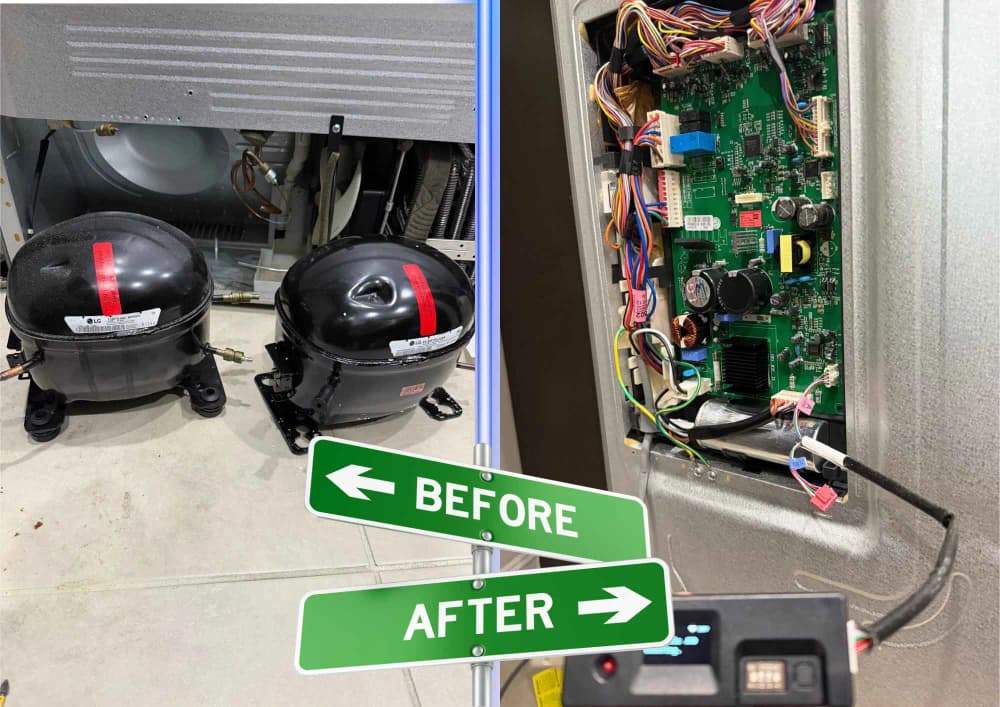
Put a surge protector on the refrigerator — a real one, rated for an inductive appliance load, not a power strip. It is inexpensive against the cost of a control board, and in a Tampa Bay summer it is the cheapest insurance in the kitchen. If a storm has just gone through and your refrigerator is dark, ask the technician one question before approving anything: did you test the board and the compressor windings separately?
2026 technician update: ask for a Cooling Triangle Diagnosis
Here is the new field-level option I recommend customers ask for in 2026: a Cooling Triangle Diagnosis.
A no-cool refrigerator is not diagnosed by one part. It is diagnosed by the relationship between three corners:
- Airflow. Are the evaporator fan, condenser fan, vents, damper, and door seals allowing air to move correctly?
- Heat rejection. Are the condenser coils clean, is the condenser fan working, and is the compressor able to reject heat without overheating?
- Frost pattern. Does the evaporator show an even frost pattern, a partial frost pattern, a frost block from defrost failure, or no frost at all?
When those three points are checked together, the diagnosis becomes much cleaner.
If airflow is bad but the sealed system is healthy, the repair may be a fan, damper, frost blockage, gasket, or defrost issue. If airflow is good but the frost pattern is weak or partial, the problem may be sealed-system related. If the condenser cannot reject heat, cleaning coils or replacing a condenser fan may solve the root problem before the compressor is damaged.
Expert opinion — Anatoli Didenco, owner, Perfect Appliance Repair Tampa. When I walk up to a refrigerator that is not cooling, I do not start by selling a compressor. I start by asking: where did the cooling chain break? Most bad no-cool diagnoses happen because someone looks at one clue and treats it like the whole answer. A hot compressor does not always mean a bad compressor. A warm fridge and cold freezer does not always mean a fan motor. Low refrigerant is not something you "top off" like windshield washer fluid. A dirty condenser coil can be the cause, but it can also be the thing that damaged another component over time. The right way is to test the chain: power, controls, fans, airflow, condenser heat rejection, evaporator frost pattern, compressor behavior, and sealed-system indicators. That is why my 7-point inspection exists. It protects the customer from paying for a guess. My advice to Tampa Bay homeowners is simple: clean the coil, check the basic airflow, keep a thermometer in the fridge, and if the temperature is still above safe range, call someone who can explain the failure path in plain English.
My 7-Point Refrigerator No-Cool Inspection
When I arrive for a refrigerator not cooling call, I use a structured process instead of guessing.
1. Customer symptom and history. I ask what changed, when it started, whether there was a power outage, storm, prior repair, noise, ice buildup, water leak, or temperature swing.
2. Power, settings, and control check. I verify power, control settings, display behavior, error codes, Sabbath/demo mode where applicable, and whether the controls are calling for cooling.
3. Door seal, loading, and airflow inspection. I inspect gaskets, blocked vents, cabinet loading, damper behavior, and fresh-food/freezer airflow.
4. Condenser coil and condenser fan inspection. I check the heat-rejection side: coil condition, fan operation, clearance, dust buildup, pet hair, grease, and compressor-area temperature.
5. Evaporator, fan, and defrost inspection. I inspect evaporator airflow, fan operation, frost pattern, defrost heater/sensor indicators, blocked drain, and signs of ice blocking air movement.
6. Compressor, start device, inverter, and electrical testing. I test the compressor circuit, start relay, overload, capacitor, inverter board where applicable, wiring, sensors, and electrical loads before calling a compressor bad.
7. Sealed-system evaluation and repair plan. If the evidence points to refrigerant loss, restriction, or compressor failure, I explain the sealed-system condition, the likely repair path, parts availability, cost, warranty, and whether repair or replacement makes better financial sense.
The goal is not to sell the biggest repair. The goal is to give you the correct diagnosis.
What you can safely check before calling a technician
You do not need to be a technician to check the basics. These steps can save you time and sometimes avoid a service call.
Check the temperature with a thermometer. Do not rely only on the digital display. Put a thermometer in the refrigerator and freezer. The food-safety target is refrigerator at or below 40°F and freezer at 0°F.
Check the power. Make sure the refrigerator is plugged in, the outlet works, and the breaker/GFCI has not tripped.
Check the controls. Confirm the temperature settings were not changed. Some units have Sabbath mode, demo mode, vacation mode, or control lock features that can confuse the diagnosis.
Move food away from vents. Leave room for airflow.
Clean the condenser coils. If you can access the coils safely, unplug the refrigerator and clean them gently with a coil brush and vacuum.
Look and listen for fans. If a fan is silent, grinding, blocked with ice, or not moving, that is a strong diagnostic clue.
Check the door gasket. Look for tears, gaps, deformation, or debris.
When to stop DIY and call a professional
Call a technician when the refrigerator is still above 40°F after basic checks; the freezer and refrigerator are both warming; the compressor is very hot, clicking, humming, or cycling off; there is heavy frost behind the freezer back panel; a fan is not running or is hitting ice; you suspect a refrigerant leak or sealed-system issue; the refrigerator is built-in, Sub-Zero, premium, or commercial equipment; or the repair may involve refrigerant, compressor replacement, brazing, or electrical testing.
A no-cool refrigerator can get more expensive if it runs too long in a failed state. If the compressor is overheating or the sealed system is struggling, waiting can damage parts that might have been saved.
Reddit and forum patterns: what real people keep asking
Reddit is not a service manual, and anonymous comments are not a substitute for a qualified diagnosis. But forum threads are useful because they show the same customer confusion technicians see every week.
The repeating patterns are clear: dirty coils can make a compressor run hot, but cleaning them does not always fix the deeper issue if a fan, sealed-system problem, or compressor damage is already present. “Freezer cold but fridge warm” is often an airflow problem — evaporator fan, frost buildup, damper, blocked vent, or defrost failure. A refrigerator that runs but will not cool can point toward frost-clogged evaporator coils, a stuck or broken evaporator fan, refrigerant leak, or compressor issue. Customers often get different diagnoses from different companies when the technician does not prove the failure path. On LG and other modern inverter/compressor units, sealed-system diagnosis requires more care than a quick visual inspection.
The honest takeaway: online symptoms can help you ask better questions, but they cannot tell you the exact repair. Your refrigerator needs testing.
What each of these actually costs
Nobody publishes an honest single number for “refrigerator repair,” and any page that gives you one is guessing. The national cost guides disagree wildly — Angi puts the average at $275, HomeAdvisor at $650, and those two are owned by the same company. So here is the spread across published sources instead of a fake average, laid out by what actually failed.
Read the chart left to right, not top to bottom. Every repair in the blue band is something you can attempt yourself in an afternoon, and together they resolve a large share of no-cool calls. Everything in the red band should never be approved on a verbal diagnosis — ask what was measured and what the reading was. And notice the overlap: a control board and a compressor can land at the same number, which is precisely why "it needs a compressor" deserves a follow-up question rather than a signature.
Two things the chart cannot show you. First, a diagnostic fee is separate almost everywhere — This Old House’s 2025 survey puts a typical service visit at $75 to $125. Ours is $69 and it comes off the repair if you approve the work. Second, refrigerant is not a consumable. A refrigerator does not use it up. If yours is low there is a leak, and topping it up without finding that leak is not a repair — it is a way of being back in the same position in four months, and it requires EPA Section 608 certification to do at all.
How long these machines are supposed to last
Before you decide whether to fix it, it helps to know where your refrigerator sits on the curve. The independent numbers are less flattering than the showroom is:
Find your refrigerator's age on the strip before you approve anything expensive. In the blue zone, fix it — even a compressor. In the amber zone, the deciding question is not the age but what else is tired: if the gaskets are hard, the icemaker already failed once, and the dispenser leaks, a sealed-system quote is money spent on a machine with three more failures queued up. In the red zone, only a built-in or premium unit usually justifies major sealed-system work, because on those the cabinet is part of the kitchen and replacement means a renovation.
Worth knowing before your next purchase: Consumer Reports finds plainly that “top-freezers are more reliable than other types of refrigerators, including the coveted French-door style,” and that units with through-the-door ice and water dispensers require the most repairs. The features that sell a refrigerator are the features that break it.
One honest caveat, because it cuts against my own headline: CR’s data says the most frequently reported refrigerator problems are icemakers and dispensers — not cooling. Cooling failures are not the most common thing that goes wrong with a refrigerator. They are simply the most consequential, because they are the only failure that empties the box of food in an afternoon.
Repair or replace?
The repair-versus-replace decision depends on four things: age of the refrigerator, brand and model, cost and availability of parts, and whether the failure is minor, major, or sealed-system related.
HomeAdvisor’s rule of thumb is a reasonable starting point and roughly matches what I tell people at the door: “stick with a repair if the quote comes in at 50% or less of a new unit’s price.” Under about eight years, almost everything is worth fixing. Past twelve, a sealed-system failure on a mid-range unit usually is not. Between those, it depends on what else on the machine is tired.
A dirty coil, fan motor, gasket, thermostat, sensor, defrost part, or damper can often be a reasonable repair. A sealed-system leak, compressor replacement, or repeated failure on an older low-end refrigerator may be a different conversation.
Premium built-ins, Sub-Zero units, undercounter wine coolers, and commercial refrigeration equipment often justify a more advanced repair because replacement cost is high and the cabinet is built into the space. A basic refrigerator that is old, rusted, and has a major sealed-system failure may not be worth saving.
A good technician should tell you both options, not just the one that creates the bigger invoice.
Before you let anyone open your refrigerator
BBB Accredited, A+ rated, and more than 200 five-star reviews across major platforms. Read what owners actually say on the reviews page — Google and BBB, in their own words.
And the honest part: if the coil cleaning and the reset above bring the temperature back and it holds, you don't need me.
Questions Tampa Bay homeowners ask
The frequently asked questions below come straight from real Tampa Bay service calls — short answers here, full details in the sections above.
Why is my freezer cold but my refrigerator is warm? Usually airflow. The freezer may still be making cold air, but that air is not reaching the fresh-food section. Common causes include a failed evaporator fan, frost-blocked evaporator, stuck damper, blocked vent, or defrost failure.
Can I just add Freon to my refrigerator? No. A refrigerator should not lose refrigerant under normal conditions. If it is low, there is usually a leak or sealed-system issue. Adding refrigerant without finding the leak is not a proper repair, and refrigerant work requires EPA-certified handling.
How often should I clean refrigerator coils in Florida? For most homes, every 6 months is a good starting point. If you have pets, dust, a garage refrigerator, or a hot kitchen, check them more often. Commercial and restaurant units need a much more aggressive schedule.
How long after cleaning coils should the refrigerator cool? You may see improvement within a few hours, but a full temperature recovery can take longer depending on food load, room temperature, door openings, and how warm the cabinet became. If it is still not approaching safe temperature after several hours, get it diagnosed.
Is a hot compressor always bad? No. A compressor can run hot because the condenser coil is dirty, the condenser fan failed, the unit is in a hot space, the start components are weak, or the sealed system is struggling. Heat is a clue, not a complete diagnosis.
What is the safe refrigerator temperature? The FDA recommends keeping the refrigerator at 40°F or below and the freezer at 0°F. Use a separate appliance thermometer because the refrigerator display may not show the actual internal temperature.
Should I unplug the refrigerator to defrost it? If the evaporator is blocked with frost, unplugging and fully defrosting can temporarily restore airflow. But if the defrost system has failed, the problem will usually return. Treat defrosting as a clue, not a final repair.
Does a not-cooling refrigerator always need a new compressor? No. Many no-cool problems are coils, fans, airflow, defrost, sensors, control boards, dampers, gaskets, or start components. A compressor should be diagnosed, not assumed.
Still isn’t cooling? The 10-minute recheck before you call
Most of the causes and solutions above take hours or days to show their full effect, so before you decide a fix failed — or spring for a new fridge — run this recheck. It catches the small things to check that get missed on the first pass, and it is the same list I walk through by phone when a caller says the refrigerator is not cooling properly a day after they thought they had solved it.
- Open the freezer first. If the freezer compartment is making cold and the fridge compartment is not, you are back to airflow — fan, frost, or damper — not the refrigerator compressor. An evaporator fan that stops working is far more common than a compressor that dies.
- Put your hand inside your refrigerator, on the back wall near the vents. Within a minute of the compressor kicking on you should feel cold air moving. Air you can hear but cannot feel means the path is blocked.
- Check the freezer door as carefully as the fridge door. A freezer door held ajar by a tilted ice-cream box is one of the most common possible reasons why your refrigerator loses its cold — the humid air it lets in frosts the evaporator over within days.
- Listen at the back of the appliance and at the top of the refrigerator. A fridge running constantly without ever clicking off is telling you it cannot reach temperature; total silence says it is not even trying. Both narrow the diagnosis fast.
- Re-clean what seals. Cleaning your gaskets with warm soapy water restores grip you did not know was lost. It costs nothing and takes five minutes.
- If the unit was just moved, give it space and time. When you install your refrigerator flush against the wall, the coils cannot shed heat — leave an inch or two of clearance, and give a just-moved machine 24 hours before judging its cooling performance.
If the refrigerator isn’t cooling properly even after this list, give it one more day — and if it still isn’t cooling properly after that, stop adjusting. When the fridge is not cooling no matter what you change, the remaining reasons your refrigerator stops making cold live behind panels: sensors, control boards, sealed-system pressure. That is the point where a qualified appliance repair technician can diagnose and repair it in one visit instead of you replacing parts on a guess. The goal is simple: keep your food cold this week, and fix your fridge for the fewest dollars that genuinely fix the issue. One warning worth repeating — if the fridge isn’t cooling and the freezer may not be cooling either, move faster: that pattern points at the sealed system, and in a Tampa kitchen the food-safety clock runs in hours, and a unit that is still not cooling on day two has earned a professional visit.
The bottom line
A refrigerator that is not cooling is urgent, but it is not a reason to panic or approve the first expensive repair someone suggests.
Start with the basics: power, settings, airflow, door seals, and condenser coils. Keep a thermometer inside the refrigerator and freezer. If the refrigerator stays above safe temperature or the freezer is warming too, bring in a professional who can test the full cooling chain.
My approach is simple: no guessing, no scare tactics, and no selling a compressor unless the diagnosis proves it. I inspect the refrigerator, explain the failure path, give an honest repair plan, and stand behind my work.
If your refrigerator is not cooling in Tampa, Wesley Chapel, Zephyrhills, Dade City, South Tampa, or the surrounding Tampa Bay area, call or text Mark at (813) 522-0014. I will help you figure out whether the repair is simple, serious, or not worth doing.
Sources
Food safety and the four-hour clock. FoodSafety.gov — Food Safety During a Power Outage. USDA — Avoid Foodborne Illness During Temporary Power Outages. FDA — Food and Water Safety During Power Outages and Floods. FDA — Refrigerator Thermometers: Cold Facts About Food Safety. Note that this guidance is written for power outages; a powered refrigerator that has stopped cooling is the same thermal situation, but that comparison is mine, not the agencies’.
Reliability and lifespan. Consumer Reports — Most and Least Reliable Refrigerator Brands (survey of 71,534 refrigerators with icemakers purchased 2015–2025; the 31% and 49% figures). Consumer Reports — Refrigerator Buying Guide (top-freezer reliability, dispenser failure rates, ~10-year life). InterNACHI — Standard Estimated Life Expectancy Chart for Homes (9–13 years).
Ambient operating range. Whirlpool — Proper Location and Environment for a Refrigerator (55–110°F, clearances). GE Appliances — Refrigerator Installation Location and Temperature (60–110°F, compressor-oil breakdown above 110°F). GE Appliances — Garage Ready models (38–110°F rating).
Energy and heat load. Harrington, Aye & Fuller, “Opening the door on refrigerator energy consumption: quantifying the key drivers in the home,” Energy Efficiency 11(6), 2018 — 235 homes; room temperature drives roughly 75% of consumption, door openings about 15%, defrost about 10%. EIA — Electricity Use in Homes and EIA RECS 2020 Table CE5.3b — 646 kWh/year South vs 617 kWh/year nationally.
Tampa climate. NOAA NCEI 1991–2020 Climate Normals, Tampa Intl AP (USW00012842) — 94.3 days per year at or above 90°F; monthly normals give average highs of 90.5°F June, 91.0°F July, 91.2°F August, 90.2°F September. NOAA NCEI 2023 Local Climatological Data Annual Summary, Tampa — 90% mean afternoon relative humidity in August.
Repair costs. Angi (2026), HomeAdvisor (2026), Fixr (2025), HomeGuide (2023), This Old House — Appliance Repair Statistics (2025 service-visit fees). Ranges are charted as spans across these sources rather than averaged, because they disagree by more than 2x on the headline number.
Refrigerant handling. EPA — Section 608 Technician Certification Requirements.
Search demand. Monthly search-volume figures for “refrigerator not cooling” are from Ubersuggest, August 2025 through July 2026, global volume.
Two things deliberately left out because I could not source them honestly: the dollar value of food in a typical refrigerator (no study exists — the figures circulating online trace back to marketing copy), and the widely repeated claim that dirty condenser coils raise energy use by 30% (no primary source). The cause percentages in the symptom tool are my own Tampa Bay call-log distribution and are labelled as such.
Brand notes: Kenmore, KitchenAid, Maytag, Amana and Viking
Six brands have their own not-cooling guides, with the model-specific parts and quirks: Samsung, LG, Whirlpool, GE, Frigidaire and Sub-Zero.
The brands below used to have their own guides on this site; everything worth keeping is here, because on the inside they are mostly the same machines.
Kenmore
Kenmore never built refrigerators — the first three digits of the model number tell you who did. 106. means Whirlpool: expect the classic evaporator fan, adaptive defrost and damper failures described above, with Whirlpool parts. 795. means LG, which puts it in linear compressor territory — read the LG guide and my LG compressor page before assuming the worst. Parts availability is the real Kenmore question in 2026; I source by the manufacturer's number, not the Sears one.
KitchenAid
KitchenAid runs on the Whirlpool platform. The French-door KRFF and KRMF models I see in Tampa Bay fail the Whirlpool way — fan, defrost, damper — and the built-in KBSD/KBSN side-by-sides behave like premium built-ins: a dusty condenser on top makes them run warm long before anything expensive breaks. KitchenAid repair details here.
Maytag
Modern Maytag is Whirlpool underneath. The MFI and MSS models share boards, fans and defrost parts with the Whirlpool section above; the "depend on Maytag"-era machines from before 2006 are a different, simpler animal that is usually worth fixing when anything short of the compressor fails. Maytag repair.
Amana
Amana is Whirlpool's budget line, which is good news: fewer electronics, a simpler defrost system, cheap parts. When an Amana stops cooling in a hot Tampa garage it is usually the condenser coils or the evaporator fan, not the sealed system. Amana repair.
Viking
Viking built-ins deserve their own house call rather than a blog section — dual systems, per-zone thermistors and a condenser that lives at the top of the unit. I cover them on the Viking page and service them under a 12-month parts-and-labor warranty, same as Sub-Zero and Wolf.
Related services
Book same-day service or read more about the exact repair:
- Refrigerator not cooling
- Refrigerator repair
- Emergency refrigerator repair — same-day
- Fridge warm but freezer works? The airflow diagnosis
- What refrigerator repair actually costs in Tampa
- How long refrigerators last in Tampa — and what shortens it
Call or text (813) 522-0014 or book online — Perfect Appliance Repair Tampa covers Tampa, South Tampa, Wesley Chapel, Zephyrhills, Dade City, and surrounding Tampa Bay.
Anatoli Didenco is the owner-technician of Perfect Appliance Repair Tampa, with 20+ years of hands-on technical experience in refrigeration and appliance repair across Hillsborough, Pinellas, and Pasco Counties. He specializes in refrigerators — particularly Sub-Zero, Wolf, and premium built-in systems — and sealed-system and compressor work. He answers the phone, and either he or Nick, his technician, shows up at the door. Read more on the About page.
Perfect Appliance Repair Tampa serves Tampa, South Tampa, Wesley Chapel, Zephyrhills, Dade City, and the surrounding Tampa Bay area. Reviews are available on the company’s Google Business Profile and BBB listing.
We Stand Behind Our Work.