From the owner — Perfect Appliance Repair Tampa · Updated August 2026
I run an appliance repair company, so you can read this with healthy skepticism — of course I think you should call us. But after years of fixing refrigerators, washers, dryers, and dishwashers across Tampa Bay, I’ve also been the second technician on hundreds of jobs: the one called after a repair went wrong. Almost every one of those bad experiences could have been avoided with five minutes of checking. Here is exactly what I would check, in order, if I were hiring a repair service for my own home.
In this guide:
- The 60-second version
- Why five minutes of checking is worth it
- 1. Licensing, insurance, and EPA certification
- 2. How to actually read customer reviews
- 3. Diagnostic fee transparency
- 4. Who actually shows up at your door
- 5. Parts: OEM or universal?
- 6. Warranty on parts AND labor
- 7. Red flags that end the conversation
- What the brand tells a technician
- Frequently asked questions
The 60-second version
Before you book anyone: confirm they’re licensed and insured, read the newest reviews (not the star average), get the diagnostic fee — and exactly what it includes — in writing, ask who actually shows up at your door, confirm the warranty covers parts AND labor, and be suspicious of anyone who quotes a repair price over the phone without seeing the appliance.
Why five minutes of checking is worth it
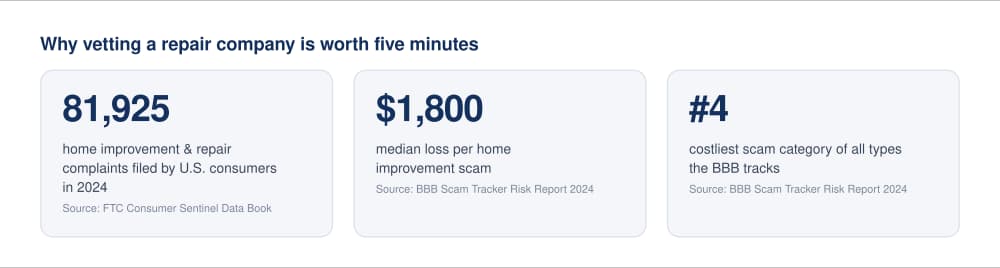
This isn’t paranoia — it’s arithmetic. U.S. consumers filed 81,925 home improvement and repair complaints with the FTC in 2024, and the Better Business Bureau ranks home improvement scams among the costliest it tracks — fourth of all scam categories in its 2024 Scam Tracker Risk Report, with a median loss of $1,800. Household appliances fail on their own schedule, usually the worst one, and time pressure is exactly what bad operators count on. Every check below exists to filter out that operator — and to help homeowners make informed decisions with a warm refrigerator humming in the background.
1. Licensing, insurance, and EPA certification
Florida doesn’t make this easy for homeowners — appliance repair doesn’t require a state contractor’s license, so anyone with a van and a toolbox can print business cards. What separates a real business: an active LLC or corporation you can find in state records, general liability insurance (this protects YOUR home if something goes wrong), and — for any refrigerator, freezer, or wine cooler sealed-system work — an EPA Section 608 certification, which is legally required to handle refrigerant. Ask for all three. A legitimate company will send them without hesitation; we publish ours on our licenses and insurance page.
One more credential worth asking about if you own a premium appliance: factory training. A technician who is factory-trained on your brand has seen your exact model before — and on a Sub-Zero or Wolf, that difference shows up in the diagnosis, not just the paperwork. Factory-trained, brand-authorized companies are also the ones a manufacturer allows to perform warranty repairs.
2. How to actually read customer reviews
The star average is the least useful number on the page. What to look at instead:
Recency. A 4.9 built on reviews from three years ago tells you who the company used to be. Sort by newest and read the last ten.
How the company answers negative reviews. Every real business has unhappy customers. What you’re looking for is whether the owner responds specifically (“we returned Tuesday and replaced the part at no charge”) or defensively. The response pattern is the company’s true customer satisfaction policy.
Repair-specific details. Fake or incentivized reviews say “great service, very professional.” Real ones say “he found the evaporator fan was dead, had the part in the van, done in an hour.” Density of specifics is the strongest authenticity signal there is. Punctuality, clear communication, professionalism — real service quality shows up in reviews as repeated patterns, not adjectives.
Where the reviews live. Check at least two platforms — Google and one other. A company that’s 5.0 on its own website and 3.2 on Google is telling you which number it can edit. Ours are collected on our reviews page with links to the source platforms.
3. Diagnostic fee transparency
The industry standard in Tampa Bay is a diagnostic fee — ours is $69 — but the number itself is the least important part. What matters is what the fee buys, and whether you learned it in writing before the visit.
Honest companies answer two questions the same way every time: does the fee apply to the repair, and is anything added on top of the estimate. Ours does apply — approve the repair and the $69 becomes part of it, with no trip fee, no shop fee, and no add-ons appearing at the end. Decline the repair and the $69 covers the visit and the diagnosis, which is a real deliverable: a named failed component and the test that confirmed it. Some calls end right there anyway, because the malfunction turns out to be a failed start relay, a control board in a locked state, or blocked airflow — problems that get corrected within the visit itself. That is what upfront pricing means: the number, and what it covers, in writing before anyone rings your doorbell. Ask three questions before booking: How much is the diagnostic? Does it apply to the repair? Is there a trip fee or extra charge on top for my city? (For us: no trip fees anywhere in our service area.)
What should end the call is the third model: the “free estimate” for in-home appliance repair. The cost of that visit doesn’t disappear — it gets built into an inflated repair price where you can’t see it. If you want to see what transparent numbers look like further down the road, we published a full breakdown of what refrigerator repairs actually cost in Tampa Bay.
Put us through this checklist. Call (813) 522-0014 and ask every question in this guide before you book. You'll have our answers — license, insurance, warranty terms, and the $69 diagnostic — before we ever knock on your door.
4. Who actually shows up at your door
Ask: “Will the person who answers this phone be the person doing the repair?” With owner-operated companies like ours, yes — and that’s not a small thing. With dispatch networks and lead-generation sites, your job may be auctioned to whichever subcontractor accepts it, and the license and reviews you checked belong to the brand, not the person in your kitchen. Networks employ experienced technicians too — you just don’t know which one accepts your job. Neither model is automatically dishonest, but you should know which one you’re buying.
Speed cuts the same way. When a refrigerator is warm at 7 a.m., a quick response matters — but ask whether the same-day repair technicians are the company’s own or subcontractors a network found twenty minutes ago. Fast and vetted are not the same thing.
5. Parts: OEM or universal?
Ask whether the company installs OEM (original manufacturer) parts or universal substitutes. Older appliances often do fine with universal parts, but on newer refrigerators and washing machines — especially smart appliances with brand-specific control boards — they’re the most common cause of the repeat failures I get called to fix. A good answer sounds like: “OEM where it matters, and we’ll tell you when a universal part is the sensible choice and price the difference.”
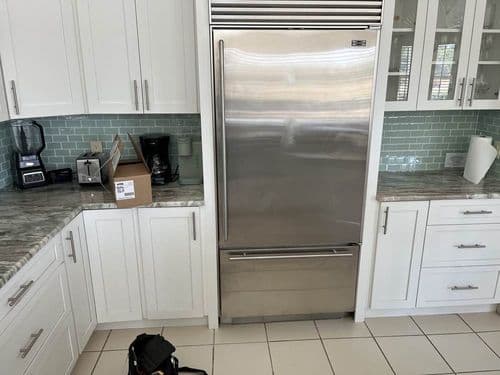
That photo above is what OEM looks like in practice: a factory ice maker assembly, in the manufacturer’s box, on the counter next to the Sub-Zero it was made for, on a service call in South Tampa. On a built-in worth five figures, the “equivalent” universal module is how a $300 repair becomes two repairs.
6. Warranty on parts AND labor
Get the warranty in writing and confirm it covers both the part and the labor to install it. A “12-month warranty” that only covers the part means you pay a second service call when the part fails in month three. The labor coverage is the important consideration — get it on the invoice, not as a verbal promise; that’s the difference between a warranty on paper and peace of mind. Our warranty terms are published on the warranty page.
7. Red flags that end the conversation
A repair price quoted over the phone, sight unseen. Cash-only. No physical business address or LLC name anywhere. Pressure to replace the appliance immediately (“not worth fixing” within two minutes of arriving). A van with no company name. An appliance service that hesitates when you ask for documents. And the subtle one: a technician who can’t explain what failed in plain language — if they can’t explain it, they didn’t diagnose it.
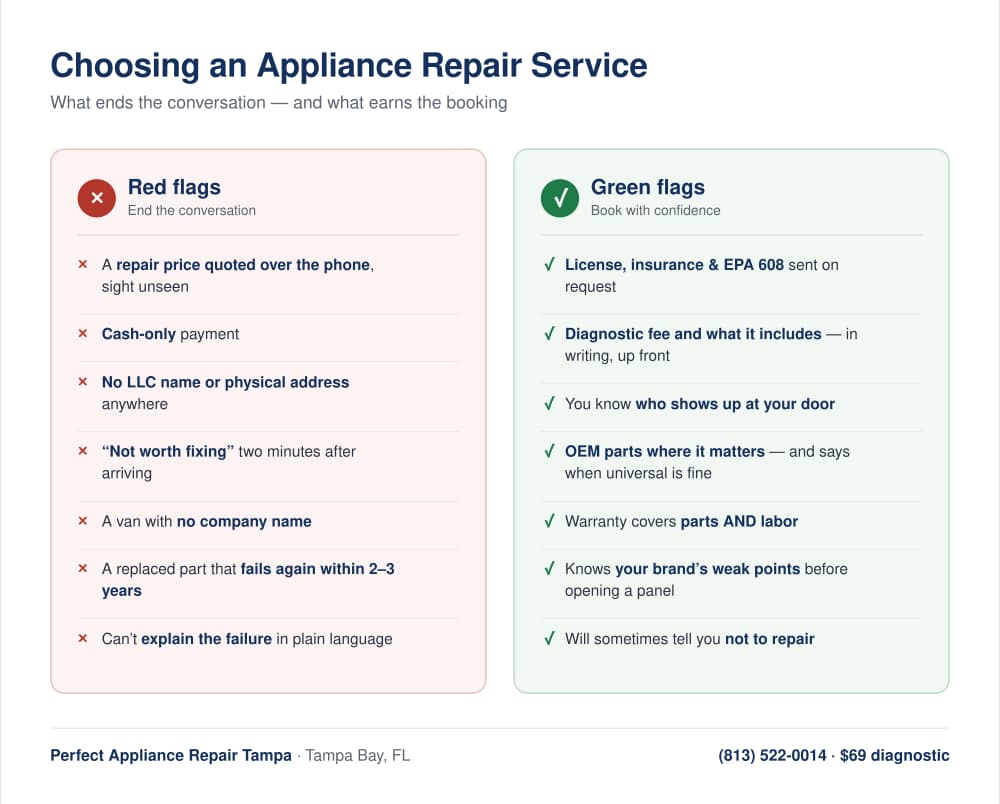
None of this requires expertise — just five minutes and the willingness to walk away. That’s the whole method to choose the right appliance repair company, in Tampa Bay or anywhere else.
What the brand tells a technician
“Which appliance company has the best reputation?” is one of the most-searched questions in this category, and my answer after years inside Tampa Bay kitchens is more useful than a ranking: the brand on the door changes the repair math, and a company worth hiring should be able to tell you how before they open a single panel.
Sub-Zero. Ask me the best refrigerator ever made and you get a one-word answer: Sub-Zero. The NAHB’s component-lifespan study puts a standard refrigerator at about 13 years; Sub-Zero states its units are designed to last about 20 years — and in the field they go further. I’ve repaired Sub-Zero units past the 30-year mark, and the repair still made financial sense. Dual compressors, decades of parts support, cabinetry-grade build: a Sub-Zero is almost always worth repairing, at ages when a mass-market unit wouldn’t be worth the trip. More on how long refrigerators actually survive here: refrigerator lifespan in Tampa.
LG. Good refrigerators with one famous weak point — the linear compressor on the 2014–2017 French-door generations. Two things every LG owner should know. First, most post-2014 models carry a 10-year sealed-system warranty that can cover the compressor itself. Second — and I’m sorry to be the one who says it — if your LG compressor was replaced and failed again within three years, the compressor isn’t the problem. The previous repair was. A professional LG compressor replacement uses the updated-design compressor kit, a proper vacuum, and a correct refrigerant charge; done right, it doesn’t come back.
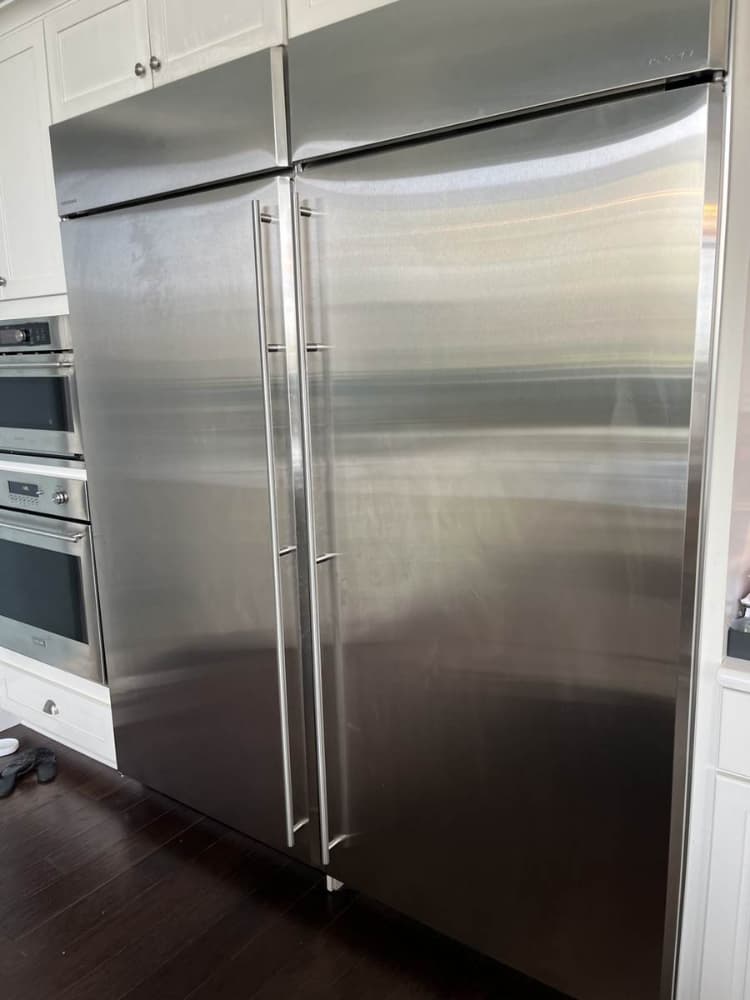
The other built-ins — Monogram, Thermador, Viking. Same logic as Sub-Zero at different price points: high replacement cost, long parts support, cabinetry-integrated installation. On a Monogram, Thermador, or Viking, “just replace it” is almost never the honest answer — which makes brand experience one of the most practical interview questions you can ask a repair company. The Monogram columns below came from a service call out in Dade City.
Here’s the practical test: when you call any appliance repair service, name your brand and listen. A company that works on your brand every week will start describing failure patterns before you finish the sentence. A company that says “we fix everything” and asks nothing is asking you to fund their learning curve.
Frequently asked questions
Should I choose the cheapest diagnostic fee?
Compare the total picture, not the fee. A low diagnostic fee can hide a trip fee, universal parts, or a parts-only warranty — and the money you “saved” comes back as a second repair. Compare what the visit includes, whether the parts are OEM, and whether the warranty covers labor.
What is the 50% rule for appliance repair?
It’s a common rule of thumb for deciding whether to repair or replace: if a repair costs more than half the price of a new appliance — and the appliance is past half its expected lifespan — replacement deserves a serious look. I treat it as a starting point, not a law. Consider the age of the appliance, the failure type, and parts availability before the math: in the first half of an appliance’s life a repair will usually cost less than replacement, while at the other end newer energy-efficient models can change the calculation. The same failure on a 12-year-old budget refrigerator and on a five-year-old built-in points to opposite answers. Full breakdowns: refrigerators, washers, dishwashers.
What credentials should an appliance repair technician have in Florida?
Florida has no state license category for appliance repair, so the burden is on you: verify an active LLC or corporation in state records, proof of general liability insurance, EPA Section 608 certification for any refrigerant work, and — for premium brands — factory training. “Certified appliance repair” in Florida means these documents, not a state license. Any legitimate company will produce all of them on request.
What questions should I ask an appliance repair company before hiring them?
Seven, in order: Are you licensed and insured? Who exactly shows up at my door? How much is the diagnostic and what does it include? Is there a trip fee for my city? Do you install OEM parts? Does the warranty cover parts and labor? Can you send all of that in writing? The whole call takes five minutes.
Which refrigerator brands are worth repairing?
Almost any brand is worth repairing while the failure is isolated and the unit is young. Brands differ at the extremes: premium built-ins — Sub-Zero, Monogram, Thermador, Viking — are designed for decades of service and are usually worth repairing at ages where mass-market units are not, while an ordinary unit with a failing sealed system past 12 years is usually replacement territory. The honest answer comes from the diagnosis, not the logo.
How do I find a reliable local appliance repair service in Tampa Bay?
When you’re looking for a repair service in a hurry, skip the lead-generation sites that auction your job to subcontractors. Search for companies based in your area, check their entity in Florida state records, read their newest Google reviews, then call and run the checklist above. In Tampa Bay we’d obviously like that call to come to us — but the checklist works on any company, including ours.
Do you repair appliances at my home?
We do — every repair happens at your home, anywhere in our Tampa Bay service area. We don’t have a shop or drop-off counter; the van carries the common parts to keep your home running the same day. That’s the standard model for honest residential appliance repair, and any company you hire should confirm the same.
Related services
Vet us against this checklist, then book the repair you actually need:
- Refrigerator repair
- Sub-Zero & built-in refrigerator repair
- Washer repair
- Dryer repair
- Dishwasher repair
Call or text (813) 522-0014 or book online — Perfect Appliance Repair Tampa covers Tampa, St. Petersburg, Clearwater, Wesley Chapel, and all of Tampa Bay.
Anatoli Didenco is the owner-technician of Perfect Appliance Repair Tampa, with 20+ years of hands-on technical experience in refrigeration and appliance repair across Hillsborough, Pinellas, and Pasco Counties. He specializes in refrigerators — particularly Sub-Zero, Wolf, and premium built-in systems — and sealed-system and compressor work. He personally answers the phone and shows up at the door. Read more on the About page.
Perfect Appliance Repair Tampa serves Tampa, South Tampa, Wesley Chapel, Zephyrhills, Dade City, and the surrounding Tampa Bay area. Reviews are available on the company’s Google Business Profile and BBB listing.
We Stand Behind Our Work.