
The short version: a washing machine is worth fixing when the written repair price is well under half the cost of the comparable new machine and the part that failed is not one of the four that signal the end — tub bearings, transmission, control board on an old budget machine, or the drive motor. Pumps, valves, lid switches, door locks, belts, couplings and actuators are worth doing at almost any age. A tub bearing on a front-loader past ten years is the textbook replace case. Below: the 50% rule and where it fails, honest lifespans by machine type, and a repair-or-replace table by what actually broke.
The 50% rule, and where it breaks down
The rule most people know: if the repair costs more than half of what a comparable new washer costs, buy a new one. It is a decent filter and I use it as a starting point. It has three problems in practice.
First, "comparable" does the heavy lifting. Price the machine you own — a large-capacity LG front-loader, a Speed Queen, a basic agitator top-loader — not the cheapest thing on the showroom floor. A control board on a premium front load washer can clear the 50% line against a budget top-loader and sit comfortably under it against the machine you would actually buy again.
Second, the rule ignores what broke. A drain pump whose cost to repair is 45% of a new machine's price and a tub bearing at 45% are not the same decision. The pump is one part in a machine that is otherwise fine; the bearing is the part that tells you the rest of the tub assembly is the same age and headed the same way.
Third, the rule ignores what a new washer costs beyond the sticker: delivery, haul-away, new hoses, a day at home, and a machine you have to learn. None of that is on the price tag, all of it is real.
So I use a stricter version. Under about a third of the replacement price on a machine with no history: repair, almost always. Between a third and a half: repair if the part is a wear item and the rest of the machine is sound; replace if it is a bearing, a transmission or a board on an old machine. Over half: replace, unless the washer is a premium machine you would buy again and the fault is a single component.
How long do washing machines last, honestly, by type
The often-quoted average is about ten years — the NAHB life-expectancy study puts a washer there and a dryer at about thirteen. Averages hide the spread, and the spread is mostly about which family of machine you own and how hard it works. A two-person household's washer sees a fraction of the loads a family of five puts through one, and the difference shows up in bearings and transmissions, not in the calendar.
| Machine type | Typical service life | What usually ends it |
|---|---|---|
| Agitator top-load, direct-drive (older Whirlpool, Kenmore, Roper) | 12–15+ years | Transmission, spin tube bearing; couplings and lid switches along the way are cheap |
| Agitator top-load, belt-drive (Maytag, GE, Speed Queen-style) | 10–14 years | Transmission or drive pulley; Speed Queen's commercial-grade build runs longer |
| High-efficiency top-load, no agitator (Whirlpool/Maytag HE, Samsung, LG, GE) | 8–12 years | Bearing-and-seal assembly, shift actuator, control board |
| Front-load (LG, Samsung, Whirlpool, GE, Electrolux, Bosch) | 10–12 years | Tub bearings and seal; door boot and drain pump are repairs, not endings |
| Compact or stacked laundry center | 8–12 years | Same as its type above; access makes labor longer |
Two honest notes. A front-loader's lifespan is really the lifespan of its tub bearings — everything else on it is repairable. And an old direct-drive Whirlpool top-loader that has had a coupling and a lid switch is not an "old machine with a repair history"; it is a simple machine doing what simple machines do, and it will often outlast the newer washer that replaces it.
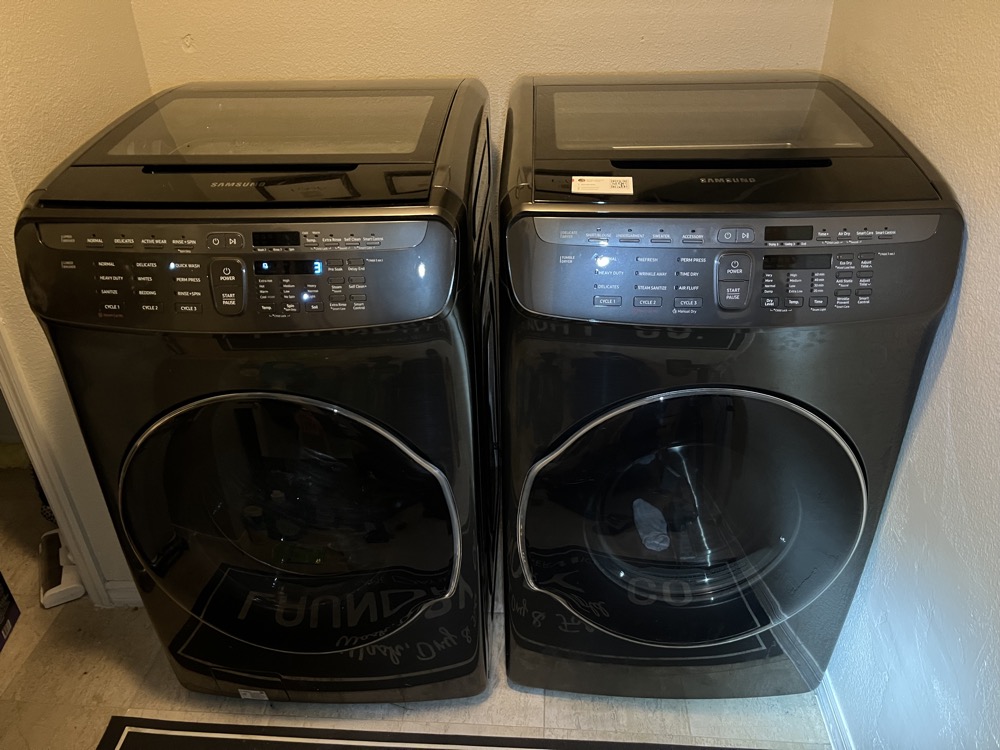
Direct-drive or belt: the machine family matters more than the brand
Homeowners ask about brands. I think about drivetrains, because that is what decides which repairs a washer will ever need.
Direct-drive agitator top-loaders (Whirlpool, Kenmore, Roper, Estate, some Maytag) drive a transmission through a small plastic motor coupling that is designed to be the weak link. Their failures — coupling, lid switch, clutch, pump — are cheap parts with known labor. Their one expensive failure is the transmission, and it is rare. These are the machines I most often tell people to keep.
Belt-drive HE top-loaders (current Whirlpool and Maytag, GE, many Samsung and LG top-loaders) replace the transmission with a belt, a shift actuator and a bearing-and-seal assembly under the tub. Actuators and belts are moderate repairs. The bearing assembly is the expensive one, and on some models it is sold only with the outer tub.
Inverter direct-drive front-loaders (LG, Samsung, and increasingly everyone) bolt the motor straight to the tub — no belt, no coupling, no clutch. What fails is the sensing and electronics around the motor, plus the universal front-load wear items: door boot, drain pump, door lock, and eventually the tub bearings. The motor itself almost never wears out. On LG and Samsung machines the repair-or-replace question is nearly always "is it the board or the bearing?" — and the answer decides everything.
Belt-drive front-loaders (many Whirlpool, Maytag, GE, Electrolux, Frigidaire) are the same story with a belt instead of an inverter motor: belt and pulley are cheap, bearings are not.
Repair or replace, by what actually broke
This is the table I run in my head at the end of a diagnostic. "Weigh it" means the written price against the machine you would actually buy, with the machine's history on the scale.
| What broke | Typical job | Under 8 years | 8–12 years | Past 12 years |
|---|---|---|---|---|
| Lid switch / lid lock | Small part, under an hour | Repair | Repair | Repair |
| Door lock (front-load) | Small part, panel off | Repair | Repair | Repair |
| Drain pump | Moderate part, bottom of machine | Repair | Repair | Repair if nothing else is wrong |
| Drive belt / coupling / clutch | Cheap part, disassembly is the labor | Repair | Repair | Repair |
| Inlet (water) valve | Moderate part, under the top | Repair | Repair | Repair |
| Shift actuator (HE top-load) | Moderate part, underneath | Repair | Repair | Weigh it |
| Door boot / gasket | Moderate part, front off | Repair | Repair | Weigh it |
| Control board | Expensive part | Repair | Weigh it — brand and price decide | Replace, usually |
| Drive motor | Expensive part | Repair | Weigh it | Replace, usually |
| Tub bearing & seal (front-load) | Hours of labor, tub split or whole tub | Weigh it | Replace, usually | Replace |
| Transmission / gearcase (top-load) | Expensive part, heavy labor | Repair | Weigh it | Replace |
| Cracked outer tub, rusted drum, drum spider | Machine-level failure | Replace unless under warranty | Replace | Replace |
Notice that the left half of the table is almost all "repair." Most washer problems are cheap problems that arrive on expensive-looking machines. If your washer will not drain, will not spin, or is leaking, troubleshoot the symptom on those pages first — the likely parts are in the repair column.
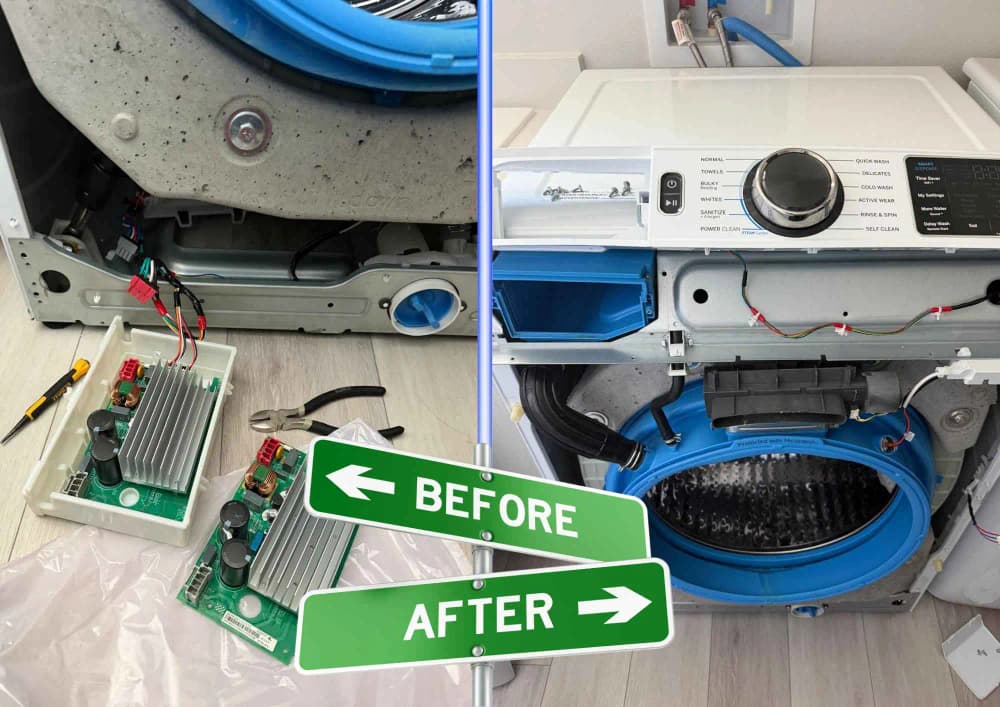
The bearing job: why a ten-year-old front-loader usually loses
The tub bearings sit at the back of the outer tub, carrying the inner drum on its shaft, protected by a lip seal. When the seal wears — and detergent, hot water and years of spin guarantee it will — water reaches the bearings, they rust, and the washer starts a rumble at spin that grows into a roar. Often there is a rusty drip under the machine. The drum develops play you can feel by lifting the front lip.
The repair means pulling the machine mostly apart, splitting the outer tub (on many machines the tub is sealed and sold only as a complete assembly), pressing out the old bearings and seal, pressing in new ones, and reassembling. It is hours of labor before the part price. On a front-loader under seven years, on a premium machine, with no other issues, I will do it and it makes sense. On a ten-year-old machine the math almost never works: the labor alone approaches a new washer, and the door boot, pump and door lock are the same age as the bearing that just failed. That is the case where I tell you to shop, and I would rather you hear it at the $69 diagnostic than after the tub is in pieces.
The one thing that extends bearing life: fix a leaking door boot promptly, because the water running down the inside of the tub is what reaches the seal first.
Is a seven-year-old washer worth fixing? Age, history and the second repair
Age alone is a weak signal. What I actually weigh:
- What failed, and is it a wear item? Pumps, valves, locks, belts and couplings are supposed to wear. Their failure says nothing bad about the rest of the machine.
- Is this the first repair or the third? A second major repair inside a year is a pattern. A machine that needed a lid lock at year six and a pump at year nine is a normal machine.
- What is the replacement, really? If you would buy the same class of machine again, the repair has a high bar to fail. If you were already planning to move from a budget top-loader to a front-load pair, a moderate repair may just be a bridge.
- Does the machine have a known Achilles' heel? Some platforms have one part that fails early and often. When that part is the one that just failed, and the fix is a redesigned part, the repair is a good one. When it is the second time, it is not.
- Rust, cracks and smell. A rusted drum lip that snags clothes, a cracked outer tub, or a drum spider that has corroded through are machine-level failures. No single part fixes them.
A three-year-old washer with almost any failure: repair, and check whether the manufacturer's warranty still covers the part. A seven-year-old washer with a wear-item failure: repair. A seven-year-old budget front-loader with a bearing: weigh it hard.
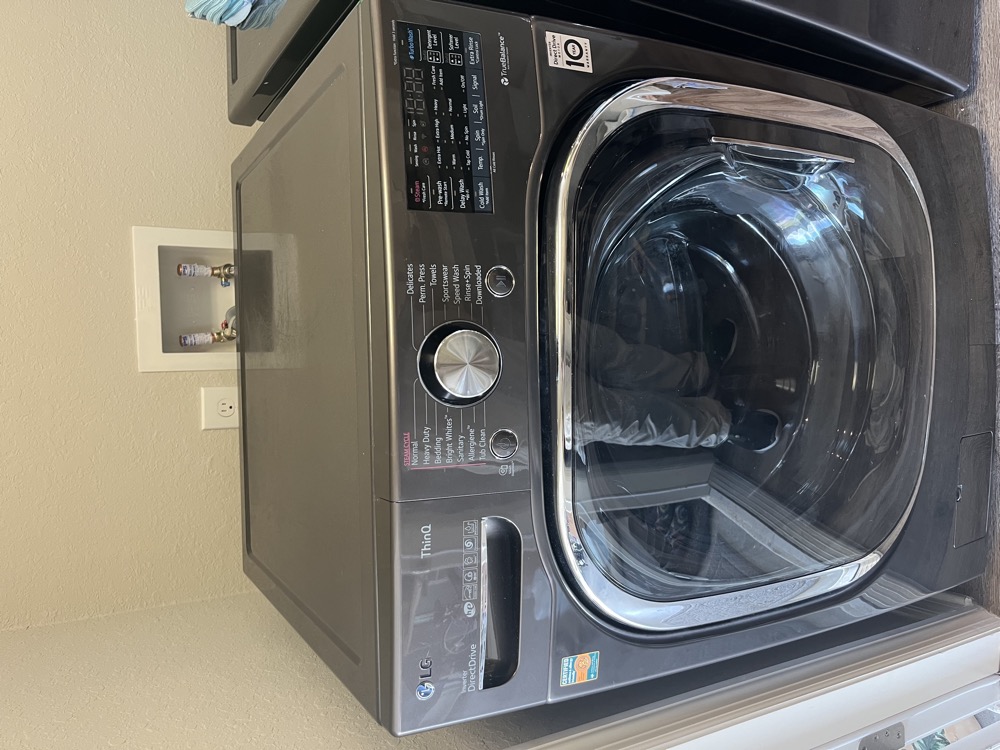
What a new washer really gets you, and what it does not
Replacing does buy things: a full warranty, a quieter spin, a bigger drum, and on the water bill a real drop if you are moving from an old 40-gallon-per-load agitator machine to a high-efficiency one. Be honest about the rest. A new washer does not come with the old washer's proven reliability; it comes with electronics that are more sensitive to Florida's summer power blips than a mechanical timer ever was, and with a bearing that will start the same clock over again. Efficiency is a tie-breaker in the repair-or-replace decision, not the reason to scrap a machine with one fixable fault. And if you do replace, keep the good braided hoses and buy a drain pan; the new machine will thank you in a decade.
One more honest point: I run a repair service, not a showroom, and I do not sell washers. The recommendation you get from me has no sales floor behind it.
Tampa Bay factors that shorten a washer's life
Hard municipal water scales up inlet valves and pressure-switch air paths; well water in eastern Pasco County and around Dade City carries grit that chews pump impellers. A washer in a garage in Tampa or Brandon spends every summer afternoon above 100°F, which is hard on belts, couplings, boots and the capacitors on a control board. Summer lightning is hard on boards, period. Near the coast, salt air rusts spring clamps and cabinet bases. None of these change what is worth fixing; they change how soon you will be asking. A surge protector, a sediment filter on a well, and a laundry room instead of a garage are the three cheapest ways to move your washer toward the long end of the lifespan table.
How common is this question? Search demand, measured
Ubersuggest counts only about 110 U.S. searches a month for the phrase "is it worth fixing a washing machine," and that number is honest about how people actually search: the question behind it gets typed as "how long do washing machines last" (about 3,600 a month) or as the symptom itself — "washer not spinning" alone is around 5,400. The curve for the exact phrase is small and flat, with a dip in February and a spring bump; the decision itself is one nearly every household makes once a decade.
Search data: Ubersuggest, national monthly volume, last 12 months. A small, steady keyword — people search the symptom, then ask this question. The April–June bump is when spring cleaning meets a washer that has been limping since winter.
Expert opinion — Anatoli Didenco, owner, Perfect Appliance Repair Tampa. Ask two questions before you ask about price. What broke, and is it a wear item? Pumps, valves, locks, belts, couplings and actuators are supposed to wear out; fixing one is maintenance, not throwing money at an old machine. Is it one of the four enders — tub bearing, transmission, board on an old budget machine, motor? Then run the 50% rule against the washer you would actually buy, not the cheapest one. A bearing on a ten-year-old front-loader fails that test almost every time, and I will tell you so at the diagnostic.
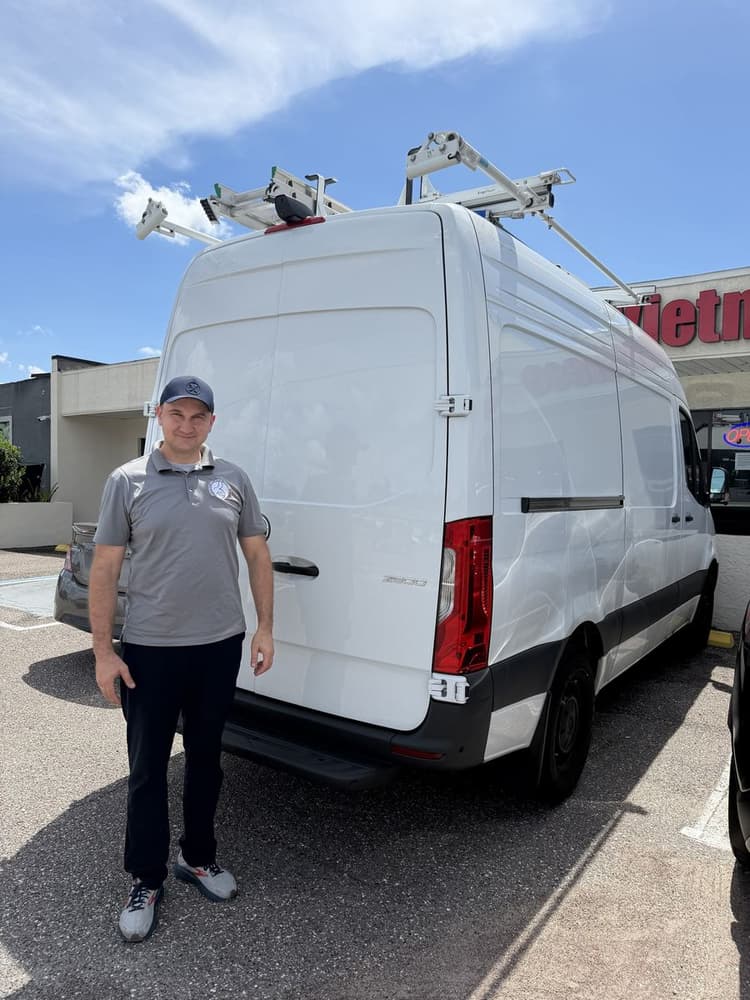
Before you decide to repair or replace
BBB Accredited, A+ rated, and more than 200 five-star reviews across major platforms. Read what owners actually say on the reviews page — Google and BBB, in their own words.
And the honest part: if this page has already told you the answer — a roaring bearing on an old front-loader, a cracked tub — you don't need to pay me to say it again. Put the diagnostic money toward the new machine.
Repair or replace a washing machine — quick answers
Is a 7-year-old washing machine worth fixing?
Usually yes. At seven years a washer is in the middle of its life, and the common failures — pump, lid lock, door lock, inlet valve, belt, coupling, actuator — are moderate repairs that give it several more years. The exceptions at that age are a tub bearing on a budget front-loader or a control board that costs a large share of a new machine.
How long do washing machines last?
A traditional agitator top-loader typically runs 10 to 14 years and the old direct-drive Whirlpools often longer; a high-efficiency top-loader 8 to 12; a front-loader 10 to 12, with the tub bearings usually deciding the end. Heavy daily use, hard water and a garage installation push a machine toward the short end.
What is the most expensive part to replace on a washing machine?
The tub bearing and seal on a front-loader, because it means splitting the outer tub for hours of labor and sometimes buying the whole tub assembly; then the transmission or gearcase on a top-loader, the main control board, and the drive motor. Those four are the parts that turn a repair into a replacement decision.
How much does it cost to fix a washing machine?
It depends on which part failed and how much has to come apart to reach it, so I do not quote a number before I have tested the machine. I charge $69 for the diagnostic and apply it 100% to the repair you approve, and you get the written number before any work starts.
Should I repair or replace a washer that needs a new control board?
On a machine under eight years old with no other problems, a board is usually worth it, especially on an LG, Samsung or a premium front-loader where the replacement machine is expensive. On a budget top-loader past ten years, the board can be half the price of a new washer, and I would replace.
Is a washing machine with a bad bearing worth fixing?
On a front-loader under about seven years old, sometimes. On one past ten years, almost never — the tub has to be split, the labor runs several hours, and the rest of the machine is the same age as the bearing that just failed. That is the classic replace case.
Does repairing an old washer waste money on energy and water?
Less than you might think. An older agitator top-loader uses much more water per load than a new high-efficiency machine, and that shows up on the water bill, but the savings rarely pay back a whole new washer on their own. Treat efficiency as a tie-breaker, not the reason to replace a machine that has one fixable fault.
Related services
Book same-day service or read more about the exact repair:
- Washer repair
- Washing machine not draining
- Washer not spinning
- Washer leaking water
- Dryer repair or replace?
- LG appliance repair
Call or text (813) 522-0014 or book online — Perfect Appliance Repair Tampa covers Tampa, South Tampa, Wesley Chapel, Zephyrhills, Dade City, and surrounding Tampa Bay.
Anatoli Didenco is the owner-technician of Perfect Appliance Repair Tampa, with 20+ years of hands-on technical experience in refrigeration and appliance repair across Hillsborough, Pinellas, and Pasco Counties. He specializes in refrigerators — particularly Sub-Zero, Wolf, and premium built-in systems — and sealed-system and compressor work. He answers the phone, and either he or Nick, his technician, shows up at the door. Read more on the About page.
Perfect Appliance Repair Tampa serves Tampa, South Tampa, Wesley Chapel, Zephyrhills, Dade City, and the surrounding Tampa Bay area. Reviews are available on the company’s Google Business Profile and BBB listing.
We Stand Behind Our Work.