
Refrigerator water dispenser not working — the short version
When a refrigerator water dispenser stops working, the cause is usually one of six things, in this order: the control lock is on, the water filter is clogged or not seated, the water line in the freezer door has frozen (side-by-sides), the water inlet valve on the back of the fridge has failed, the house water pressure is too low for the valve to open, or the dispenser switch behind the paddle has quit. The first two are free to fix and cover more calls than the rest combined. The same chain feeds the ice maker, so a fridge that will not dispense water or ice at all is usually a supply, lock or valve problem, while one that fails on a single side has a single-side fault.
The fastest diagnostic you own is the ice maker. If ice keeps coming while water does not, the water supply, the shutoff and the main line are all fine, and the problem lives in the water-only half of the system: one solenoid, one door line, one switch. That single observation cuts the list in half before anyone touches a screwdriver.
Four free checks that solve most of these
This is how I troubleshoot it, and you can do the first part yourself before you call anyone, including me. On my Tampa Bay calls the water dispenser problem that turns out to be a button or a filter is not rare, and I would rather you keep the $69.
- Control lock. Every modern dispenser has a lock — a padlock icon, Control Lock, Child Lock or Dispenser Lock — that disables the dispenser controls so a toddler cannot flood the kitchen. It gets pressed while wiping the panel. Hold the lock button for three seconds; the icon goes out and the paddle works again. Two cousins of the same problem: Sabbath mode disables the dispenser and its light on many Whirlpool, GE and KitchenAid models, and a door that the fridge thinks is open does the same — press the door switch by hand and confirm the light goes off.
- Hold the paddle for 20 seconds. After a filter change, or after the line has been drained, the system is full of air. It can take most of a minute of pressing before water arrives, sputtering. Manufacturers say to run two to three gallons through a new filter for exactly this reason. A good share of the "I just changed your filter and now there is no water" calls I take are air — and yes, that is how people phrase it on the phone.
- Filter age and seat. If it has been six months — or you cannot remember — the filter is due. Pull it, put in the bypass plug that came with the fridge (or run without it on models that allow that), and press the paddle. Water back? A clog in the filter could be the whole story, and it usually is. No bypass? Reinstall the filter and make sure it turns all the way to its stop; a filter one quarter-turn short passes almost nothing.
- The shutoff behind the fridge. Pull the refrigerator away from the wall and follow the water supply line to its valve — under the sink, in the wall box behind the fridge, or a small saddle valve clamped onto a copper pipe. Open it all the way. A saddle valve that was "opened" by a mover often sits half-closed, and the needle in the pipe corrodes shut over the years. While you are back there, check for a pinched water line — a kink where the fridge was pushed in cuts flow completely.
If ice still comes out during all this, keep the good news in mind: the supply and the main line have just been proven. Everything left is in the water-only branch.
Read the symptom: no water, a trickle, ice but no water
The pattern of what works and what does not is the diagnosis. Match your fridge to a row.
| What you see | Where it points | What to try first |
|---|---|---|
| Nothing at all, no sound at the paddle | Control lock, dispenser switch, door wiring, dispenser control board | Unlock; hold the paddle; listen for a click at the switch |
| Nothing, but you hear a hum or buzz when you press | Valve energized but not passing water: frozen line, closed shutoff, failed water solenoid | Open the shutoff fully; thaw the door line; then the valve |
| A trickle or slow water flow | Clogged filter, low water pressure, RO system, partly closed saddle valve, pinched line | Bypass the filter; check the shutoff; measure pressure |
| Ice works, water does not | Water-only branch: water solenoid, frozen door line (side-by-side), dispenser switch | Thaw the door line; then meter the water solenoid |
| Water works, ice does not | Ice-only branch: ice solenoid, fill tube, ice maker itself | See the ice maker guide |
| Sputters after a filter change, then fine | Air in the line | Run two to three gallons through; done |
| Water tastes bad or looks cloudy but flows fine | Filter overdue, or the reservoir sat unused | New filter; flush; not a repair |
| Drips after you let go | Valve not sealing, or a clogged filter holding back pressure | New filter first; if it keeps dripping, the inlet valve |
The water filter — what Tampa Bay hard water does to it
The filter is a cartridge of carbon block, and every gallon leaves a little more mineral and sediment in it. The manufacturer rating of six months assumes average municipal water. Municipal water across Hillsborough and Pinellas runs hard, Pasco is harder, and homes on wells in Odessa, Lutz and Land O' Lakes bring iron and sand on top of the hardness. On that water a filter can reduce water flow to a trickle by month five and the dispenser slows so gradually that nobody notices until it stops. Replacing the filter every six months is not a suggestion here; it is the cheapest refrigerator repair you will ever do.
Three details that catch people. First, filter type: a Samsung HAF-CIN, an LG LT1000P, a GE RPWFE or XWF, a Whirlpool-family everydrop — Whirlpool, KitchenAid and Maytag share the same filter housing — each turns and locks a specific way, and a look-alike with the wrong seal will pass almost nothing or leak into the filter housing. Second, the seat: the cartridge has to turn all the way to its stop, and on some models the filter head has a small flap valve that only opens when the cartridge is fully home. Third, GE's RPWFE-family filters carry an RFID chip; on those models the fridge disables the dispenser if it does not recognize the filter, and it says so on the panel — read the panel before you blame the plumbing.
The cracked filter housing deserves a mention of its own. Over-tightening a cartridge, or forcing the wrong one, can crack the plastic head that holds it. The symptom is a slow leak at the filter or a puddle in the crisper. That is a small repair — the housing is a modest part on most models — but it is a repair, not a filter change. If you see water on the floor as well as no water at the dispenser, my guide to a leaking refrigerator covers the rest.
The frozen line in the freezer door (side-by-side owners, this is you)
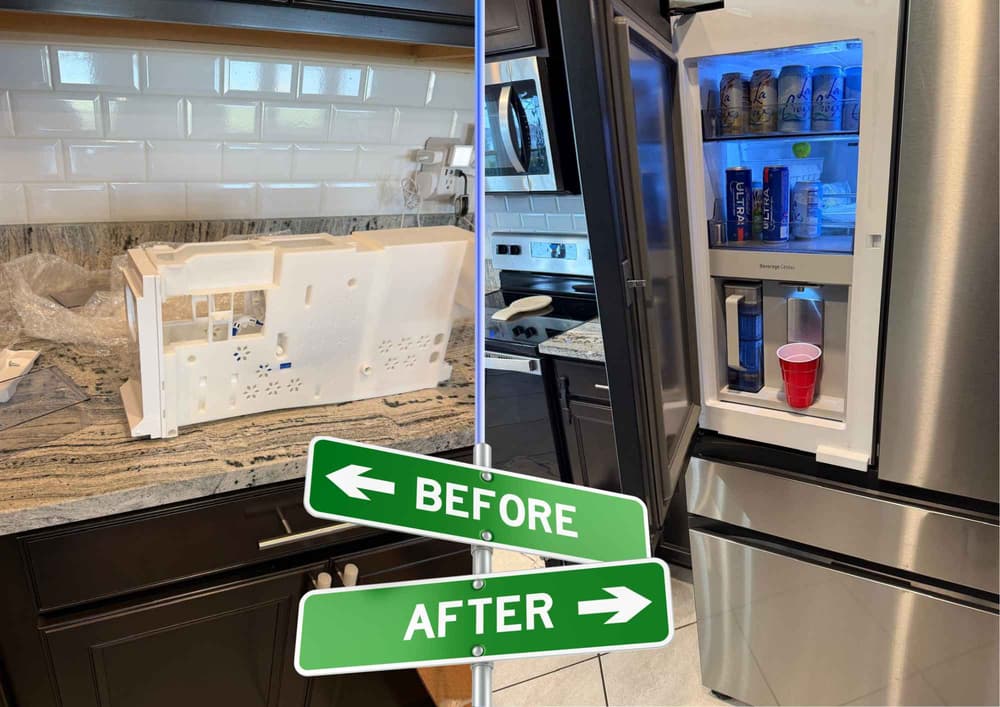
On a side-by-side, the water dispenser sits in the freezer door, and the line that feeds it runs up through that door — through freezer-temperature air — to the spout. Water sits in that line between uses. If the freezer is set too cold (below 0°F on most models), or the door gasket lets humid Florida air in that then freezes around the tube, that standing water turns to ice. Symptom of a frozen water line: the valve hums when you press, nothing comes out, and the ice maker is perfectly happy because it is fed from the other solenoid by a different path.
Thaw method. Set the freezer no colder than 0°F. Open the freezer door and let the inside of the door warm; a hair dryer on low along the inside door panel near the dispenser for a few minutes speeds it up. A turkey baster of warm — not hot — water into the dispenser tube outlet from below works too. Wait, then hold the paddle. When water sputters back, you have your answer. Do not use anything sharp in the tube and do not pour hot water on a plastic door panel.
Why it refreezes. A line that freezes once after a cold snap or a wrong setting is a fluke. A line that freezes every week has a reason: the freezer is genuinely too cold (a stuck damper or a failed thermistor), the door gasket is torn or not sealing at the dispenser side, or on some models the small heater around the tube has failed. On a fridge where the freezer is colder than the setting, this is the same root problem I cover in why a refrigerator freezes food. Thawing the line is the homeowner fix; finding out why it froze is the repair.
The water inlet valve and your house water pressure
The water inlet valve sits at the back of the fridge, at the bottom, where the supply line enters. It is a dual solenoid valve: two electric coils, one for the ice maker and one for the water dispenser, sharing one inlet with a small mesh screen. When you press the paddle, the dispenser switch tells the board, the board energizes the water coil, and the valve opens for as long as you hold it. When a coil in the water valve burns out or the plunger sticks on mineral scale, you get a buzz and no water — or, if the coil is fully dead, silence.
The valve needs pressure to open. Most brands spec a minimum of about 20 psi at the valve; Whirlpool asks for 30. If your home has low water pressure, or the line comes through a half-closed saddle valve, or the fridge is fed from a reverse-osmosis system — very common in Tampa Bay kitchens because of the taste of the water — the valve may open and pass only a dribble, or not open at all. RO systems are the classic case: the storage tank pressure drops as the tank empties, and the fridge gets the leftovers. If your RO faucet is also slow, the fridge is not the problem; the RO tank or its membrane is.
How I sort it: I disconnect the supply line at the fridge and run it into a bucket. Strong flow means the house is fine and the valve or the line beyond it is the suspect. Weak flow means the shutoff, the saddle valve or the RO system, and no appliance part is going to fix that. Then I meter each coil on the valve for resistance and watch actual flow with the outlet line disconnected. Ice coil good, water coil open: there is your "ice works, water doesn't". Both coils good, no flow: scale in the valve body or a frozen line downstream. If the ice dispenser in the door also quit at the same moment, I look at the door harness before either valve. The genuine valve for your model is a modest part, and the labor is mostly about moving the fridge without kinking the water supply line — the part gets swapped in minutes.
The paddle, the switch and the control board
Behind the dispenser paddle — the lever or pad you push the glass against — is a small micro switch. The paddle is the dispenser actuator; the switch is what tells the board you pressed it. Both are plastic parts in a spot that gets used thirty times a day. The paddle cracks at its pivot, the switch contacts wear, and one day the press does nothing: no click, no hum, no light. On many models you can hear the switch click when it is healthy; silence at the paddle with a working panel is the tell.
Above that sits the dispenser control board, or on newer fridges the main board that drives the dispenser through the door's wiring harness. The harness runs through the top hinge and flexes every time the door opens. A broken wire in that bundle produces the strangest symptoms on the list — water that works with the door pulled slightly open, a dispenser that stops after a hard door slam, a panel that flickers. Control board failures are real but rare, and they usually come with other symptoms at the same time: a dead panel, an ice maker that quit the same day, or a surge in the house. After a storm on the Gulf side, I see surge-damaged boards; a good surge protector on a refrigerator outlet is cheap insurance for that.
The order matters. I test the switch first (it is a one-minute meter check with the panel off), then the harness, then the board. A board bought to fix a bad switch is the least satisfying way to spend money on a refrigerator.
Brand notes: Samsung, Whirlpool, LG, GE
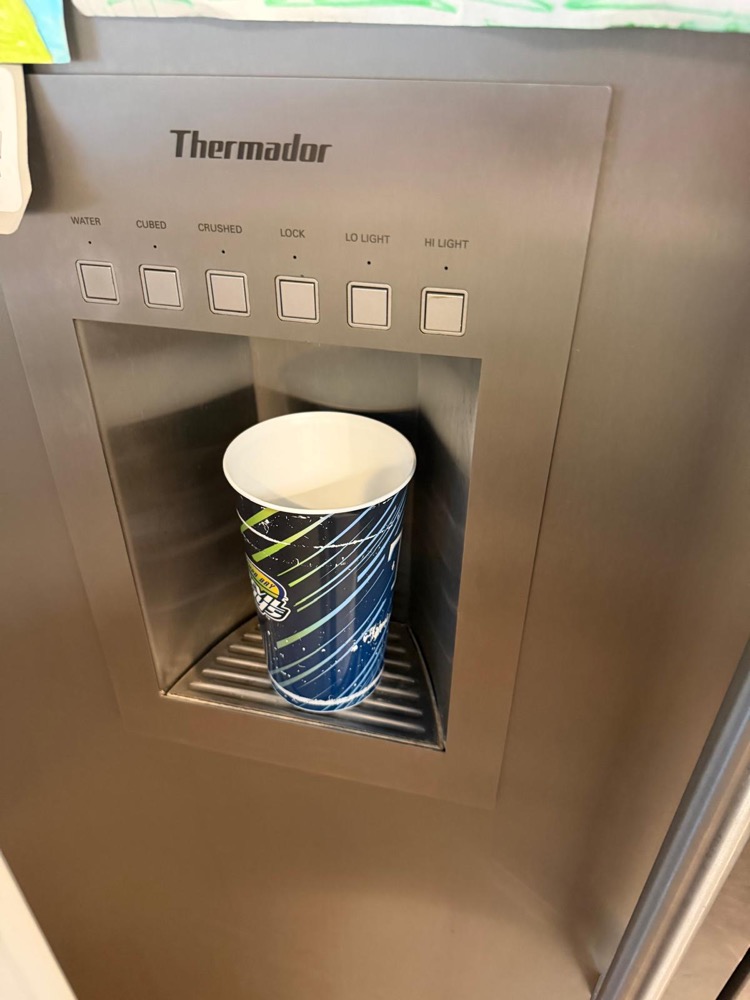
The system is the same on every brand; the places it breaks are not.
Samsung. French door models with the in-door dispenser have a long line through the left door and a filter in the fresh-food section; a mis-seated HAF-CIN filter and a cracked filter housing are the common calls, and the panel lock is usually a three-second hold on one of the dispenser buttons. Details on the Samsung repair page.
Whirlpool, KitchenAid, Maytag. everydrop filters, a 30 psi minimum, and a dispenser lock that is usually a three-second hold. On the side-by-sides the frozen door line is the classic. See Whirlpool repair.
LG. The LT1000P filter clogs faster than people expect in hard water, and in-door ice makers add a second path to check. If the ice maker also stopped, my LG ice maker guide picks up there; otherwise the LG repair page.
GE. RFID filters that disable the dispenser when unrecognized, an RPWFE/XWF filter family, and — on some Café and Profile models — a dispenser board that is sensitive to surges. See GE repair.
Repair or replace: honest math on a dead dispenser
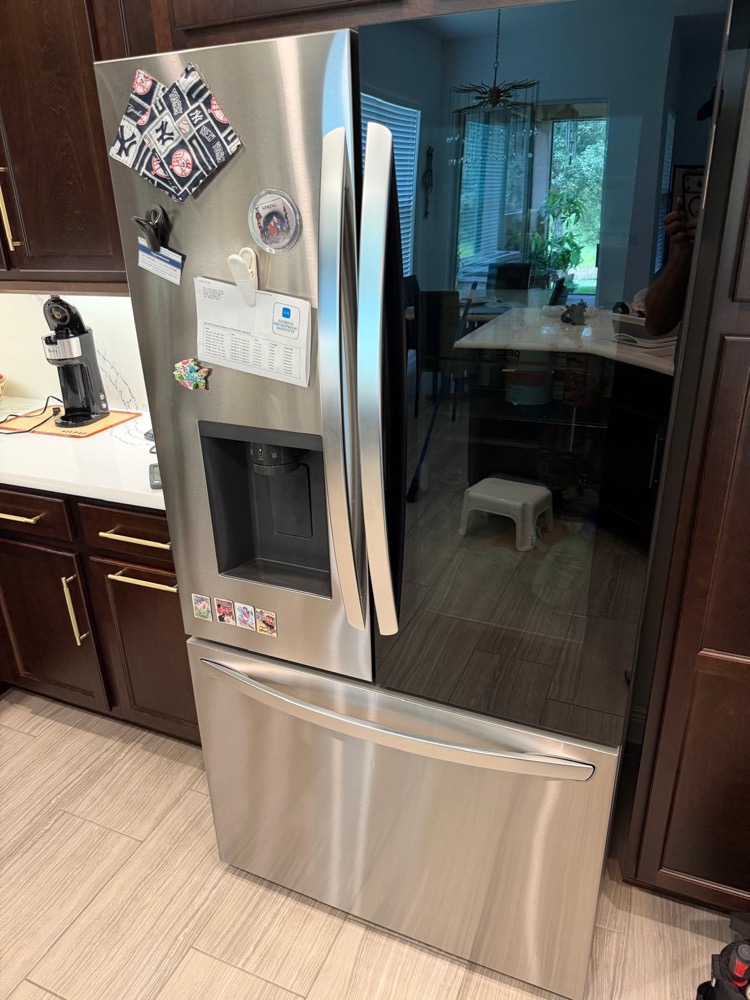
A water dispenser is a convenience, not the refrigerator's job. That shapes the math. A filter, a thawed line or a lock button is free or nearly free. An inlet valve, a dispenser switch or a paddle is a modest part with quick access, and worth it on any refrigerator that is cooling well — I do not care how old it is. A dispenser control board or a door harness is a bigger ticket, and on a fridge past 12 years, or one that has also started running warm, I will tell you so before you approve anything.
The honest exception: if the dispenser died because the freezer is running too cold or too warm, the dispenser is a symptom. That is a cooling diagnosis first, and my hub on why a refrigerator stops cooling is where to start. And some owners, once they hear the number for a board, simply decide to live without the dispenser and use a pitcher. That is a legitimate choice, and I will say so. Every visit starts with a $69 diagnostic, applied in full to the repair you approve, and the answer comes in writing.
How common is this? The search data
Ubersuggest counts about 1,600 U.S. searches a month for "refrigerator water dispenser not working", and the year has a clear shape: demand climbs through the fall, peaks in January, and eases through spring. January is also when kitchens are at their busiest and the last thing anyone wants is a guest holding a glass under a dead spout.
Search data: Ubersuggest, national monthly volume, last 12 months. Searches more than double from the September floor to the January peak. If your dispenser is slowing down in the fall, replace the filter now — the winter queue for service only gets longer.
Expert opinion — Anatoli Didenco, owner, Perfect Appliance Repair Tampa. Before you buy a single part for a water dispenser, do three things: hold the lock button, hold the paddle for twenty seconds, and pull the filter. That sequence clears more dispenser complaints than every part in my van combined. If water still will not come and the ice maker is still working, you have a one-solenoid, one-line, one-switch problem — small, cheap to test, and not worth guessing at. Twenty-plus years of hands-on technical experience taught me that the meter is faster than the parts catalog.
Before you let anyone open your refrigerator
BBB Accredited, A+ rated, and more than 200 five-star reviews across major platforms. Read what owners actually say on the reviews page — Google and BBB, in their own words.
And the honest part: if the lock was on, the filter was six months old, or the line was frozen and thawed, you don't need me. Run a few gallons through and enjoy the water.
Refrigerator water dispenser — quick answers
Why did the water dispenser on my fridge suddenly stop working?
Sudden, with no warning, usually means a setting or a freeze: the control lock got pressed, the door-side line in a side-by-side froze overnight, or the water solenoid on the inlet valve quit. A dispenser that faded slowly over weeks is almost always the water filter.
Why is there no water coming out of my refrigerator dispenser at all?
Nothing at all — not even a trickle — points to a lock, a frozen line, a closed shutoff behind the fridge, or a water inlet valve that no longer opens. A trickle points to the filter or low water pressure. Hold the paddle for a full 20 seconds before deciding which one you have; a line that was air-locked after a filter change can take that long.
Can a clogged water filter stop the dispenser completely?
Yes. In Tampa Bay hard water a six-month filter can pack tight enough to pass almost nothing, and a new filter that is not turned fully into its seat does the same. Pull the filter, fit the bypass plug (or run without the filter on models that allow it), and try again — if water returns, the filter was the problem.
How do I know if my refrigerator water line is frozen?
On a side-by-side, the dispenser goes silent or you hear the valve hum with no water, while the ice maker keeps working. Open the freezer door and blow gently into the dispenser tube outlet, or run a warm cloth along the inside of the door. If water flows after the door warms for a few hours with the freezer set no colder than 0°F, the line was frozen — and the next question is why.
Why does my ice maker work but the water dispenser does not?
The two share one inlet valve with two separate solenoids. Ice working proves the supply, the shutoff and the main line; the water side has its own solenoid and its own path through the door. The fault is the water solenoid, a frozen door line, the filter, or the dispenser switch and paddle.
How do you fix a refrigerator water dispenser?
Start free: unlock the panel, hold the paddle 20 seconds, replace or bypass the filter, open the shutoff behind the fridge all the way. If the fridge still will not dispense water, the remaining parts — inlet valve, dispenser switch, door line, control board — are a service call. I meter the switch and the valve and tell you the answer in writing.
How much does it cost to fix a refrigerator water dispenser?
It depends entirely on which part failed, and I will not guess a number on a page. What I can promise: the $69 diagnostic covers testing every part in the chain, it is applied in full to the repair you approve, and if the fix turns out to be a lock button or a filter, you will hear that first.
Related services
Book same-day service or read more about the exact repair:
- Refrigerator repair
- Ice maker repair
- Refrigerator ice maker not working? The full guide
- What to do if your refrigerator is leaking
- Samsung appliance repair
- Whirlpool appliance repair
Call or text (813) 522-0014 or book online — Perfect Appliance Repair Tampa covers Tampa, South Tampa, Wesley Chapel, Zephyrhills, Dade City, and surrounding Tampa Bay.
Anatoli Didenco is the owner-technician of Perfect Appliance Repair Tampa, with 20+ years of hands-on technical experience in refrigeration and appliance repair across Hillsborough, Pinellas, and Pasco Counties. He specializes in refrigerators — particularly Sub-Zero, Wolf, and premium built-in systems — and sealed-system and compressor work. He answers the phone, and either he or Nick, his technician, shows up at the door. Read more on the About page.
Perfect Appliance Repair Tampa serves Tampa, South Tampa, Wesley Chapel, Zephyrhills, Dade City, and the surrounding Tampa Bay area. Reviews are available on the company’s Google Business Profile and BBB listing.
We Stand Behind Our Work.