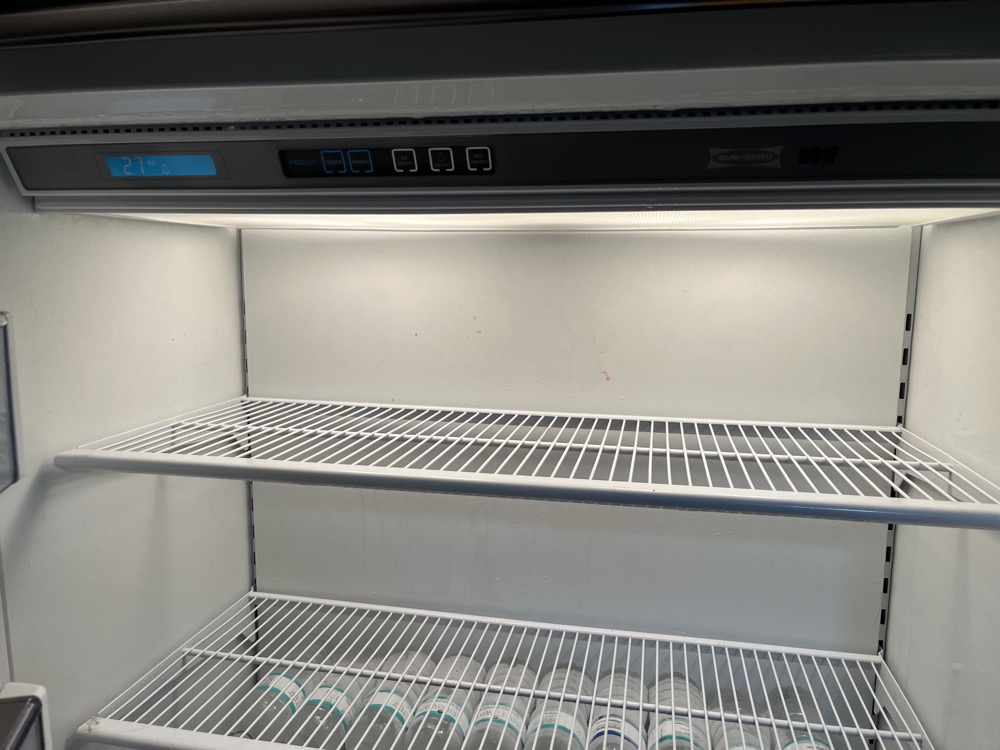
Why a dead fridge light is rarely "just a bulb" — and why the cheap-looking fix is the one that sends people to the emergency room.
Light out and you'd rather not guess? Call (813) 522-0014. Same-day in most Tampa Bay areas. $69 diagnostic, 100% applied to your repair if you approve the work. If I can't fix it, you don't pay.
The short version (read this in 60 seconds)
A refrigerator light that won't come on is one of four things, and they are not equally likely. In my service log, across every brand I work on in Tampa Bay, the order runs like this: the door switch fails most often, the bulb second, a setting or power fault third, and the control board last. Most homeowner guides get that order backwards and send people straight to the bulb.
Three things worth knowing before you open the door:
- A broken bulb is a live 120-volt socket. If the glass snapped off and left the metal base in the fixture, the light is dark but the power is not. Unplug the refrigerator before your fingers go anywhere near it. Full explanation below — this is the part that actually hurts people.
- Test the door switch before you buy a bulb. It takes ten seconds and costs nothing, and it is the single most common cause I find.
- If your fridge has a sealed LED strip instead of a screw-in bulb, there is nothing to unscrew. That's a light board, it's a service part, and in Tampa Bay it's the part our storms kill. Why that matters, with real prices.
Everything below is the long version: how to tell which light you have, how to find the fault without spending a dollar, the real part numbers by brand, and the line where a five-minute job turns into one you should not be doing yourself.
Before you touch anything: the 120 volts nobody mentions
I want to start here, because every other guide starts with "just swap the bulb" and that advice has a hole in it big enough to put someone in the hospital.
Here is the scenario I get called to more often than you'd think. The bulb is old, someone bumps it while loading groceries, and the glass breaks off at the base. The glass is gone. The light is dead. What's left is a jagged metal ring sitting in the socket — and if the refrigerator is still plugged in, that ring is carrying 120 volts.
The dark is what fools people. Your brain reads "no light" as "no power." It isn't. The bulb failed; the circuit didn't. The socket is still energized exactly the way it was five minutes earlier, and now the insulating glass that used to stand between your fingers and the live contact is on the floor of the crisper drawer.
Reaching into a live socket to pull a broken bulb is the same job as changing a wall outlet without switching off the breaker. Yes — plenty of professionals do it live. I have done it. But a professional who does it live has tested the circuit, knows exactly what is energized, is standing on a dry floor, and is not reaching around a grounded steel cabinet with wet hands after unloading groceries.
A real professional's first move is still the same one I'm asking of you: pull the plug. Not because we're fragile — because the two seconds it costs are worth more than the alternative. Then gloves, because a broken appliance bulb leaves an edge that will open your hand, and a cut in a refrigerator is a cut in the place you keep food.
The part that makes this a Florida problem rather than a general one: a kitchen here is a humid room, the floor tile is often damp, and a refrigerator is a large grounded metal object. Those three things together are what turns a shock into a serious shock. In a dry climate, brushing a live contact might make you swear. Standing barefoot on a damp tile floor with one hand on a grounded cabinet, the current has somewhere to go, and it goes through you.
And there's a second casualty nobody plans for. Broken bulb glass in a refrigerator means glass fragments in a food compartment, at the exact height where a child reaches for a juice box. Any open food below the fixture goes in the trash — not because I'm cautious, but because you cannot see the small pieces and you will not find them all with a paper towel.
Expert opinion — Anatoli Didenco The safe sequence, in the order I do it in a customer's kitchen:
One: unplug the refrigerator at the wall. If the outlet is behind the unit and you can't reach it, switch off the breaker instead — and confirm the fridge went quiet before you go any further. Silence is your proof.
Two: gloves. Not dish gloves, not a paper towel — work gloves you can grip through. If the base is still in the socket, needle-nose pliers on the metal shell will back it out cleanly; there's no need to put a finger in there at all.
Three: clean up before you plug back in. Glass, then the shelf, then anything open that was underneath it. Wipe the socket dry with the power still off.
Four: when it's back together and lit, notice how it burned out. A bulb that shattered rather than simply going dark usually had help — a door slammed hard, a bulb rated for the wrong wattage running hot, or a fixture that's been vibrating. Fix that too, or you'll be back here.
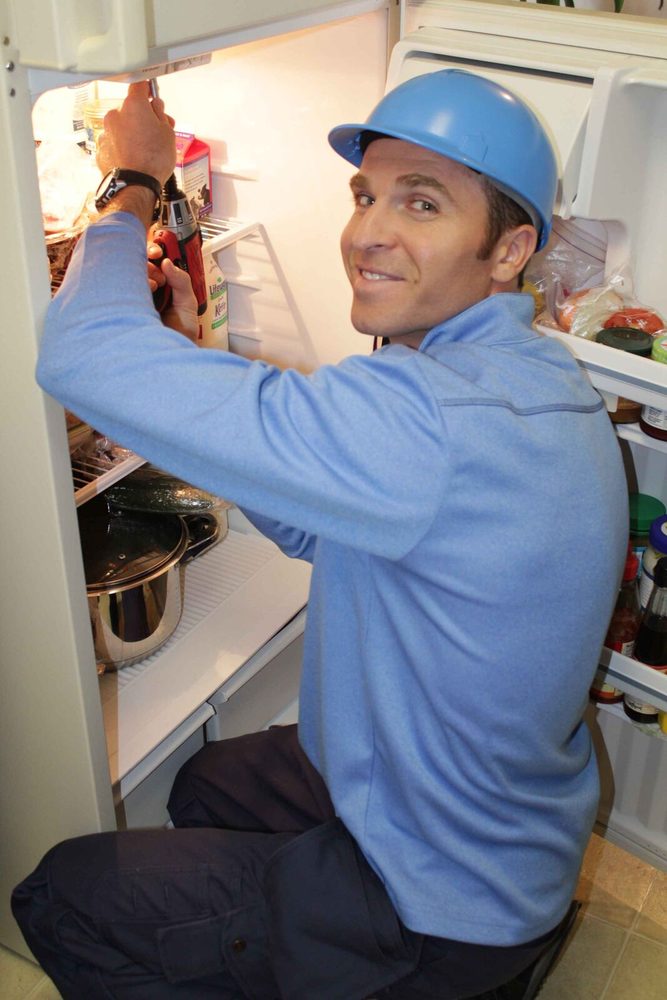
Which light does your refrigerator have?
This decides everything that follows — what's safe to touch, what a replacement costs, and whether this is a ten-minute job or a service call. Pick the one that matches what you see inside your fridge.
The traditional appliance bulb
How to recognize it: a small pear-shaped glass bulb behind a clip-on plastic cover, warm to the touch after the door has been open a while. The standard is an A15 appliance bulb, 40 watts, 120 volts, on a medium E26 screw base — the same thread as a normal household lamp, just a smaller glass envelope. Some models use 25W, and some use a narrower E17 intermediate base, so check the old bulb before you buy.
Who can do it: a homeowner, safely, with the fridge unplugged.
What it costs: a few dollars for a generic A15 at any hardware store. The manufacturer's own version — Whirlpool's part 8009, a 130-volt 40W A15 that fits nearly every Whirlpool, KitchenAid, Maytag, Amana and Kenmore appliance — runs about $14–$23.
The catch: this is the type that breaks in the socket, and this is the socket that carries line voltage. Match the replacement to the old one on both counts — shape and wattage — and never fit a light bulb rated above what the fixture calls for. An oversized incandescent bulb runs hot inside a sealed plastic housing, and that heat is what makes the next one shatter.
Cheapest to fix · highest shock risk if it breaks · always unplug first
The screw-in LED replacement
How to recognize it: same socket, same twist-out fitting, but the bulb is a stubby frosted plastic cylinder instead of clear glass, and it stays cool. Many manufacturers moved to these as a factory part — Frigidaire's 5304511738 (3.5W, E26 medium base) and 5304517886 (3.8W, E17 intermediate base) are the two I run into most in this market.
Who can do it: a homeowner. Same rule: unplug first. The socket is still line voltage even though the bulb is not glass.
What it costs: this is where people get surprised. An OEM screw-in LED is not a $3 part — Frigidaire's run $36 to $64 depending on base and model. A generic LED appliance bulb of the correct base and wattage is a legitimate alternative and a genuine upgrade over incandescent: it runs cool, so it stops cooking the fixture, and it lasts years rather than months.
The catch: base type. E26 and E17 look similar in a photo and are not interchangeable. Take the old bulb with you or photograph the part number on its collar.
Still homeowner-safe · runs cool · check the base size before ordering
The sealed LED light board
How to recognize it: there is no bulb. You see a flat white strip or a row of small diodes behind a fixed diffuser panel — usually along the top of the compartment or up the side walls on a French-door model. Nothing twists. Nothing unclips without tools.
Who can do it: this one is a service part. The module is fed low-voltage DC from the control board, which is genuinely safer to be near than a 120-volt screw socket — but replacing it means pulling a trim panel, releasing a harness connector, and matching the module to the exact model. On many French-door models the module sits behind the top hinge cover rather than inside the compartment, so getting to it means working above the door line. On several brands the diffuser is bonded and the whole assembly comes as a kit.
What it costs: this is the number nobody expects. A Whirlpool LED module service kit runs about $151. LG's lamp assembly is about $149. Samsung's current LED runs about $86. That's the part alone, before labor. The full comparison is below, and it's the reason this section exists.
The catch: a surge that a glass bulb would shrug off can take out a light board. See the Florida section — this is the single most preventable expensive failure in a modern refrigerator.
Safer to be near · 3–6× the cost of a switch · vulnerable to power surges
Start here: the checks that cost nothing
Before any part gets ordered, four checks. None of them requires a tool, and between them they explain most of the dark-light calls I take.
1. Confirm the refrigerator actually has power. Is it humming? Is it cold? If the whole unit is dark and warm, this isn't a light problem — it's a tripped breaker, a popped GFCI, or a loose plug. Test the outlet with a phone charger. And if the light died right after a storm or a flicker, unplug for five minutes and plug back in before anything else: a reset clears a surprising number of post-storm fault states, and it costs nothing.
2. Press the door switch with your finger. It's the small plunger set into the door frame — the button the door presses in when it closes. Push it in and let it out a few times. If the light flickers, stutters, or responds erratically, you've found your fault in ten seconds. On a Samsung there may be no plunger at all: Samsung uses a magnetic reed switch, so the "button" is a sealed sensor and a magnet in the door. Nothing to press.
3. Look at the bulb before you touch it. Is the glass intact? A dark filament with intact glass is a normal burnout — unplug, swap, done. A broken or missing glass envelope is the situation from the safety section above, and the procedure changes.
4. Rule out a setting, not a fault. Three settings mimic a dead light, and between them they explain a real share of the calls I get. Most refrigerators automatically turn the interior lights off after the fridge door has been left open several minutes — that's a door-ajar timeout protecting the bulb, and it's by design, so a light that only "won't come on" after a long open door is working properly. Display models ship in demo or showroom mode, which disables features including the light; if the fridge is new, recently delivered, or was just reset, your owner's manual lists the button sequence to turn it off. And the one that catches the most people: Sabbath mode. Nearly every major brand builds it in for observant Jewish households — it disables the interior lights, the chimes and the display so that opening the door triggers no electrical action. It is easy to enter by accident on a control panel, it survives a power cycle, and from the outside it looks exactly like a broken light on a refrigerator that is otherwise cooling normally. If your fridge is still cooling and the display seems oddly quiet, check for Sabbath mode before you check anything else.
And check the freezer while you're there. On a side-by-side or French-door model the fresh-food and freezer compartments usually have separate lights and separate door switches. If both compartments went dark at once, that points upstream — at the board or the power feeding it — rather than at two bulbs failing on the same day. If only the freezer light is out, treat it as its own problem with its own switch and its own bulb or module.
The door switch: the part that actually fails most
Here's what field experience changes about the usual advice. A bulb has one failure mode — the filament or the diode dies. A door switch has four, and every one of them is common in a Tampa Bay kitchen.
It gets pressed and released thousands of times a year, so the internal contacts wear. It sits in the doorway of a humid box, so a sticky film builds around the plunger and stops it springing back. It lives at the boundary between a cold compartment and an 82-degree kitchen, so it cycles through condensation every single day. And on many models it doesn't only run the light — it also tells the control board the door is open, which pauses the ice and water dispenser, silences or triggers the door chime, and cuts the evaporator fan.
That last detail is a free diagnostic, and almost nobody uses it. Open the door and watch what else the fridge does:
- Light dark, but the dispenser still locks out and the chime still works? The switch is doing its job and talking to the board. Your fault is downstream — the bulb or the socket. Cheap territory.
- Light dark and nothing else responds either — no chime, no dispenser lockout? The switch itself, or the signal it sends. That's the switch or the wiring above it.
- Light flickers, or comes on dim, or other electronics act strange at the same time? That's a board or a power-quality problem, not a light problem — and in this market, that pattern shows up hardest after storm season.
One thing to try before buying anything: clean the plunger. A cotton swab with rubbing alcohol around the shaft and its housing removes the sticky residue that builds up in a humid kitchen, and I've had switches come back to life from that alone. It works often enough to be worth the sixty seconds.
The three kinds of switch you'll meet
The plunger switch (SPST). The classic — a spring-loaded button that opens and closes a single circuit. Whirlpool, GE, Frigidaire and LG all use variations. Pops out with a small flat tool on most models, no wiring, genuinely homeowner-replaceable.
The magnetic reed switch. Samsung's approach and increasingly common elsewhere. A sealed glass reed in the cabinet and a magnet in the door — nothing mechanical to wear, nothing to press, and no plunger to get sticky. It fails less often, but when it does, there's no finger test that will tell you.
The multi-function rocker or paddle. On some Whirlpool-family units the door switch is combined with other functions in one body. Same job, different shape, different part number — which is exactly why matching to your model number matters more than matching to a photo.
Find your part: switches and light boards by brand
These are the numbers I actually order. Pick your brand and you'll get the switch, the light board it may or may not have, and what each one costs — because the gap between those two numbers is the whole point of the next section.
Every part number below was verified against manufacturer and OEM-parts listings in August 2026. Prices are typical US retail for the part alone. Always confirm against your full model number before ordering — the model tag is usually inside the fresh-food compartment on a side wall or behind a crisper drawer. Supersessions are noted where the old number still shows up in search results.
The LED light board trap
Every manufacturer moved to LED lighting for good reasons. It runs cool, so it stops baking the fixture and the food above it. It draws a fraction of the power. It lasts years instead of months. And from a safety standpoint it is a real improvement — the module itself runs on low-voltage DC, so the thing you'd be reaching toward is no longer a 120-volt screw socket.
Here's the trade nobody explains at the showroom. On an old fridge, the lighting system had two failure points and both were cheap: a bulb and a switch. On a new one, the bulb is gone and its job has been absorbed into a sealed electronic assembly. When any part of that assembly fails, you don't replace a bulb. You replace the board.
And that changes the arithmetic completely. Look at what the same symptom — a dark refrigerator — costs to fix depending on which part died.
Expert opinion — Anatoli Didenco I am not against LED lighting. It is better in almost every way, and I'd rather a customer reach toward a low-voltage module than a live 120-volt socket. What I am against is nobody telling people what changed underneath.
When the light went out on a fridge built in 2005, the worst case was a bulb and a switch — call it fifty dollars and twenty minutes. When the light goes out on a fridge built in 2022, the worst case is a sealed module that costs a hundred and fifty dollars before anyone touches it, plus the labor to pull a trim panel and release a harness connector without cracking anything.
That's not a reason to avoid a modern refrigerator. It's a reason to protect the one you have — because unlike a filament, a light board does not usually die of old age. It dies of electricity, and we live in the part of the country that supplies the most of it.
Why Florida is the worst place in America to own a light board
A filament bulb is close to immune to a power surge. There is nothing in it to damage that isn't already a piece of wire designed to run white-hot. A light board is the opposite: it's an electronic assembly with a driver circuit, and driver circuits are exactly what voltage spikes destroy.
Which brings us to where we live. Florida is the lightning capital of the United States, and that is not a slogan — it shows up in the insurance data every single year.
Notice which of those numbers moved fastest. Total US lightning payouts went from $1.04 billion in 2024 to $1.65 billion in 2025 — but the number of claims only rose from 55,537 to 61,986. The claims grew 12%; the money grew 59%. The gap between those two figures is the story: the cost per lightning claim is climbing far faster than lightning itself, because the average home now contains far more electronics for a surge to destroy.
A refrigerator light board almost never makes it into those statistics. It's too small — a $150 part on a $1,000 deductible never becomes a claim. It just becomes a bill you pay quietly, and that's exactly why nobody tracks it and nobody warns you about it.
Expert opinion — Anatoli Didenco Here is what I tell every Tampa Bay customer who buys a refrigerator with LED lighting: put it on a surge protector, today.
The math isn't close. An appliance-rated surge protector — look for a joule rating above 1,000 and a clamping voltage below 400V — costs less than the cheapest light board in the chart above. And the light board isn't even the expensive thing it's guarding: the same surge that takes out the LED driver is coming for the main control board behind it, which runs several hundred dollars on a standard fridge and $700–$1,200 on a Sub-Zero or other premium built-in.
Two details most people miss. First, a surge protector has a finite life — it absorbs damage until it can't, and the status light on the front is telling you whether it still works. Check it after every serious storm season, and replace it if the indicator has gone dark. A dead surge protector looks exactly like a live one from behind the fridge. Second, surge protection and voltage stability are two different problems. A protector handles the spikes; it does nothing about the sags that happen every time your AC compressor kicks on. If the fridge shares a circuit with a window unit or a space heater, the electronics are absorbing that too. A dedicated 15-amp circuit is the real fix.
And when a light board does die after a storm — check the rest of the fridge before you order the part. If the ice maker got strange, if the display flickered, if temperatures drifted, the board took the hit and the light is only the part of it you can see.

A Florida cause most guides skip: moisture and corrosion
There's a failure mode here that barely exists in a dry climate. Condensation and humid air around the light fixture, socket, or switch corrode the contacts and produce an intermittent or dead light with a perfectly good bulb in place. If you pull a bulb and find green-white crust on the socket contacts, or moisture sitting near the fixture, that's your answer.
With the fridge unplugged, light surface corrosion on the contacts can sometimes be cleaned gently. But treat the moisture as a message, not just a mess. Water inside the lighting area usually means something upstream: a door not sealing fully, a defrost drain backing up, or humid air pushing in past a hardened gasket. The dead light is the visible symptom of a moisture problem that's also working on your seals and your defrost system. Run the dollar-bill test on the gasket while you're in there — my guide on maintaining refrigerator door seals walks through it — and if the gasket is stiff or the folds are dirty, that's where the moisture is getting in.
Where the line is: what to do yourself, what to hand over
Here's the honest split, from bulb to board.
The bulb — homeowner-safe, unplugged. Match type, base and wattage. Never exceed the fixture's rating. If the glass is broken, gloves and pliers, and the plug comes out first.
The door switch — homeowner-safe on most models. Snap-in, no wiring. Clean the plunger before you replace it. Match the part number to your model, not to a photo.
The light socket — borderline. Cleaning gentle corrosion off the contacts with the fridge unplugged is reasonable. Cutting, splicing or rewiring it is not: on many modern units that harness is shared with control electronics, and it isn't the simple 120-volt lamp circuit the older internet guides assume.
The wiring harness — call someone. Damaged wiring near a grounded appliance in a humid kitchen isn't a wire-nut situation. The savings aren't worth the risk.
The LED module or light board — call someone. Not because it's dangerous — it's low voltage — but because it's a $150 part that breaks if you flex the wrong panel, and because a board that just died in a storm needs the rest of the system checked before anyone spends money on parts.
The control board — call someone. This one needs instruments, not guesswork.
There's no shame in stopping at the switch. The whole point of doing the free checks first is that if it turns out to be something deeper, you've spent nothing finding out, and you hand a technician a specific, well-described problem instead of a mystery.
Not sure which of these you're looking at? Call (813) 522-0014 and describe what you see — a photo of the fixture and your model tag tells me almost everything. Real humans answer, Monday through Saturday. If I come out, the $69 diagnostic is 100% applied to your repair when you approve the work, and if I can't fix it, you don't pay.
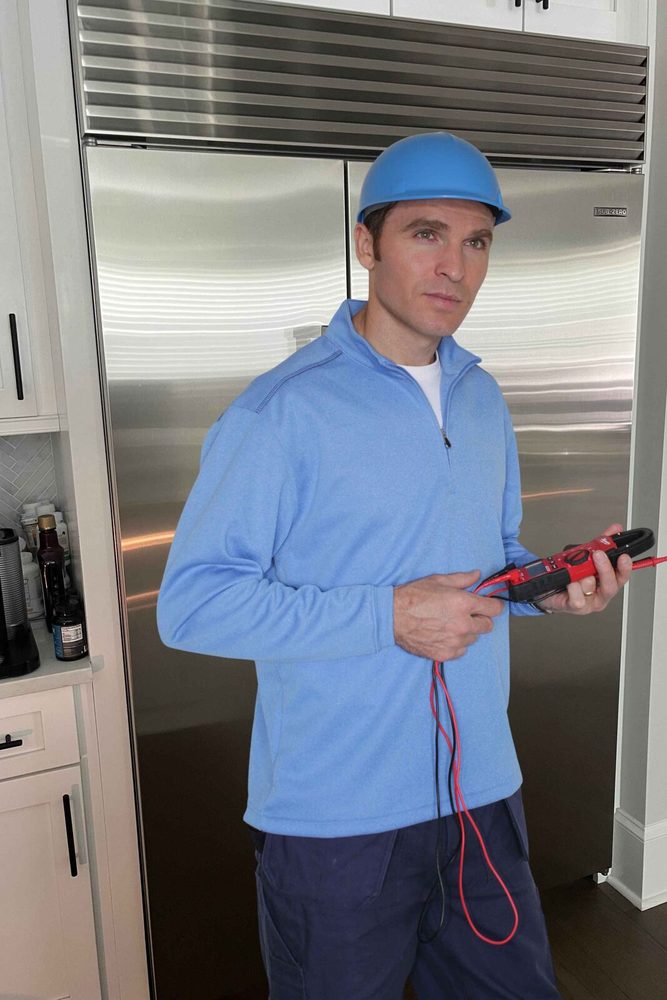
Before you let anyone open your refrigerator
BBB Accredited, A+ rated, and more than 200 five-star reviews across major platforms. Read what owners actually say on the reviews page — Google and BBB, in their own words.
And the honest part: if the door switch clicks when you press it and a new bulb lights up, you don't need me.
Questions Tampa Bay homeowners ask
My fridge is cold but the light won't come on. Where do I start? Good news first: a cold fridge means you have power, so this isn't a breaker problem. Start with the door switch — press it in and out with your finger and watch for any flicker. Then look at the bulb. Those two cover most cases, and neither costs anything to check.
The bulb broke off in the socket. Can I just pull the base out? Not while it's plugged in. That metal base is carrying 120 volts even though the light is dark — the bulb failed, the circuit didn't. Unplug the refrigerator at the wall (or kill the breaker and confirm the fridge went quiet), put on work gloves, and back the base out with needle-nose pliers. Then clean up the glass and throw away any open food that was underneath it.
Why do you keep saying the switch fails more than the bulb? Because of how each one lives. A bulb sits still and waits. A door switch gets pressed thousands of times a year, sits in the humid doorway of a cold box, and cycles through condensation daily. In my service log it's the more common failure by a clear margin — which is why the ten-second finger test comes before any trip to the parts store.
My refrigerator has a light strip, not a bulb. Can I replace it myself? Physically, sometimes. Practically, I'd advise against it. It's a sealed module fed by the control board — safe to be near, but it comes as a service kit, it needs the right part for your exact model, and getting to it means releasing trim and a harness connector without cracking anything. On Whirlpool and LG that part alone runs about $150. That's a lot of money to risk on a trim clip.
The light went out right after a storm. Coincidence? Probably not, in this market. First try a reset: unplug five minutes, plug back in. If the light returns and everything else behaves, you're fine. If other things are also acting strange — ice maker, display, temperatures — the board took a surge hit and the light is just the symptom you can see. That's worth a diagnostic before it becomes a bigger repair.
Is a surge protector really worth it for a refrigerator? In Florida, yes, and the math isn't close. An appliance-rated protector costs less than the cheapest LED light board on the chart above, and far less than the control board sitting behind it. Florida leads the nation in lightning claims every year, and the average claim cost jumped 42.8% in 2025 alone as homes filled with more electronics. Your refrigerator is one of those electronics now.
Can I just rewire the light socket myself? I'd stop at gentle contact cleaning. On many modern refrigerators the lighting circuit shares a harness with control electronics and is not a simple 120-volt lamp circuit, and improvising with wiring near a grounded appliance on a damp kitchen floor is a genuine risk, not a theoretical one. Past the bulb and switch is the point to call.
My new refrigerator's light has never worked. Is it broken? Check demo mode first. Display models ship with a showroom mode that disables features including the interior light, and it's a common surprise on a newly delivered or recently reset unit. The manual lists the button sequence to turn it off.
Could my refrigerator be in Sabbath mode? It's worth ruling out first, because it costs nothing. Sabbath mode is a setting nearly every brand includes for observant Jewish households: it shuts off the interior lights, chimes and display so that opening the door causes no electrical action. It can be entered accidentally from the control panel, it survives unplugging, and it looks identical to a dead light on a fridge that is cooling normally. Your owner's manual lists the button combination for your model.
Can a refrigerator work without the light? Yes — the lighting circuit has nothing to do with cooling, so a dark refrigerator that is still cold is safe to keep using. But don't let it run that way for months. On some models the light shares a door switch with the evaporator fan and the dispenser lockout, so a failed switch can quietly change how the fridge behaves with the door open. And in a Tampa kitchen, hunting for things in the dark means a door that stays open longer than it should.
Does a dead fridge light actually cost me anything? A little, and it compounds. Without light you hunt for things, so the door stays open longer, and in a Tampa kitchen running 80–90°F half the year, every extra second is warm humid air the compressor has to pull back out. It's small per opening. It isn't small over eight months.
The whole thing in order
If you want one list to work from, this is how I troubleshoot a dark refrigerator light in a customer's kitchen, in the order I actually do it.
- Is it cooling? A fridge that's cold has power, so this is a light problem. A fridge that's warm and silent is a control or power problem, and the light is the least of it.
- Check the settings. Door-ajar timeout, demo mode, Sabbath mode. Free, instant, and they explain more calls than people expect.
- Work the refrigerator door switch with a finger. Any flicker names the culprit in ten seconds. No plunger to press means a magnetic reed switch — skip to step 5.
- Watch what else the door does. Chime and dispenser lockout still working means the light switch is fine and the fault is downstream at the bulb or socket. Everything gone quiet means the fault is the switch or above it.
- Look at the light bulb — don't just swap it. Intact glass and a dark filament is a normal burnout. Broken glass means unplug first, then gloves, then pliers.
- Clean before you buy. Alcohol on a sticky plunger, and a look at the socket contacts for the green-white corrosion our humidity produces.
- Match the part to your model, not to a photo. The chart above has the numbers; your model tag has the final word.
- Stop at the harness. Past the bulb and switch — wiring, LED module, control board — is where the savings stop being worth it.
Lights that stop working almost always fall out at step 2, 3 or 5. The value of doing them in order is that the free steps come first, so you find out for nothing.
The bottom line
A refrigerator light that won't come on is usually a cheap fix — most often a door switch, sometimes a bulb, occasionally nothing more than a setting. The skill isn't forcing every repair yourself. It's knowing which repairs are genuinely safe, which ones the fridge is using to tell you about something bigger, and which single precaution — unplugging before your hand goes near a broken bulb — separates a five-minute job from a trip to the emergency room.
Do the free checks first. Let the door system show you how deep the fault goes. And if your refrigerator lights with an LED strip rather than a bulb, put it on a surge protector before storm season, because in this state that part does not usually die of old age.
Ready for an honest look instead of a guessing game? Call (813) 522-0014 or book online. Same-day in most Tampa Bay areas. $69 diagnostic, 100% applied to your repair if you approve the work. If I can't fix it, you don't pay — no labor, no parts, no charge.
Where these numbers come from
Lightning and insurance data: Insurance Information Institute — 2024 lightning claims and Triple-I — 2025 lightning claims and average cost per claim. Thunderstorm frequency: Florida Climate Center (FSU). Part numbers and prices verified August 2026 against manufacturer and OEM-parts listings including PartSelect, GE Appliance Parts, Whirlpool, LG Parts and Sub-Zero's own switch reference. Failure-order and field observations are from my own repair log across Hillsborough, Pinellas and Pasco Counties — clearly marked as experience, not laboratory data.
Related services
Book same-day service or read more about the exact repair:
- Refrigerator repair
- How long refrigerators last in Tampa — and what cuts their life short
- Refrigerator repair cost in Tampa: real price ranges
- How to maintain refrigerator door seals
- Why a refrigerator stops cooling — every cause, ranked
Call or text (813) 522-0014 or book online — Perfect Appliance Repair Tampa covers Tampa, South Tampa, Wesley Chapel, Zephyrhills, Dade City, and surrounding Tampa Bay.
Anatoli Didenco is the owner-technician of Perfect Appliance Repair Tampa, with 20+ years of hands-on technical experience in refrigeration and appliance repair across Hillsborough, Pinellas, and Pasco Counties. He specializes in refrigerators — particularly Sub-Zero, Wolf, and premium built-in systems — and sealed-system and compressor work. He answers the phone, and either he or Nick, his technician, shows up at the door. Read more on the About page.
Perfect Appliance Repair Tampa serves Tampa, South Tampa, Wesley Chapel, Zephyrhills, Dade City, and the surrounding Tampa Bay area. Reviews are available on the company’s Google Business Profile and BBB listing.
We Stand Behind Our Work.