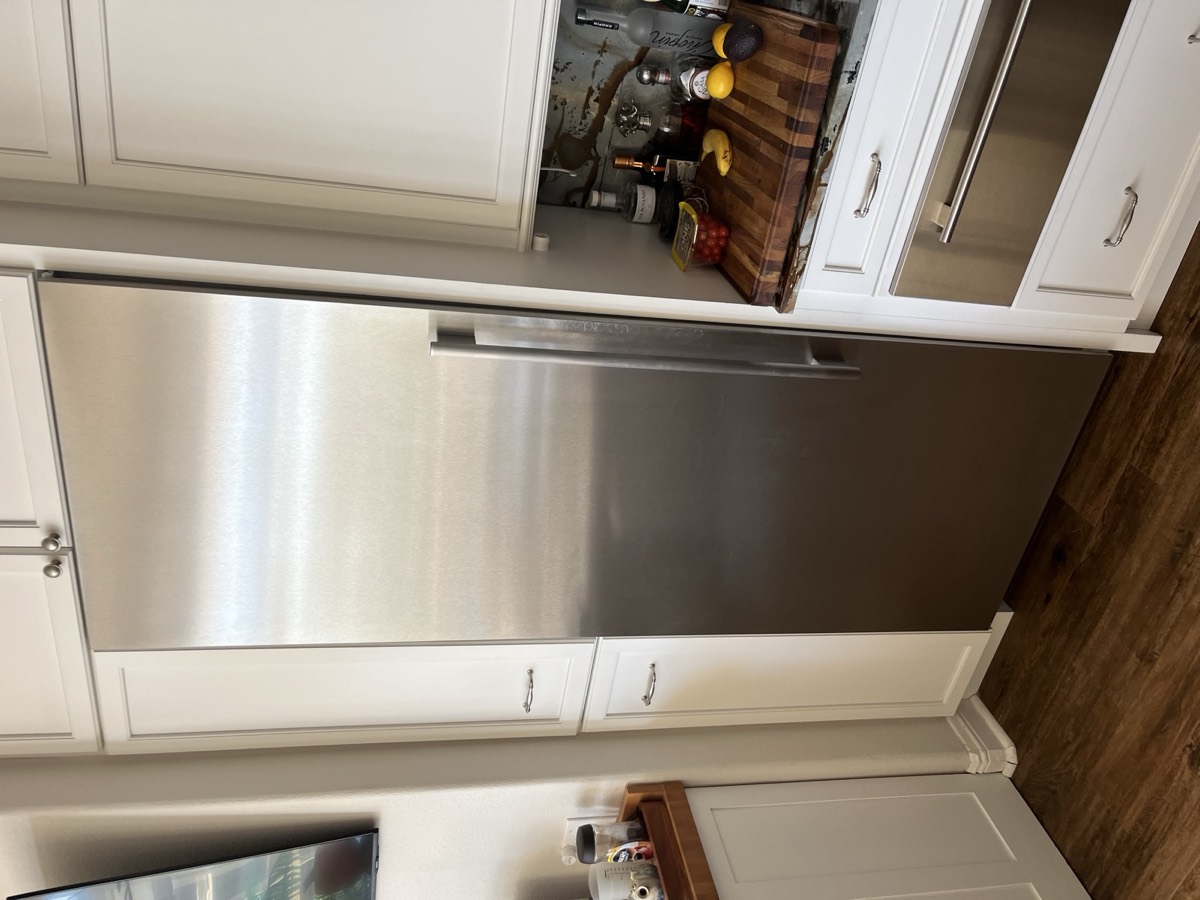
Why is my refrigerator ice maker not working?
A refrigerator ice maker that stopped making ice almost always falls into one of these eight causes:
- Water supply turned off or kinked
- Water inlet valve failed or clogged
- Frozen fill tube
- Old or clogged water filter
- Freezer too warm (above 10°F)
- Ice maker arm or sensor blocked
- Motor or module failure
- Optics board failure (newer fridges)
The first five are DIY checks anyone can do in about 30 minutes. The last three are where most calls to Perfect Appliance Repair Tampa come from. Work through this list top to bottom -- most ice maker issues get solved before you reach step six.
What causes a refrigerator ice maker to stop making ice?
1. Water supply turned off or kinked
The most common cause and the one most often missed. The 1/4-inch water line behind the fridge can get kinked when the fridge is pushed back against the wall, or the saddle valve under the sink can vibrate closed over time. Pull the fridge out, check the line is straight, and confirm the shutoff valve at the wall or under the sink is fully open. No water in equals no ice out.
2. Water inlet valve failed or clogged
The water inlet valve is a solenoid at the back of the fridge that opens to fill the ice mold. Mineral buildup from Florida's hard water -- especially in parts of Hillsborough and Pasco -- clogs the valve over 5 to 7 years. A failed valve gets stuck closed and never fills the mold. The valve is a mechanical part that bolts to the back panel, and swapping it is usually an hour on site.
3. Frozen fill tube
The fill tube delivers water from the inlet valve to the ice mold. If freezer temperatures drop too low or the inlet valve drips, the tube freezes solid and blocks new water. The fix: unplug the fridge for 2 to 4 hours, melt the ice with a hair dryer on low (not high -- you'll damage plastic), and check that the freezer is set to 0 to 5°F, not colder.
4. Old or clogged water filter
A filter past its replacement date -- every 6 months in Tampa because of hard water -- restricts flow enough that the ice maker can't get enough water per cycle. You get small, hollow cubes or no cubes at all. Replace the filter, then run 2 to 3 gallons through the dispenser to flush air from the line before judging the result.
5. Freezer too warm
Ice makers need freezer temperature below 10°F to cycle properly. Pack the freezer too full, leave the door ajar, or let the gasket fail and the temperature creeps up. The ice maker has water in it but won't release the cubes because they're not fully frozen. Check temp with a thermometer if your fridge doesn't display it directly.
6. Ice maker arm or optics sensor blocked
Older ice makers have a wire bail arm that swings up when the bin is full and stops production. If the arm gets stuck in the up position -- bumped during loading, frozen in place, or jammed by a stray cube -- the ice maker thinks the bin is full and stops. Newer fridges use an infrared optics sensor on each side of the bin; ice or frost on the sensor causes the same problem. Lift the arm and let it drop, or wipe the optics windows clean.
7. Motor or module failure
The ice maker module contains a small motor that drives the ejector and a thermostat that triggers the cycle. When the module fails, the ice maker stops mid-cycle, never starts, or the ejector arm freezes in place. You'll often see partial ice or a tray full of water that never gets ejected. The module comes out as one assembly, and for common models it is a part we keep on the truck.
8. Optics board failure (newer fridges)
Newer refrigerators use a control board that processes the optics sensor signals and runs the ice maker cycle. When the board fails, the ice maker stops responding to its sensors entirely. This usually shows as no ice production with no obvious cause -- water flows, freezer is cold, sensors are clean. A board costs more than a module, because the part itself is electronic, and it takes a tech to confirm the board is what failed.
How to fix a refrigerator ice maker that stopped working
Work these steps in order. Stop when you find the problem -- most refrigerator ice maker issues get solved by step four.
- Check the water supply. Pull the fridge out, look at the 1/4-inch line for kinks, confirm the shutoff valve is fully open. Listen at the back of the fridge during a fill cycle -- you should hear water flowing for 5 to 7 seconds.
- Replace the water filter. If it's been 6 months or more, swap it. Run 2 to 3 gallons through the dispenser to flush trapped air.
- Verify freezer temperature. Use a thermometer if needed. Target 0 to 5°F. Too warm and ice won't release; too cold and the fill tube can freeze.
- Lift the bail arm or clean the sensors. Drop the wire arm or wipe the optics windows. Many newer fridges show ice maker status on the display -- check for an error indicator.
- Defrost the fill tube. If you suspect the tube is frozen, unplug the fridge for 2 to 4 hours, or aim a hair dryer at low setting at the back of the ice maker for 5 minutes.
- Force a test cycle. Most ice makers have a test button or a way to manually trigger a cycle (check your model number for the exact procedure). Run it. If the cycle completes but no water arrives, the inlet valve is the issue. If the cycle won't start at all, the module or board has failed.
If the test cycle fails or you've worked through everything and still no ice, it's time for a tech. The remaining causes -- inlet valve, module, optics board -- need diagnostic tools and parts.
Water first: why most «broken» ice makers are really water problems
Your refrigerator’s ice maker is a small machine with one job — freeze water into ice cubes and drop them into the ice bin — and nine times out of ten a halt in ice production is a water story, not a motor story. To make ice at all, the unit needs steady water flow to the ice maker: the water supply line at the wall, the water valve behind the fridge, and the ice maker’s fill valve all sit upstream of every cube. A clogged filter is the most common ice maker failure there is — it will reduce water flow, then restrict water flow to a trickle, decrease ice production down to small or no ice production, and eventually prevent the ice maker from cycling at all, which reads as «my ice maker stopped» when the machine is simply thirsty. Whirlpool recommends using everydrop® water filters and says the water filter be replaced every 6 months — and in Tampa, on mineral-heavy water, filters should be changed more frequently if the family leans on ice and water daily. Make sure the water filter is locked in place after a swap — a cartridge that is not locked in place can stop water entirely — check the installation twice, and if water dispenses at the door but no cubes appear, you have just proven the supply is healthy and the fault sits downstream. Replacing your water filter regularly is the cheapest insurance this machine has, and it buys fresher-tasting drinking water in the bargain: clean water in, optimal ice out.
The rest of the troubleshooting tips take five minutes and no tools. Check for ice where it should not be: a frozen water line — the thin fill tube at the back — chokes water to the ice maker and is the classic cause of low ice, and a pinched water line behind a fridge shoved hard against the wall does the same without freezing anything. Confirm the ice maker is turned on: wire arm down, or the switch lit — a bumped arm is the most embarrassing of the common ice maker problems and we find it weekly. Watch the ice level: many units read the level of ice with an arm or an optical sensor, and a stray bag of ice in the bin blocking the ice sensor convinces the machine the bin is full, so it will not produce ice until the sensor sees daylight. Ensure the freezer temperature is set at the proper temperature — good production wants the temperature in the freezer at 0°F, and if the freezer temperature is set warmer to save energy, expect thin cubes and a slow tray. Then try resetting the ice maker: most models hide a reset button under the front lip or behind the bin, and a reset after a filter change is routine, not a failure. If the ice maker is not making anything after all of that — no hum, no fill, the module never cycles — the motor module, the valve or the control side has genuinely failed, and professional service is recommended: we test whether the existing unit is working properly, and when it is not, a new ice maker is replaced or installed in under an hour on most models, priced in writing first. Regular maintenance — the filter on schedule, coils clean, the door gasket creating a proper seal, checking water pressure at the valve — is what keeps ice and water steady through a Tampa summer.
When to call a refrigerator repair tech
DIY didn't solve it -- that's the clearest sign. But a few specific patterns tell you to call sooner.
Water leaks under the fridge alongside no ice point to the inlet valve dripping internally. That's not a DIY repair -- it requires shutoff, parts replacement, and verifying the new valve is properly sealed before the freezer floor floods. Intermittent ice production where you get small cubes one day and nothing the next often means a partial inlet valve failure that gets worse over time.
Age matters in the decision. An ice maker assembly on a 5-year-old fridge is almost always worth replacing -- the rest of the unit has years left. At 12 years or more with multiple problems building up, the math sometimes shifts toward a new fridge. Perfect Appliance Repair Tampa gives you the straight answer after diagnosis.
Florida note: Tampa's hard water -- especially in parts of Hillsborough and Pasco served by well systems -- accelerates mineral buildup in inlet valves and water lines. Ice maker problems show up earlier here than in cities with soft municipal water. Annual water filter changes and an occasional flush of the dispenser line head off most issues.
If you'd rather skip the DIY phase, here's what a visit costs: $69 diagnostic, 100% applied to your repair if you approve the work. No fix, no fee. That is our guarantee. For specialty ice maker work -- standalone units, undercounter ice makers, or commercial models -- see our ice maker repair Tampa page. For full ice maker assembly replacement, see refrigerator ice maker replacement.
Brand notes: KitchenAid, Kenmore and Maytag
All three ride on the Whirlpool modular ice maker, so the diagnosis above applies almost line for line. What differs:
KitchenAid
KitchenAid French-doors and built-ins use the same modular ice maker as Whirlpool, but on built-in models the water line runs a longer path that clogs sooner on hard Hillsborough County water — check the inlet valve screen and the fill tube for scale before condemning the ice maker itself. KitchenAid repair.
Kenmore
Model prefix 106. = Whirlpool ice maker, prefix 795. = LG tray-style — two completely different repairs. The Whirlpool-built units take a standard modular kit; the LG-built ones fail the LG way (see the LG ice maker guide).
Maytag
Same Whirlpool platform, same modular kit, same fix. If the ice maker cycles but produces hollow or small cubes, look at water pressure and the filter first — on well-water homes east of Valrico we replace far more inlet valves than ice makers. Maytag repair.
Dedicated brand guides with model-specific detail: Samsung, Whirlpool, Frigidaire, GE and LG.
Related services
Book same-day service or read more about the exact repair:
- Ice maker repair
- Refrigerator repair
- How long refrigerators last in Tampa — and what shortens it
- Water dispenser not working? Start with the line and filter
- What refrigerator repair actually costs in Tampa
Call or text (813) 522-0014 or book online — Perfect Appliance Repair Tampa covers Tampa, South Tampa, Wesley Chapel, Zephyrhills, Dade City, and surrounding Tampa Bay.
Anatoli Didenco is the owner-technician of Perfect Appliance Repair Tampa, with 20+ years of hands-on technical experience in refrigeration and appliance repair across Hillsborough, Pinellas, and Pasco Counties. He specializes in refrigerators — particularly Sub-Zero, Wolf, and premium built-in systems — and sealed-system and compressor work. He personally answers the phone and shows up at the door. Read more on the About page.
Perfect Appliance Repair Tampa serves Tampa, South Tampa, Wesley Chapel, Zephyrhills, Dade City, and the surrounding Tampa Bay area. Reviews are available on the company’s Google Business Profile and BBB listing.
We Stand Behind Our Work.