
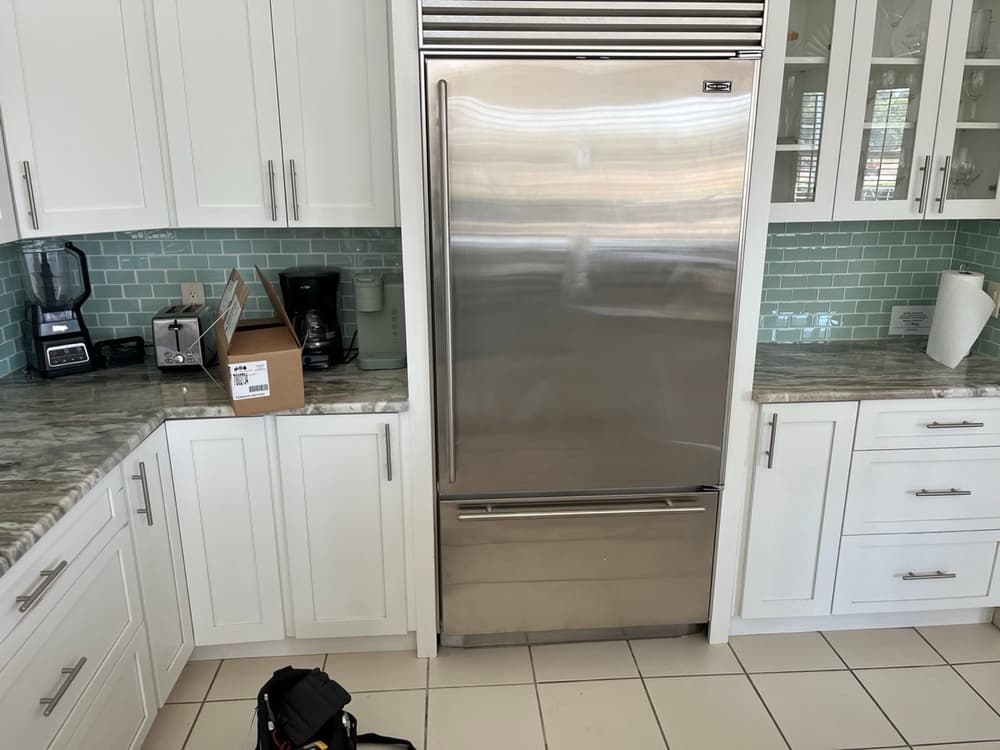
The short version: a Sub-Zero refrigerator that stops cooling is almost never "dead". On my Tampa Bay calls the warm-refrigerator problem sits in one of five places: a condenser packed with dust, a fan that quit, a defrost system that let the evaporator ice over, a door that no longer seals, or, least often, the compressor on that side. Because most built-in Sub-Zeros run two independent cooling systems, the freezer usually keeps working while the refrigerator warms up, and that split tells me a lot before I touch a screwdriver.
Below is how I troubleshoot a Sub-Zero refrigerator not cooling properly, in the order I actually do it, with the free checks first. I have been working on these units for 20+ years; the photos are from real Sub-Zero service calls in Tampa Bay.
Five checks before you call anyone
None of these cost money, and two of them clear a surprising number of "Sub-Zero not cooling" calls before I ever get in the van.
- Is the unit actually on? Sub-Zero has an ON/OFF on the control panel and, on built-ins, a power switch behind the top grille. Vacation and Sabbath modes turn the lights and display off, so a dark panel doesn't always mean a dead machine. A tripped breaker after a Tampa Bay storm is the other quiet one.
- Read the display. Sub-Zero shows the actual compartment temperature, not the temperature setting. Fridge should sit at 38 °F, freezer at 0 °F. If the display shows an EC code, write it down before you clear it.
- Which compartment is warm? Refrigerator warm and freezer cold is one problem; both warm is another (more on that below).
- Look at the condenser. Pull the top grille off (it tilts forward on most built-ins). If you see a grey blanket of dust on the condenser coils, you have found a large part of the problem. Vacuum it, brush it, run the unit for six hours and recheck.
- Check the door. Frost on the freezer wall, sweat on the door edge or a door ajar alarm that keeps chirping all point at the gasket, not the cooling system. Close the door on a sheet of paper; if it slides out with no drag, the seal is done.
If the temperature is still climbing after that, the problem is inside the machine, and that is where the meter comes out.
Why the freezer works and the refrigerator does not
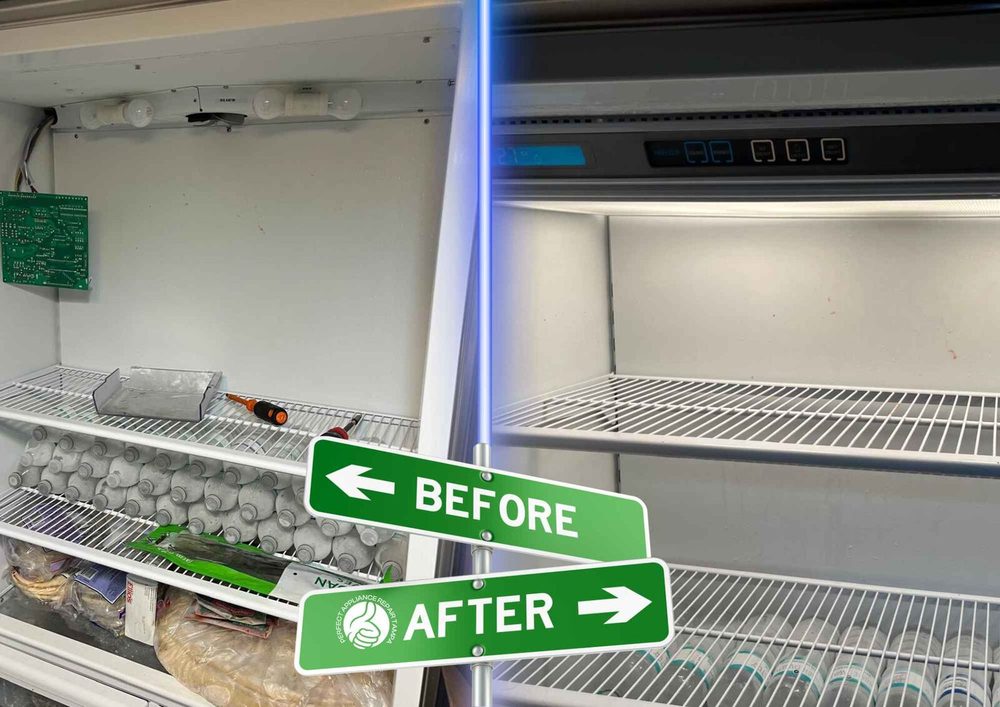
This is the Sub-Zero question I hear most, and it has a clean answer. The classic built-in line (the 500 and 600 series and today's Classic models) uses dual refrigeration: two compressors, two condensers, two evaporators. The refrigerator section and the freezer are, mechanically, two appliances sharing a cabinet. That is why the brand advertises drier freezer air and longer-lasting produce, and it is also why a warm refrigerator with a cold freezer is not a mystery: the refrigerator side has its own fan, its own defrost system and its own compressor, and one of those has quit.
So the freezer is my witness. If it holds 0 °F, the electrical supply, the control board's power section and half of the sealed system are fine. I go straight to the refrigerator side: evaporator fan, evaporator coil, then the compressor circuit.
If both compartments are warming at the same time, the cause is almost always shared: a blocked condenser, a dead condenser fan, a control fault, or a power problem. Two compressors do not fail on the same morning unless something upstream made them.
One honest caveat: some drawer models, under-counter units and certain integrated columns run a single system. Same diagnosis, fewer suspects. The label inside the door tells me the Sub-Zero model and series in a second, and the Sub-Zero brand page has a model decoder if you want to look yours up before you call.
The condenser: the cheapest fix and the most common cause
Every refrigerator has to dump the heat it pulls out of the food somewhere. On a built-in Sub-Zero that "somewhere" is the condenser coil behind the louvered grille at the top, with a fan pulling room air through it. Cover that coil in dust and the compressor runs hotter and longer, the refrigerator section drifts up a few degrees, and one hot July afternoon it simply cannot keep up. On a dual-compressor unit the refrigerator side, which does the most work in a warm kitchen, usually loses first.
Sub-Zero recommends cleaning the condenser every 3 to 6 months. In Tampa Bay I would stay at three. Our homes run air conditioning almost year-round, the kitchens are open to the living room, and a dog or a cat adds its own contribution. On my calls the condenser is the first thing I check and the thing that is dirty most often. Cleaning it is not a repair; it is maintenance, and it is the one thing on this page you should do yourself. A Sub-Zero fridge that cannot cool properly behind a dirty condenser is not broken; it is suffocating.
While the grille is off I also listen for the condenser fan. No fan means the coil is cooling by hope alone; that motor is a straightforward replacement and it is the second most common cause of a Sub-Zero cooling issue on my truck.
What actually fails inside, in the order I test it
Once the free checks are done, this is my sequence. It runs from the cheap, common parts toward the expensive, rare ones, and I test rather than guess at every step.
- Evaporator fan motor. The fan circulates cold air throughout the compartment. When it stops, the coil behind the back panel gets cold but the food does not. Symptom: refrigerator warm, no fan hum when you open the door and hold the light switch, sometimes a squeal for a week before it dies. A one-part repair.
- Defrost system. Each side has a defrost heater and a thermostat or sensor. When the heater or its control fails, frost builds on the evaporator until it becomes a block of ice and airflow stops. Symptom: cooling that fades over a few days, frost on the back wall, sometimes a puddle after the unit is switched off. I can see this the moment the panel comes off.
- Door gasket. Sub-Zero uses heavy magnetic gaskets that seal tighter than a standard refrigerator, and after 8 to 12 years they harden and pull away at the corners. Warm air leaks in, the compressor runs constantly and frost shows up on the freezer wall. The gasket is a standalone part, not a new door.
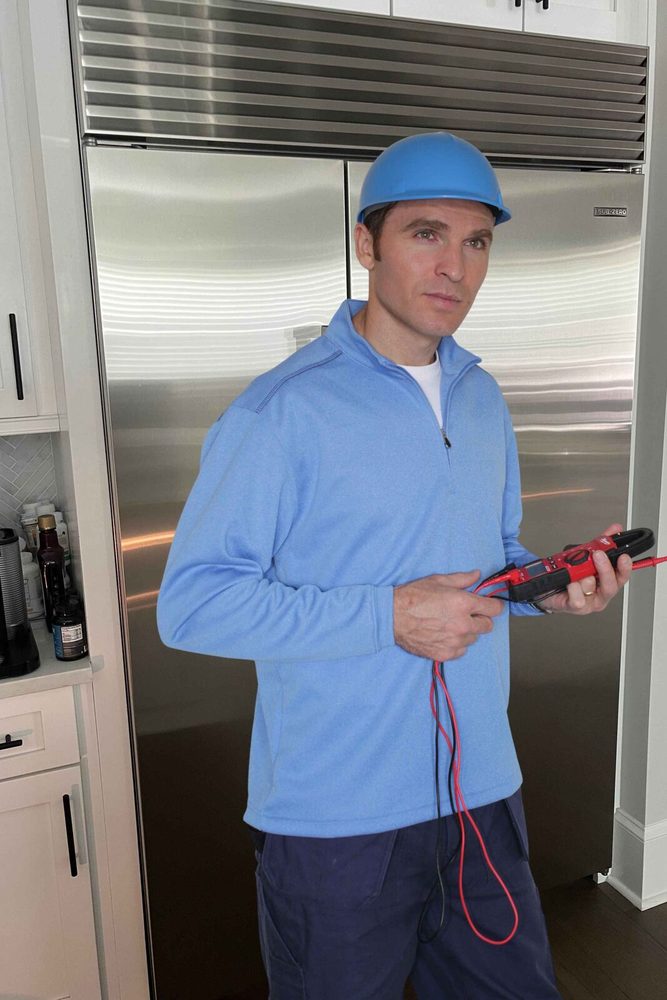
- Start relay, overload and compressor circuit. A compressor that clicks and does not start, or hums and cuts out, usually has a failed relay or overload protector on its side, not a failed compressor. Those are small plug-in parts. I confirm with the meter before anyone hears the word "compressor".
- Control board and sensors. A thermistor reading wrong, or a board that has lost an output after a surge, can leave one side idle while the display looks normal. Tampa Bay lightning is the usual author of this one; a whole-house or dedicated surge protector is the cheapest insurance a Sub-Zero owner can buy.
- Compressor. Last on the list on purpose. If the compressor on one side is truly gone, the repair is sealed-system work: recovery, replacement, a new drier, evacuation and a precise charge. On a Sub-Zero it is worth doing far more often than on a builder-grade box, because the cabinet around it is built for two more decades.
Every one of these gets checked, every time. A cooling problem that turns out to be a small plug-in relay after someone else quoted a compressor is not a rare story in this trade, and it is the reason I test before I quote. The visit is a $69 diagnostic, applied 100% to the repair you approve, with a written number before any work starts.
Sealed-system leaks, salt air and well water
Refrigerant does not get "used up". If a Sub-Zero is low on charge, it leaked, and on this coast I know where to look first. In waterfront homes along Bayshore Boulevard, Davis Islands and the beach communities, and in well-water homes in Pasco and northern Hillsborough, I have pulled copper lines out of refrigerators that were only five to seven years old and had corroded through. Salt air does it from the outside; well water carrying iron and hydrogen sulfide does it through the ice maker plumbing; the tubing crumbles in your hand and the refrigerant leaves through pinholes you cannot see.
That is the one Sub-Zero cooling problem where I slow down and talk about the whole picture: where the leak is, whether the unit has had one before, and whether the factory sealed-system warranty still applies (if it does, the factory network is the right call for that specific repair, and I will say so). When repair is the right answer, it is done properly: leak found and fixed, filter-drier replaced, system evacuated and charged by weight. When it is not, I will tell you that too.
Repair or replace: the Sub-Zero math
Sub-Zero designs and tests its refrigerators for a 20-year life, and a built-in that has been maintained often goes past it. That changes the math compared with a standard refrigerator. A compressor or sealed-system repair on a 12- to 18-year-old Sub-Zero is normally still far below the cost of a new built-in of the same size, before you add the cabinetry work a new unit can require. Fans, gaskets, relays, sensors and boards are all reasonable repairs at any age.
The honest exceptions: a second sealed-system leak on a coastal unit, rust that has reached the cabinet or the liner, or a 700-series or older unit where the control parts are no longer available. In those cases I will walk you through the replacement math before you spend a dollar on parts. For the general version of that decision, see is it worth repairing a refrigerator, and for what shortens a refrigerator's life on this coast, how long refrigerators last in Tampa Bay. For every non-Sub-Zero cause of a warm refrigerator, my full guide is why a refrigerator stops cooling.
How common is this? Sub-Zero cooling calls, measured
"Sub-Zero refrigerator not cooling" is a small search compared with mainstream brands, for the simple reason that there are fewer of them. But the shape of the curve is the same one I see in the van: it climbs into summer and peaks in July, when a warm kitchen and a dusty condenser finally meet.
Search data: Ubersuggest, national monthly volume, last 12 months. If your Sub-Zero starts drifting warm in June, clean the condenser before July does the diagnosing for you.
Expert opinion — Anatoli Didenco, owner, Perfect Appliance Repair Tampa. Before you call anyone about a warm Sub-Zero, look at two things: the freezer and the condenser. If the freezer is cold, half the machine is healthy and the fault is on one side. If the condenser is grey with dust, clean it and give it six hours. Those two checks sort most Sub-Zero cooling problems into "maintenance" or "one part", and neither of those should ever be quoted as a compressor. I test every part on the list before I name one, and I stand behind Sub-Zero work with 12 months on parts and labor.

Before you let anyone open your Sub-Zero
BBB Accredited, A+ rated, and more than 200 five-star reviews across major platforms. Read what owners actually say on the reviews page — Google and BBB, in their own words.
And the honest part: if a clean condenser brings the refrigerator back to 38 °F by tomorrow morning, you do not need me. Put the money toward a surge protector.
Sub-Zero not cooling: quick answers
How do I reset a Sub-Zero refrigerator?
Turn the unit off at its own power switch (behind the top grille on most built-ins, or the OFF button on the control panel), wait 30 seconds, turn it back on. A reset clears a stuck control; it does not fix a dirty condenser, a dead fan or a compressor. If the fault code returns within a day, stop resetting.
Why is my Sub-Zero refrigerator warm but the freezer is fine?
Most built-in Sub-Zeros run two separate cooling systems, one per compartment. A warm refrigerator with a cold freezer usually means the refrigerator side has its own problem: its evaporator fan, its defrost system or its compressor. That is good news in one way: the freezer proves the other half of the machine is healthy.
How often should the condenser on a Sub-Zero be cleaned?
Sub-Zero recommends cleaning the condenser every 3 to 6 months. In Tampa Bay, with year-round air conditioning dust, pets and open kitchens, I would stay at the 3-month end. It is a 10-minute job with a soft brush and a vacuum, and it prevents more warm-refrigerator calls than any part I carry.
What is the life expectancy of a Sub-Zero refrigerator?
Sub-Zero designs and tests its units for 20 years, and a well-kept built-in often goes past that. A cooling repair on a 12- to 18-year-old Sub-Zero is normally still a clear win over a new built-in of the same size.
Is it worth repairing an older Sub-Zero that stopped cooling?
Usually yes. Fans, gaskets, relays, control boards and even a compressor are all replaceable, and the cabinet is built to outlast them. The honest exceptions are a sealed-system leak on a unit that has had one before, or rust that has reached the cabinet or the liner.
Do I need a factory-certified technician for Sub-Zero repair?
Not for a diagnosis or for most repairs. I am an independent technician, not Sub-Zero Factory Certified Service, and I use genuine Sub-Zero parts. If your unit is still under the factory sealed-system warranty, the factory network is the right call for that specific repair, and I will tell you so.
What does an EC code on the Sub-Zero display mean?
It means the control has logged a fault. On many 600-series units EC 50 points at the refrigerator side and EC 40 at the freezer side; other codes cover the ice maker and sensors. Write the code down before you clear it. It tells me where to start before I open the grille.
Related services
Book same-day service or read more about the exact repair:
- Sub-Zero appliance repair
- Refrigerator not cooling
- Refrigerator repair
- Why a refrigerator stops cooling: every cause, ranked
- Refrigerator not cooling but freezer works
- Is it worth repairing a refrigerator?
Call or text (813) 522-0014 or book online — Perfect Appliance Repair Tampa covers Tampa, South Tampa, Wesley Chapel, Zephyrhills, Dade City, and surrounding Tampa Bay.
Anatoli Didenco is the owner-technician of Perfect Appliance Repair Tampa, with 20+ years of hands-on technical experience in refrigeration and appliance repair across Hillsborough, Pinellas, and Pasco Counties. He specializes in refrigerators — particularly Sub-Zero, Wolf, and premium built-in systems — and sealed-system and compressor work. He answers the phone, and either he or Nick, his technician, shows up at the door. Read more on the About page.
Perfect Appliance Repair Tampa serves Tampa, South Tampa, Wesley Chapel, Zephyrhills, Dade City, and the surrounding Tampa Bay area. Reviews are available on the company’s Google Business Profile and BBB listing.
We Stand Behind Our Work.