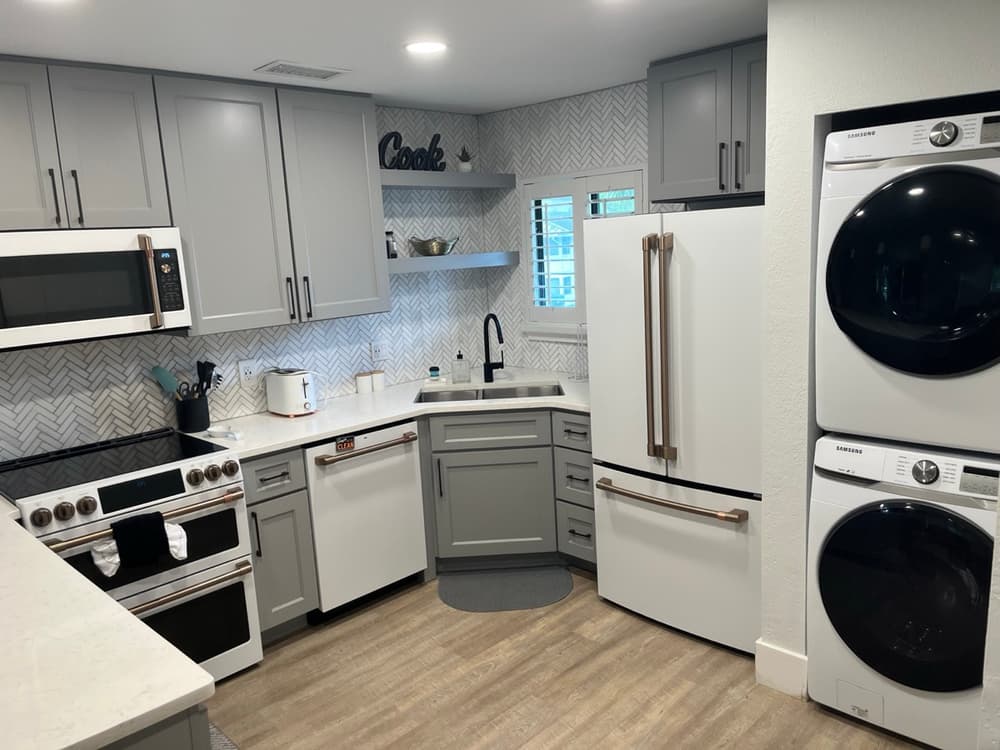
Why is my washer not spinning?
A washer that will not spin usually comes down to one of seven things. Here is what to check, in order of likelihood:
- Unbalanced load: the most common cause by a wide margin
- Lid switch failure (top-loaders)
- Door latch failure (front-loaders)
- Water not draining before the spin cycle starts
- Worn or broken drive belt
- Motor coupling failure (direct-drive top-loaders)
- Control board not activating spin mode
If your clothes come out soaking wet after the cycle, the washer is spinning weakly, not skipping it entirely. That points to an unbalanced load or a partial drain blockage.
What causes a washing machine to stop spinning?
Unbalanced load
This is the cause on more than half the washing machine repair calls we go on. Modern washers have sensors that stop or reduce the spin cycle when the drum is off-balance, because a full spin with a lopsided load can damage the machine. You will usually hear a loud thump before it stops. Redistribute the clothes so heavier items are spread around the drum. If you are washing one bulky item like a comforter or a pair of jeans with nothing else in there, add a few towels to balance it out. Front-loaders are especially sensitive to this. Do not just restart and hope. Fix the load first.
Lid switch failure (top-loaders)
Top-loading washers will not start the spin cycle if the lid switch is not registering that the lid is closed. It is a safety feature. The switch sits under the lid, and over time the plastic tab that presses it wears down or breaks. You can test it by pressing the switch manually with a pen while the lid is open. If the washer starts spinning, that confirms it. A lid switch is a cheap mechanical part, it rides on the truck, and it is not difficult to swap out.
Door latch failure (front-loaders)
Front-loaders use a door latch assembly rather than a lid switch. The latch has to click physically and send a signal to the control board before the machine will spin. If the latch is worn or the strike is bent, one of those two things fails. Sometimes the door looks closed but is not latched properly. Push it firmly until you hear the click. If it clicks and the machine still will not run the spin cycle, the latch assembly or door wiring harness is likely the problem.
Water not draining before the spin cycle
Washers are supposed to drain first, then spin. If the drain pump is clogged or the drain hose is kinked, water stays in the drum and the spin cycle never starts, or starts briefly then shuts off. You will usually see standing water in the drum. Run a drain-only cycle and watch what happens. On front-loaders, there is a pump filter access panel near the bottom front of the machine. Pull it out and clean it. Hair, coins, and small socks are the usual culprits.
Worn or broken drive belt
Belt-drive washers, common in older top-loaders and some front-loaders, use a rubber belt to connect the motor to the drum. When the belt slips or breaks, the drum does not spin even though the motor runs. You might hear the motor humming with no drum movement, or catch a faint burning rubber smell during the spin cycle. Getting to the belt usually means removing the back or front panel of the machine depending on the model. The belt itself is a cheap part, but the labor adds up because of the disassembly involved.
Motor coupling failure (direct-drive top-loaders)
Direct-drive top-loaders, Whirlpool and Kenmore machines from the last few decades mostly, connect the motor directly to the transmission using a plastic coupling. That coupling is built to break under overload before the motor burns out. If you have been washing heavy loads, there is a decent chance that is what happened. The coupling itself is a cheap plastic part. The work is what you are paying for: getting to it means pulling the cabinet, removing the pump, and lifting out the motor. Doable for an intermediate DIYer, but takes a couple hours the first time.
Control board not activating the spin cycle
The control board is the last thing to check, not the first. A failing board can stop sending the signal to start the spin cycle. You will see the timer advance, maybe hear the motor click, but no drum movement. Error codes on digital displays are a good clue. Boards fail from power surges, moisture, or age. This is the most expensive washer not spinning diagnosis, because the board itself is the costly piece and what it costs depends on the brand. Do not replace the board until everything else has been ruled out.
How to fix a washer that won't spin (DIY steps)
Start with the simple things before pulling any panels off.
- Redistribute the load. Open the lid or door and move clothes around so weight is even across the drum. Add or remove items if needed. Restart the spin cycle and see if it completes.
- Test the lid switch manually. On top-loaders, locate the small plastic tab on the lid that presses the switch. Press the switch with a pen or finger while the lid is up. If the machine starts the spin cycle, the lid switch tab is broken or worn.
- Run a drain-only cycle. If there is water sitting in the drum, do not go straight to spin. Run the drain cycle alone. If it drains and then spins, the drain was blocking the spin. Clean the pump filter and check the drain hose for kinks.
- Clean the pump filter (front-loaders). The filter is behind a small access panel near the bottom front of the machine. Have a towel ready because water will come out. Twist the cap counterclockwise and clean out whatever is in there.
- Inspect the drive belt if accessible. If you can remove the back panel without major disassembly, look at the belt. Cracks, fraying, or a belt sitting loose off the pulley tells you what you need to know.
Motor coupling replacement is intermediate-level DIY. Expect to spend 90 minutes the first time. Control board diagnosis and replacement is best left to a technician who can confirm the board is actually the problem before you spend money on a part.
When to call for washer spin repair
Some of this you can handle yourself. Other situations are worth picking up the phone.
Call a tech when:
- Redistributing the load did not help and the washer still will not complete the spin cycle
- Pressing the lid switch manually confirms it is dead
- You smell burning rubber during the spin: that is a belt slipping and getting hot
- The washer is completely silent during spin mode (motor or board issue)
- There are error codes on the display you cannot clear
What each of these repairs actually involves, low end to high end:
- Lid switch — a cheap mechanical part, stocked on the truck, installed in minutes
- Motor coupling — a cheap part, but the cabinet, pump and motor all come out to reach it
- Drive belt — also a cheap part, with the same catch: most of the time goes into the disassembly
- Control board — the part itself is the expensive piece, which puts this at the top of the range
Most spin cycle problems come down to a single part, which is worth fixing on a machine that is otherwise in good shape. If the machine is more than 12 years old, run the 50% rule against the written price: if the repair comes in under half of what a comparable new washer costs today, repairing is the better buy. Perfect Appliance Repair Tampa charges $69 for the diagnostic, 100% applied to your repair if you approve the work.
Related services
Book same-day service or read more about the exact repair:
Call or text (813) 522-0014 or book online — Perfect Appliance Repair Tampa covers Tampa, South Tampa, Wesley Chapel, Zephyrhills, Dade City, and surrounding Tampa Bay.
Anatoli Didenco is the owner-technician of Perfect Appliance Repair Tampa, with 20+ years of hands-on technical experience in refrigeration and appliance repair across Hillsborough, Pinellas, and Pasco Counties. He specializes in refrigerators — particularly Sub-Zero, Wolf, and premium built-in systems — and sealed-system and compressor work. He personally answers the phone and shows up at the door. Read more on the About page.
Perfect Appliance Repair Tampa serves Tampa, South Tampa, Wesley Chapel, Zephyrhills, Dade City, and the surrounding Tampa Bay area. Reviews are available on the company’s Google Business Profile and BBB listing.
We Stand Behind Our Work.