
The short version: a washing machine that shakes violently on spin has one of six causes, in the order I check them: shipping bolts left in a new front-loader, leveling feet that are not all on the floor, an unbalanced load, worn suspension (rods on a top-loader, shock absorbers on a front-loader), a failing tub bearing, or a floor that flexes under a machine that is doing nothing wrong. The first three are free. The test below tells you in two minutes whether it is the floor or the washer, and the rest of this page explains what each fix involves and when it is not worth doing.
How much shaking is normal, and when it stops being normal
Every washer vibrates at top spin speed. A front-load washer spinning wet towels at 1,200 rpm is moving a lot of mass, and the suspension is designed to let the tub float inside the cabinet while the cabinet stays put. What is not normal: the cabinet itself rocking, a foot lifting off the floor, the machine walking a few inches, or a bang you can hear from the kitchen. That is the tub hitting the cabinet, and each hit is wear the machine was not built to take.
| What you notice | Machine type | Where I look first |
|---|---|---|
| Shakes hard from the first spin on a new or just-moved machine | Front-load | Shipping bolts still in the back panel |
| Rocks corner to corner; you can tip it by hand | Any | Leveling feet not down, locknuts loose |
| Banging on spin with one heavy item or a small load | Any | Unbalanced load; HE top-load without agitator |
| Tub sags, bangs the cabinet, even with a balanced load | Top-load | Suspension rods or springs worn |
| Walks across the floor at high spin, drum swings freely when pushed | Front-load | Shock absorbers (dampers) worn or unpinned |
| Rumble or roar that gets louder with spin speed | Any | Tub bearing |
| Whole room vibrates; dryer next to it rattles too | Any | Floor structure, pedestal, second-floor laundry |
Free checks first: bolts, feet and the load
- Shipping bolts (front-load, new or recently moved). Inspect the back panel for three or four large bolts with plastic spacers, usually near the corners. They stabilize the drum during transport and must come out before the first wash. If your washer is under a year old or was just delivered or moved and it has shaken since day one, this is it. Remove them with the wrench that came in the bag, and keep them — you will want them the next time the machine moves.
- Leveling feet. All four have to touch. Put a level on top of the washer, adjust the adjustable front feet with a wrench or pliers, and tighten the locknuts against the cabinet so the feet cannot back off. Many top-loaders have self-adjusting rear feet that set themselves when you tip the machine forward and drop it; if those are jammed with rust or lint, they never set, and the machine rocks front to back.
- Redistribute the load. A single heavy item — a comforter, a bath mat, a pair of wet jeans — or an overload of towels sits on one side of the drum and throws the washer off balance the moment spin starts. Pause, open, spread the wet clothes around the drum, add a few towels to a bulky item, and restart. Newer machines detect the imbalance and drop the spin speed or stop, which is why the clothes come out sopping.
- Run an empty spin. This is the test that separates load problems from mechanical ones. Details below.
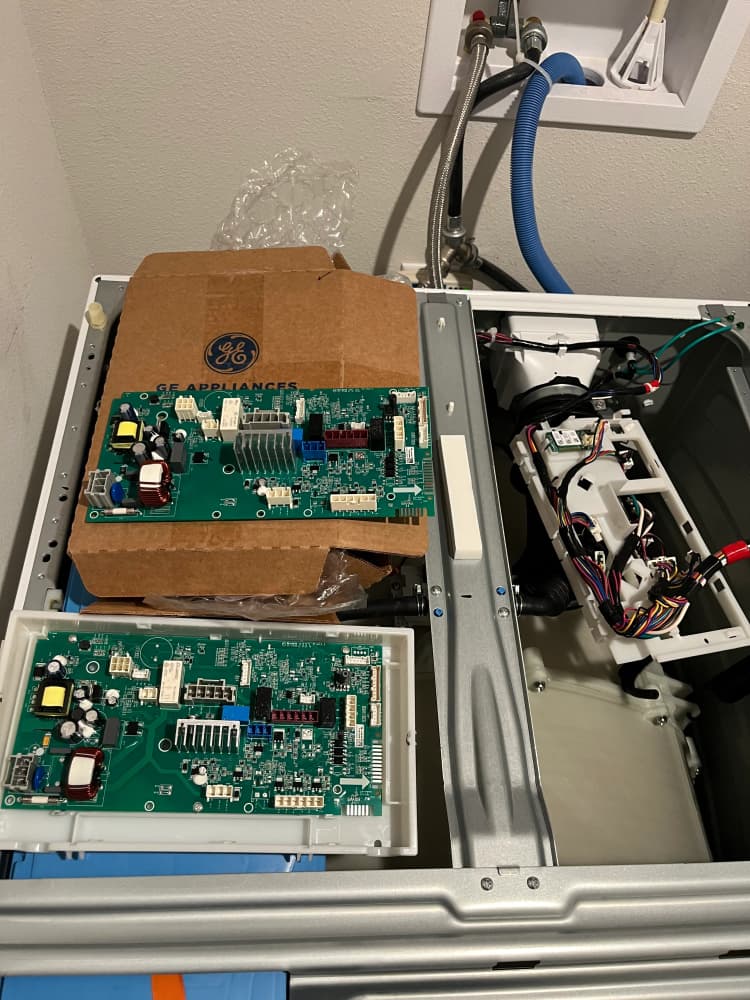
Is it the floor or the machine? A two-minute test
People buy anti-vibration pads for a shaking washer with a broken shock absorber and call a technician for a machine that is simply standing on a springy floor. The test below sorts the two before any money moves.
The two-minute test: is it the floor or the machine?
- Empty the drum. No clothes. Set a small level on top of the washer, front to back and side to side, and adjust the feet until the bubble is centered on both. Tighten the locknuts up against the cabinet.
- Rock test. Push down on each corner of the cabinet. Any rock at all means a foot is not touching. Fix that before going on.
- Run spin only, empty. Stand a few feet back with a hand on the wall.
- Read the result. Empty drum, level machine, and the machine is shaking, walking or banging: the suspension inside (rods on a top-loader, shock absorbers on a front-loader) or the bearing is worn. Empty drum, level, smooth spin, but the floor and walls hum and the dryer beside it rattles: the machine is fine and the floor is flexing. Shakes only with clothes in: load balance, or a machine that is at the edge of its suspension and needs a full load to hide it.
A washer that passes the empty test and only shakes with laundry is almost always a load or floor problem. A washer that fails the empty test needs a part.
Top-load washers: suspension rods, the missing agitator and the tub
A top load washer hangs its tub from four suspension rods — steel rods with a spring or a damping cup at the top, hooked into the corners of the cabinet. Over years of loads the cups wear and the rods lose their damping, and the tub starts to sag, bounce and bang the cabinet on spin. The tell: push the tub down by hand with the lid open. A healthy tub returns slowly and settles; a worn one bounces like a trampoline, or one corner sits visibly lower. Rods wear together, so I replace all four; a single new rod next to three tired ones just moves the problem to the next corner. On Whirlpool, Maytag and Kenmore top-loaders this is one of the most worthwhile repairs there is.
High-efficiency top-loaders without an agitator deserve their own line. The tall impeller machines wash with very little water, which is efficient and also means there is less water to cushion an uneven load. They are quicker to go off balance with two towels and a sheet, and their electronics will stop or slow the spin rather than fight it. It is not a defect; it is how the design behaves. Loading them with several medium items instead of one bulky item is most of the fix.
Older agitator machines (direct-drive Whirlpool, Kenmore, Roper) can also grind on spin when the drive block or the basket drive wears, and a rumble with the shaking usually means the tub bearing in the spin tube. On those, the shaking is a symptom of a drivetrain that is finishing its life.
Front-load washers: shock absorbers, counterweights and the bearing
A front-load washer supports its tub from above on two heavy springs and steadies it from below with two to four shock absorbers, also called dampers. They are friction or gas struts pinned between the tub and the cabinet base. When the friction pads wear out, the tub swings freely, and at high spin the whole machine walks across the floor. You can feel it: with the machine off, push the drum. A tight suspension resists and settles; worn shocks let it sway and swing for several seconds. Shocks are replaced in pairs; the job means the front or back panel off and, on some LG and Samsung models, tipping the cabinet to reach the lower pins. It is a fair repair on a machine of any age.
Counterweights. The concrete or cast blocks bolted to the outer tub keep it from launching itself on spin. Their bolts can loosen over years of vibration, and a loose weight makes a heavy clunk on every start of spin along with the shaking. It is a tighten-and-check, not a part, unless the concrete has cracked.
The tub bearing (drum bearing). This is the one that decides the fate of an older front-loader. Two bearings at the back of the outer tub carry the inner drum; when the seal ahead of them lets water in, they rust and get loud — a rumble that rises with spin speed, then a roar. The drum develops play you can feel by lifting it at the front lip. Replacing the bearings means splitting the outer tub, which on many machines is sold only as a complete tub assembly, and the labor runs several hours. On a front-loader past ten years I usually recommend a new machine; I go through that math in is it worth fixing a washing machine. If it is also leaving water under the machine, see washer leaking water — the bearing seal is the common cause of both.
The drum spider. The aluminum three-arm casting that holds the inner drum to the shaft corrodes over years of detergent and, on some brands, cracks. When it goes the drum wobbles at every speed, not just spin, and clanks. That is a replace-the-machine finding on almost anything but a new washer under warranty.
Second-floor laundry rooms, pedestals and anti-vibration pads
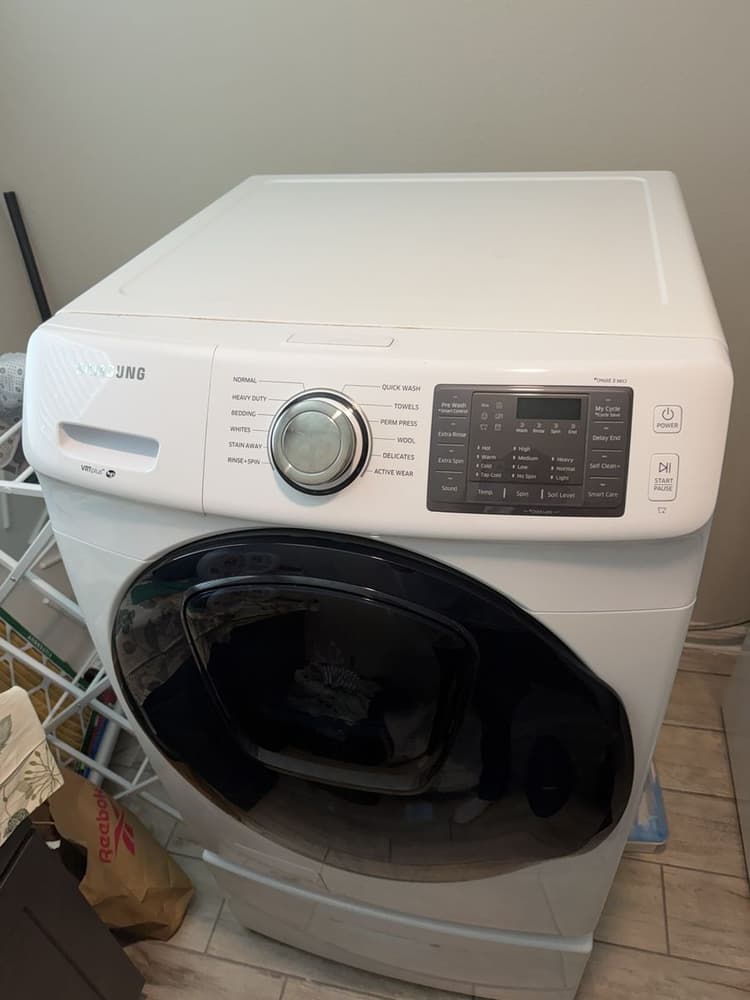
Many of the newer two-story homes going up across Wesley Chapel, Riverview and Land O' Lakes put the laundry upstairs, and a wood-framed or uneven floor flexes in a way a slab does not. A perfectly healthy front-loader spinning at 1,200 rpm on a floor with a little bounce will hum the whole room and rattle the dryer beside it. Add a pedestal and you have raised the center of gravity another 15 inches, so a small sway at the bottom becomes a big one at the top. Pedestal drawers with loose contents and pedestals bolted only two of four corners are a common shake source on their own.
What actually helps: level the machine on the pedestal and the pedestal on the floor; make sure all pedestal-to-washer bolts are tight; put the washer over a joist rather than between two if you have any say in the location; and use dense rubber anti-vibration pads under the feet to absorb what the floor amplifies. What does not help: pads under an unlevel machine, or a plywood sheet on top of carpet. If the floor is the whole problem, I will tell you so — there is no washer part that fixes a floor.
Brand notes: Samsung calibration, LG, Whirlpool and Maytag
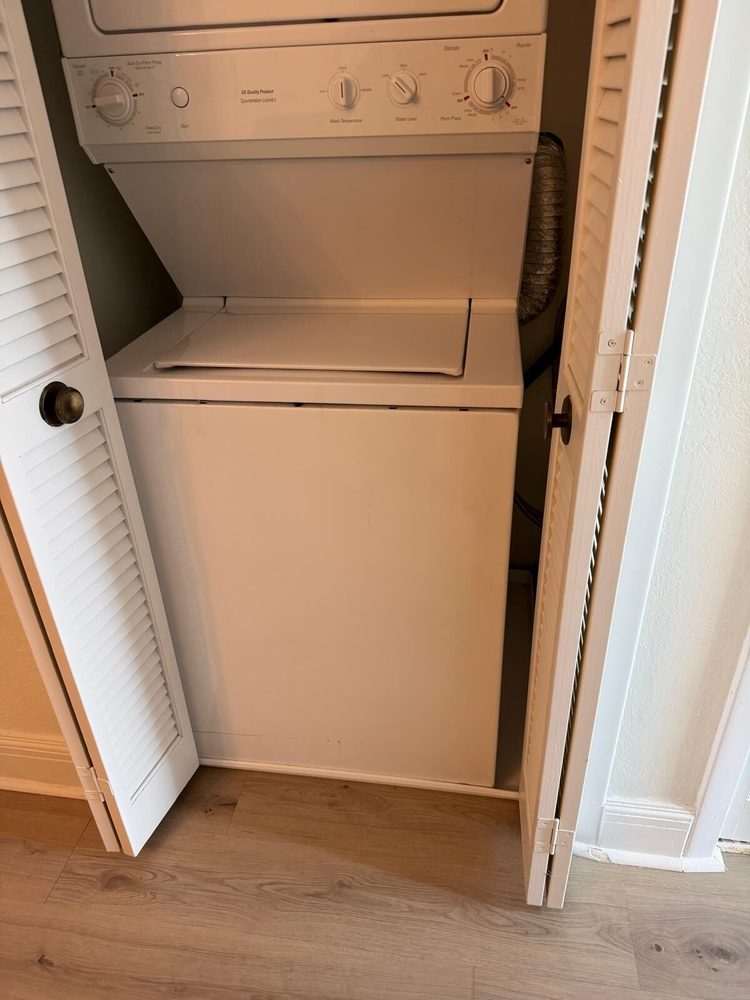
Samsung front-loaders and many of its top-loaders have a calibration mode that teaches the machine the weight of its empty drum; Samsung's own troubleshooting page for a washer shaking too much walks through running it after leveling, and after a move or a repair. Skipping it leaves the balance sensing working from old numbers. LG front-loaders use a very stiff suspension and a heavy counterweight; they are quiet when healthy and unmistakably loud when a damper has come off its pin, which happens more than it should after a move without shipping bolts. Whirlpool, Maytag and Kenmore top-loaders (the belt-drive HE platforms as well as the older direct-drive ones) are the suspension-rod machines; the four-rod kit is a stocked part and a repair that gives the machine years. GE top-loaders use a similar rod-and-damper arrangement and the same test: push the tub, watch it bounce. Brand pages: Samsung, LG, Whirlpool, Maytag, GE.
Repair or replace: when the shaking is worth fixing
Leveling, shipping bolts and load habits cost nothing. Suspension rods, shock absorbers and a loose counterweight are moderate repairs that I recommend on almost any machine that is otherwise in good shape, because they restore the washer to the way it spun when it was new. The line is the tub bearing and the drum spider: on a front-loader past ten years, or on any machine where the bearing has already scored the shaft, the repair approaches the price of a replacement and I will say so at the diagnostic. The $69 visit is applied 100% to the repair you approve, and the repair carries a 90-day labor warranty. If the machine stopped spinning altogether rather than shaking, start at washer not spinning.
How common is this? Search demand, measured
Ubersuggest counts about 1,600 U.S. searches a month for "washing machine shaking violently," with a low in April and two shoulders — early summer and October–November. The spring low lines up with fewer heavy loads; the fall rise is when comforters and blankets come out of the closet and go into the washer one at a time, which is exactly the load that throws a washer off balance.
Search data: Ubersuggest, national monthly volume, last 12 months. The May–June and October–November shoulders are comforter season in most of the country. Wash the bulky item with a few towels and you skip the whole chart.
Expert opinion — Anatoli Didenco, owner, Perfect Appliance Repair Tampa. Before you call anyone, run one empty spin on a machine you have just leveled. If it is smooth, your washer is fine and the problem is the load or the floor, and no part I carry will change that. If an empty, level machine still bangs or walks, something in the suspension is worn, and that is usually a fair repair. The only shaking I talk people out of fixing is a roaring bearing on a front-loader past ten years — that money belongs in a new machine.

Before you let anyone open your washer
BBB Accredited, A+ rated, and more than 200 five-star reviews across major platforms. Read what owners actually say on the reviews page — Google and BBB, in their own words.
And the honest part: if the empty, level spin test came back smooth, you don't need me. Change how you load the bulky items, put pads under the feet if the floor hums, and keep your money.
Washing machine shaking — quick answers
Is it safe to use a washing machine that is shaking violently?
For one cycle to finish, usually yes, but not as a habit. Violent shaking hammers the tub bearings, cracks the outer tub and can pull the fill hoses off the wall. Stop the cycle, redistribute the load, and if it shakes again on an empty spin, stop using it until it is diagnosed.
How much should a washer shake during the spin cycle?
Some vibration at top spin speed is normal, especially on a front-loader spinning past 1,000 rpm. What is not normal is the cabinet rocking, feet lifting off the floor, the machine walking, or banging that you can hear from another room.
How do I rebalance my washer drum?
Pause the cycle, open the lid or door, and spread the wet clothes evenly around the drum. Split one heavy item, like a comforter or a bath mat, with a few towels. Then run spin only. If an empty spin still shakes, the drum is not the problem; the suspension or the floor is.
Can shipping bolts make a washer shake violently?
Yes, and it is the first thing I check on any front-loader under a year old or one that was just moved. The three or four bolts at the back lock the tub to the cabinet for transport. Left in, the whole machine shakes hard from the very first spin and the suspension takes the damage.
Why does my washer shake only on the spin cycle?
Spin is the only stage where the drum turns fast enough for an unbalanced load, a soft floor or worn shock absorbers to show; anything that can vibrate, wobble or unbalance the tub does it at spin speed. A machine that shakes during wash or fill, at low speed, points at the motor mount or a broken drum spider instead.
Do anti-vibration pads really stop a washing machine from shaking?
They cut the noise and vibration that a level machine passes into a wood floor. They do not fix an unlevel machine, worn shocks or bad suspension rods, and on a very soft floor they can make walking worse. Level first, pads second.
Why did my washer start shaking after we moved it?
Three usual reasons: the leveling feet were never reset to the new floor, the locknuts on the feet are loose, or a front-loader was moved without shipping bolts and a shock absorber popped off its pin. Check the feet with a level on top of the washer before anything else.
Related services
Book same-day service or read more about the exact repair:
- Washer repair
- Washing machine not draining
- Washer not spinning
- Is it worth fixing a washing machine?
- Samsung appliance repair
- LG appliance repair
Call or text (813) 522-0014 or book online — Perfect Appliance Repair Tampa covers Tampa, South Tampa, Wesley Chapel, Zephyrhills, Dade City, and surrounding Tampa Bay.
Anatoli Didenco is the owner-technician of Perfect Appliance Repair Tampa, with 20+ years of hands-on technical experience in refrigeration and appliance repair across Hillsborough, Pinellas, and Pasco Counties. He specializes in refrigerators — particularly Sub-Zero, Wolf, and premium built-in systems — and sealed-system and compressor work. He answers the phone, and either he or Nick, his technician, shows up at the door. Read more on the About page.
Perfect Appliance Repair Tampa serves Tampa, South Tampa, Wesley Chapel, Zephyrhills, Dade City, and the surrounding Tampa Bay area. Reviews are available on the company’s Google Business Profile and BBB listing.
We Stand Behind Our Work.